Tag: Personalization

  • SEO: It Gets Personal

    Google launched Personal Search in early 2005, initiating a new search paradigm that didn’t depend on the user being signed on or not. Going forward, search results would be weighted on the user’s search history, not just keywords. Algorithm updates followed, one after the other, like the Venice update in 2012 and the introduction of Google Now in 2012. At this juncture it’s safe to say Personalization is more than a major factor among many. It will dominate Search in the near future.

    SEO

    Image Source

    Most Internet users don’t have a clue that their Search results are being personalized. Where Personalization initially made use of context and relevancy, localization now heavily influences the behavior of Search. Google’s algorithmic changes to Search over the years have locked in Personalization. With the Humming Bird update in 2013, we saw how search results could be tailored to individual needs by judging and understanding the entire context of search terms, not just individual words.

    Eric Schmidt, CEO of Google, has said, ”Google search will continue to become more personalized, getting away from the ‘10 link’ approach that we see in search results today.”

    How Does Personalization Affect SEO?

    1. Web-pages/websites focused only on keywords and intended only at improving links will no longer gain prominence
    2. User-centric content with a high “like” factor and greater probability of being shared among users will elevate in search results
    3. Branding will be significant enough that businesses need to build brands and not just websites
    4. Relevancy of content underscored by proper social relevance, asset optimization and syndication is vital

    Factors that affect the personalization of search results

    1. Users’ location

    Google — or any other search engine — knows exactly where a search query originates. With logged in users add age, sex, places travelled recently, et al. to the list of retrievable personal data. The increased use of smartphones has substantially increased the personal data flow into Google’s servers.

    1. Search & Web History

    User’s behavior on the web, the type of search queries made, the websites visited can be mapped to the kind of search results a user experiences on Google.  Google collects data about logged in users to understand the kinds of websites a user favors and browses. Another key factor is the user’s profile on Google+. Likes and ratings to web-pages, product reviews, etc. all factor into the search results. And so do links a user likes that get pushed to people in his Google+ circles who then make a Google search.

    Position2′s PoV

    Three things you can do to win at the Personalization game

    1. Relevant & Fresh Content

    Don’t just write for Search engines. Make your site content relevant to users. Fulfill a need. Continually update web pages to cater to users’ search behaviors.

    1. Social Sharing

    Regularize social posting and sharing activity. Utilize all social channels, but focus on Google+, Google Local and YouTube.

    1. Focus on Content Syndication

    Users reliably click on videos, infographics, and other rich-media assets much more than they click on editorial-heavy web-pages. So leverage your rich-media assets for content distribution.

    The Personalization of Search: that’s the future of SEO. Let us know what you think.
  • Evolution of Content Marketing

    We trace the shift in the approach to marketing with higher than ever emphasis on “creating meaningful experiences” for the audience.

    Global Content Marketing

    The traditional content marketing was very limited in ways of reach and effect. Content marketers traditionally ‘push’ what they have, to potential customers rather than what potential customers demand. Majority of the websites in the past are example of this traditional content marketing where content was deployed using a single common language (usually English) for visitors across the globe.

    • A single website is developed online for the entire targeted areas to advertise or show all the available products, services and information
    • The content is created without any targeting for specific geographies or regions
    • The intent of the content is not customized to suit specific potential customers
    • The tone of the content seems like a one-way communication

    The traditional content marketing was just like a seller offering what he had, not what the buyers needed or demanded. The dissemination of information was straightforward and limited.

    Geo-based Marketing (Localization of content)

    Globalization influences the reach of content. With business expansion and scattered target audience, a single website is not the best solution to market to the whole world. Marketers realized that whatever content they marketed was to be understood by specific sets of target audience and hence had to be tailored accordingly – which is Localization of content based on the Geography.

    The whole information is translated and modified to suit each targeted consumer in terms of local preferences, languages, products and services demanded. Marketers realized that the perception of their website adversely affects the acceptance of their products in those geographies where content has not been localized and optimized.

    Coupa Software was in its rapid 120% growth stage with customers spread across 40+ countries. It had 150K+ users of its services in over 140 countries who used 20+ different languages. Coupa had no bandwidth to localize their marketing campaign to suit every specific region. But with the help of Cloudwords, a translation and content localization company, Coupa Software has managed to localize their products, thus, attaining a higher click through rate from the same audience. This audience now brings more than 50% higher conversion rate.

    Personalized Content Marketing

    Approach to content marketing has shifted from a global audience to local to a more individual level. The localization of content has been filtered further to a more accurate target. This involves real-time personalization of content.

    Personalization means identifying a person’s attributes such as potential, behavior, profile etc, and customizing their experience by presenting them with relevant content, call-to-action or visuals. Personalization can be B2B or B2C and has a unique process consisting of Who (target audience, potential, profile), What (content, case studies, videos, assets) and Where (website, email, mobile, ads).

    What personalized content marketers do is that they track the overall behavior of an individual engaging with the content. User preferences, likes, navigation history, pages navigated, sections of the content viewed and other such data is collected by the content marketer. The more the visitor frequents the website, the more personalized the content gets with every new visit due to his previous interactions. The content is generated based on the visitor’s profile like location of access, time, source, form factor, et al. This way the visitor is served when he is most interactive and engaging optimally with the website and its content.

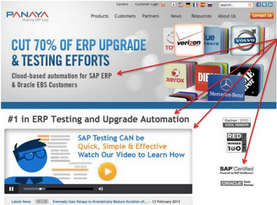
    Take for example, Panaya has a visitor from a particular IP address who browses through the content and clicks on some link. In the first visit, the user is served a normal web content that Panaya offers to all visitors.

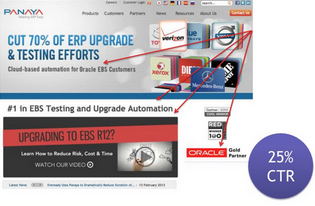
    Position2- An example of Panaya serving users with real-time personalization of content

    Based on the pages visited and the sections of contents read by the visitor, Panaya served a different content to the visitor when he returned back to the site. This highly personalized content marketing strategy is likely to boost conversion because the visitor has been served with content that he wants from the website.

    Contact Position2 to learn more about personalized content marketing

    How does Personalization help you?

    • It creates a meaningful interaction by serving the right content
    • It educates and nurtures top-of-funnel prospects
    • It optimizes budget and lowers cost per lead
    • It improves site performance, analytics and content consumption
    • Extends marketing automation reach
    • Turns anonymous prospects into qualified leads

    Contact us to learn more about personalized content marketing.

  • 6 Important ‘Must Haves’ for a Successful Personalization Strategy

    Personalization strategy

    Personalization is a major focus area for digital marketers with mobile, cross channel marketing and marketing automation. According to a recent study, one-third of marketers said that personalization will be a key component in the future.

    Customers have a lot of information on products with less time to focus and decide. So, it makes sense for marketers to deliver a marketing experience that’s personalized and relevant. This means personalized messages, offers, products, communication and more.

    We have already written about the importance of personalization, not just in generic marketing, but also in cross channel marketing. Cross channel marketing is closely tied to personalization because of the changes in the way users are doing product research today (read on for more on this).

    Now, for the ‘must have’s’…

    • Audience Segments

    The way you have segmented your target audience plays a vital role in formulating your personalization strategy.

    Your target audience comprises of several different aspects, each of which plays a role in determining marketing effectiveness. Identifying each of these aspects and tailoring them to suit your audience is at the heart of personalized marketing. The more granular your understanding and the more personalized your approach, the more effective your marketing will be.

    For example, your customers may come from different regions – the US, Canada, France etc. and personalizing your marketing to cater to different languages and cultures can increase ROI. From within the same market, different individuals may have different information needs. Knowing what each individual in your audience wants enables successful personalization.

    • Prospect/Customer Data

    Data is central to understanding an audience. A robust and comprehensive database of prospects/ customers is extremely important while preparing a personalization strategy. Marketers recognize this – recent eMarketer research shows that marketers are increasing their efforts to gather customer data. Marketers also are broadening the boundaries of their data collection. Working without data makes marketing ineffective.

    Every bit of data can help fine tune personalization further. So, it’s important to meticulously gather information on a variety of aspects such as:

    • Demographics and zip codes
    • Loyalty membership
    • Device/s used
    • Referral sources such as websites, social network sites, ads, email campaigns etc.
    • Keyword referral data
    • Site search data
    • Past browsing and purchase history
    • Email campaign responses

    For example, using techniques like geo-targeting, you will be able to target prospects with offers personalized to their location. Add tracking codes on your website that allow you to follow prospect trails through your website and gather information about prospects’ likes and habits.

    Prospects have a plethora of channels at their disposal today and they use all of them for product research. Tracking prospects can help you follow the digital footprints they leave through channels they use. In the hands of a savvy marketer, these footprints are like gold nuggets!

    If you analyze your business’s data, you will spot many opportunities for personalization. The more relevant data you get, the greater the likelihood of fine tuning your personalization.

    • Prospect/Customer Journeys

    The customer journey offers many important cues for personalization especially in terms of personalizing information and offers.

    You want the customer journey to be smooth and quick but that doesn’t happen often. Understanding who gets stuck and where and for what reasons – this forms the basis for developing an appropriate personalization strategy. You may need to repurpose your content or develop fresh content to help the prospect get over his information road blocks or even reconfigure your offers to make him get over his inertia.

    • Personalization Technologies

    Before implementing your personalization strategy, you need to check if your technological capabilities match your strategy requirements. If you aim to collect prospect/customer data such as those mentioned above, you need to ensure that your website and marketing campaigns use technology and tools that enable collection and unification of such data. Infrastructure normally follows ambition. So, once you know your destination, you can acquire the appropriate technologies in a phased manner corresponding with your marketing readiness.

    • Strategy Cost

    Keep a close eye on the cost of building and implementing your personalization strategy. Some tools and technologies required can cost a lot. Build a basic personalization strategy that fits your budget and then make changes or retain the same depending on the availability of funds. As mentioned in the earlier point – set a high ambition in terms of where you want to reach in personalization, but get there based on what’s possible.

    • Product Suite/Service Offerings

    Your product/service spread determines your brand’s relevance to your audience. There will be people with diverse tastes and preferences in your target audience. While it’s not possible to have products for each one of them, the more relevant products you have, the more relevant you will be to individuals in your audience. This helps a lot of customers migrate across products as their requirements evolve or prospects to try out an entry level model. It’s this relevance that can lead to higher effectiveness.

    Personalization is an integrated process of constant fine tuning. You can keep adding dimensions and improve on what you are doing, but these 6 pointers should set you firmly down the road to success.

    Are there any other important pointers to consider while putting together a personalization strategy? Let us know through your comments below!

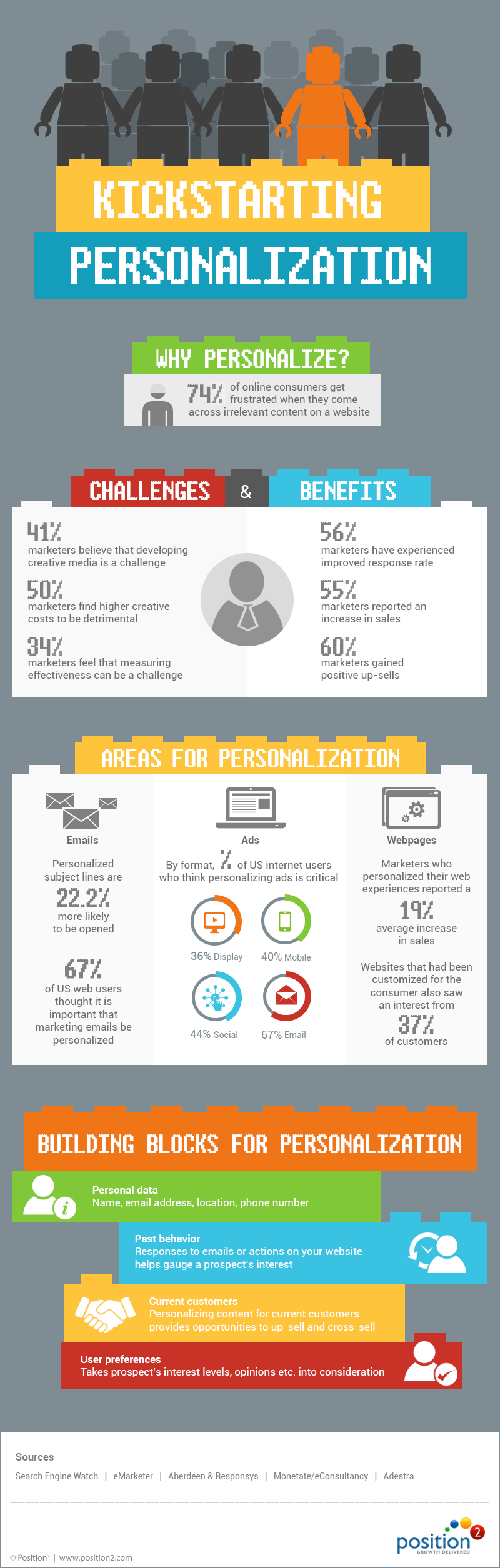
  • [Infographic] Kickstarting Personalization

    Kickstarting Personalization

    Personalization. This word is being heard, rather a lot, in the industry. A lot of content is available on the same. This is why we came out with this infographic that talks about why you need personalization, its challenges and benefits, areas you can implement it and what you need to apply personalization. Check it out!

  • Implementing cross-channel personalization, state of B2B search marketing and much more…| Best of the Week

    This week’s hot news, events and videos from the online marketing and social media world.
    Implementing Cross-Channel Personalization
    From the Position² Blog This Week:
    Implementing Cross-Channel Personalization
    How do you apply personalization to your cross-channel campaigns? What are the crucial factors that you should consider? Read this blog post to know the answers to these questions and more…
    Top Stories this Week: Social Media
    Top Stories this Week: SEO, PPC and Digital Media
    Best of the Week Video Best of the Week Video
    Even if you have amazing content, unless you increase its visibility, it is not of much use to you. Watch this video where Ben Lloyd and Brian Rauschenbach talk about tips and tactics to amplify the reach of your content.
    White Paper: Increase Visibility for Your Content by 4x
    Today’s traditional SEO is inadequate: Ignite your search results by accelerating visibility in more places than ever before.Download this White Paper and learn:

    • SEO, why the way we know it is not enough
    • Introducing and implementing Enterprise Visibility Accelerator (EVA)
    • Using multi-channel tracking tools for effective monitoring
    • How EVA benefits businesses.

    Download the complimentary EVA White Paper now

    Know more about Enterprise Visibilty Accelerator(EVA)
    If you are reading this blog post via a RSS reader, please click here to subscribe.
  • Implementing Cross-Channel Personalization

    How to implement cross channel personalization

    Personalization is the name of the game.

    Whether it’s for your email campaigns or your website, personalization is an essential ingredient. Now that cross-channel campaigns are gaining popularity, it’s logical that one applies personalization across channels.

    Revisiting cross-channel marketing

    Cross-channel marketing refers to the practice of integrating marketing campaigns that are being run across different channels. This means making sure your website, email and social campaigns are talking to the same person in the same way.

    Getting down to business…

    The Need for Personalization in Cross-channel Marketing

    As you would have noticed in our blog posts, we’ve been talking about how consumer attention today is getting divided between multiple media. This is necessitating marketing communication to be sent through different platforms. Every channel has unique characteristics and lends itself to a specific style of messaging. This often leads to inconsistent messaging in terms of tone and manner and occasionally messaging that seems irrelevant.

    It is not easy to tailor your messages to suit each platform’s conditions and still capture audience attention. This is where personalization can come to your rescue. By personalizing cross-channel marketing, you tend to catch your prospects attention because the message is developed keeping in mind his interests, habits and other data you have picked up about him. It’s more relevant and therefore, more likely to strike home. Also, when you personalize your marketing, you stay with the prospect all through the communication cycle, otherwise the same brand may sound inconsistent or disconnected while talking to the same person at different stages of communication.

    Important Factors for Implementation of Cross-channel Personalization

    Identify available data

    Personalization is dependent on data. Brands have different types of data about customers stored in different sections of the company. Create a culture of company-wide appreciation of the importance of data. Collate all data into a single database, which can help build an integrated view of the customer and enable creation of personalization strategies. You will be well prepared for more possible scenarios and can build a robust analytics strategy for your cross-channel personalization efforts.

    Unify data sets

    Brands typically have different data sets about the same customer. There is often disconnect between offline and online data sets. Consolidating all the data against one customer ID helps get an integrated image of the customer. As the database gets richer in terms of data, different user personalities emerge, each with a set of homogenous customers. This enables segregation of customers into different segments from your core audience to less prominent yet important segments.

    Develop a connected profile across the customer journey

    Customer touch points are many: onsite behavior, email campaign offers & responses, display ads, search terms used, customer support conversations and social media interactions. You will also have data from on-site customer behavior, the transactions they conduct and data from references:

    • Device related factors – IP address, device type, browser details etc.
    • Onsite behavioral factors – Time spent on site, site paths followed, product interests etc.
    • Offline factors – CRM system used, brand loyalty, data from third parties etc.
    • Time related factors – Time of day during site visit/engagement, day of the week, frequency of visits etc.
    • Reference related factors – PPC ads, natural search, referring domain etc.

    All the above touch points are a part of the customer’s journey. Joining these dots will give you the big picture about the customer segment and specific cues about individuals’ profile.

    Stay consistent across channels

    Share the available profile data across all the channels that are a part of your cross channel personalization strategy. All your channels should carry the same message since they would be talking to the same customer depending on the channel the customer has chosen. If customers approach you through two different channels and see different offers, it will lead to confusion and indecision.

    Build engagement rules

    Establish rules that define engagement. Decide how you are going to engage customer profiles on different platforms. Have a plan in place that outlines your strategy after each customer engagement action on every platform. Base these campaign tactics on unique customer profiles.

    Implement personalization across touch points

    Provide personalized experiences for customers across various touch points. Coordinate these experiences by leveraging customer profiles and recommendations.

    Reporting and Analysis

    Generating reports and analyzing data will enable you to meet customer requirements better by optimizing your cross channel experiences. However, reporting and analysis can get complex due to the involvement of multiple channels. Knowing the end requirement from every channel can help you channelize the sub-points under every channel to drive towards that end need.

    Do you run cross-channel campaigns? What have you learned?

  • The Concept of Smart Segmentation

    What is smart segmentation

    You have a large database of leads? That’s great!

    It takes a lot of effort to build one. But worth it since a business’s future is built on leads. A database is only as good as what you do with it. So you need to use it carefully.

    Large disorganized databases are messy to handle. Organizing them would be a good first step.

    Smart segmentation is a system of classifying and categorizing leads based on certain pre-determined stipulations.

    Key Considerations

    Your segments must be:

    • Practical: Not too many, not too few. A rule of thumb suggests 8 is ideal because this tends to be a manageable number.
    • Distinct: Make sure that each segment is markedly different so that you can tailor your messages/ actions for maximum effectiveness.
    • Adaptable to different campaigns: Segment creation should be such that they can be used for varied campaigns.
    • Open to adjustments: Be prepared to make edits to segments based on results and feedback.

    Base Factors

    Customer segmentation needs to be based on certain tangible parameters:

    • Identity
      Know the identity of your customers, they expect it. Maintain a basic profile about your customers with demographical information such as their age, gender, occupation details etc. These factors help you classify leads into appropriate segments.
    • Attitudes & Behavioral Cues
      The different kinds of attitude and behavior that prospects demonstrate gives important cues on how you need to engage with and convert them. Tracking your prospects’ engagement activities will give you valuable inputs for your campaigns.
      Who is opening your emails and who isn’t? Are they looking at your discount offers and moving away without buying? Is discount the only incentive that makes them buy? All these questions give you an idea on handling prospects in different segments.
    • Channels of Engagement
      Know the channels through which customers prefer to hear from you. Successful marketing communication depends on delivering the message through a channel the prospect prefers. Knowledge of customer preference of channels helps develop and target content right with the most impact.
      For example, millennials may prefer being contacted through social media channels but baby boomers may be more partial towards emails. Similarly, younger customers might engage with your brand through apps more but older customers may show preference for your desktop site.
    • Timing
      Sending marketing communication when the prospect is not available or is uninterested is of no use. It’s important to know the best time to approach prospects. Gain understanding of their browsing habits so that you can connect with them when their interest is at the optimum – the time at which they check emails, do product research, shop etc.
    • Current and Future Value of Customers
      Factor in the value customers are adding to your company now and project the value they might add in the future while establishing segments. Knowing the expected value of customers will help in approaching a segment.
      For example it’s one thing to approach a prospect as a one-time buyer of a $100 product and it’s another thing to see the customer as a potential $10,000 business possibility based on the prospect buying a $100 product once a month for the next 10 years.

    Smart segmentation based on measurable factors helps in:

    • The ability to create exclusive campaigns for specific segments
    • Executing more precision-targeted campaigns
    • Customized and more intelligent marketing communication

    Have you implemented ‘smart’ segmentation? What do the results say? Tell us in your comments below…

    Image source

  • The Importance of Persona-based Lead Scoring

    Importance of Persona-based lead scoring

    According to Aberdeen research, companies that get lead scoring right have a 192% higher average lead qualification rate than those that do not.

    A lot is being said and done about lead scoring. Every week, we receive an alert on a white paper (sometimes well researched, sometimes not) that is solely based on the concept of lead scoring.

    But another concept is picking up steam now and that is, persona-based lead scoring. Check out this excerpt from our white paper on persona-based lead scoring, that will be released soon:

    “Marketing has always been an extension of the dialogue between buyers and sellers. Enter the information age. The marketer faces challenges of identifying preferences, content and geo market-centric personalization, which would complete this dialogue. Implementing a persona-based lead scoring system will help you classify leads based on their behavior and demographic details.

    Based on their buying influences, different prospects have different approaches. Here is an example: prospect A visits your website’s home page, but prospect B goes to your product page directly and fills a form. Prospect B has displayed more interest by checking out your product. With persona-based lead scoring, depending on the persona prospect B belongs to, you score prospect B higher.”

    Persona-based lead scoring is especially important because it will help in personalizing your lead scoring system thereby helping in better lead targeting, nurturing and conversions.

    Interested in knowing more?

    We will be releasing our white paper on the ‘Importance of Persona-based Lead Scoring’ soon. Watch this space for more!

    Image source: mintigo