Tag: Native Advertising

  • The Future of Native Ads

    The Future of Native Ads

    Image Source: oDesk

    Native advertising has been called ‘ads dressed as content’. It is slowly changing the face of ads in the digital space. Native advertising has not only spawned a host of new ad types, it has also captured marketers’ fancy due to its ROI capabilities.

    In this blog post, we attempt to answer the following questions with respect to native advertising:

    • Why are publishers focusing on native advertising?
    • What is influencing the growth of native advertising today?
    • What is it being used for?
    • What does the future hold for native ads?

    Native Advertising to the Rescue

    The rise of native advertising will compensate media publishers who have been hit by dwindling print ad revenues. According to eMarketer, US print ad revenues will reduce from $32.16 billion this year to $31.29 billion in 2018; digital ad spending on newspapers and magazines will increase from $7.48 billion in 2014 to $8.41 billion by 2018. This shift in ad dollars is encouraging media publishers to turn towards native advertising.

    Drivers of Growth

    Web users have become so used to seeing display ads that they overlook them very easily as soon as they identify them as ads. The increasing immunity of consumers to regular display ads has prompted advertisers to adopt native advertising to regain consumers’ lost interest. Designed in the format of the host site’s content, native ads blend in to the content and lure users into engagement.

    Social media has quickly adapted to native ads’ format (for example, Facebook’s newsfeed redesign). Understandably, native ad spending is strongly focused on social media platforms. However, native ads are also flourishing on content portals, news properties, video sharing sites and streaming services, wherever fresh content is to be found.

    As per a BIA/Kelsey research, native ad spends will continue to grow in the coming years driven by mobile devices. As more people take to mobile devices, marketers will increase their focus on mobile marketing and native advertising.

    The Usage of Native Advertising

    According to the eMarketer study mentioned above, the top 3 reasons brands are using native advertising on mobile devices are for:

    • Raising awareness
    • Branding
    • Brand affinity

    Other lead-related reasons like purchase intent and customer acquisition come later in the list of priority reasons. Brand native advertising on mobile devices is more a branding exercise than a sales initiative.

    The Road Ahead

    Despite being a relatively new concept in digital marketing, native advertising has grown considerably and is poised for further growth.

    According to the BIA/Kelsey report mentioned above, in 2014, marketers plan to spend $3.1 billion on native ads in social networks. Growth projections for native ad spending are pegged at a significant 42.4% in 2014. Native advertising offers an interesting opportunity for brands who want consumers to engage with them and they are putting money on this opportunity.

    Have you tried native ads? What is your opinion about them?

  • Facebook Top Performers – News Feed Ads, Custom Audiences and Mobile Ads [Study]


    Facebook

    Facebook news feed ads have shown impressive ROI figures in a recent study by Marin Software.

    The study found that news feed ads in Q3 2013 displayed 44 times higher CTR and 5x increase in conversion rate when compared to the ads that appeared on the Right-Hand Side (RHS) of Facebook. The news feed ads not only outshone RHS ads, they also have a 67% lower CPC.

    Marketers have noticed the high performance levels of news feed ads. Marin Software found that marketers increased their news feed ads spend by 140% in the same quarter.

    News Feed Redesign & Native Advertising

    Facebook’s recent news feed redesign may have had a hand in boosting the performance capabilities of news feed ads.

    As the news feed became more visual-oriented post the redesign, the news feed content requirements for brands also changed; thereby also affecting news feed ad content and probably, their performance. The current emphasis on visuals in digital marketing is also a catalyst here.

    Another factor that probably is in play is that the Facebook newsfeed is a great platform for native advertising.

    Advertisers can subtly slip their messages into the viewers news feed and the better targeted and more attractive these messages are, the greater the chance of them being clicked on.

    Marketers, do take note of this!

    Excellent Performance by Facebook Mobile Ads

    With more and more consumers accessing Facebook through their mobile, marketers are opting for mobile-only campaigns on Facebook. Marketers also seem to recognize that Facebook users behave differently while accessing the site via mobile and computer, and are segregating their Facebook budgets between these two.

    Between Q2 and Q3 2013, 45% more marketers chose mobile-only ads. The reason for this is clear when you see these stats: mobile-only news feed ads outperformed desktop ads with 187% higher CTR and 22% lower CPC.

    This rise in choice of mobile-only ads can also be expected to increase due to the separation of ad buying options by Facebook due to which, marketers can now buy only desktop or mobile ads. Given that marketers may have different objectives while advertising on mobile and desktop, this was a good option that was provided.

    Facebook Custom Audiences Tool Adoption Increases

    Facebook’s Custom Audiences tool, which was launched in March 2013, has seen widespread adoption by brands. It’s not surprising given that it offers marketers better targeting options than the broader options available earlier. Sharper targeting through Custom Audiences should in turn lead to better conversion and lower CPC rates.

    And it has.

    82% more marketers used the Custom Audiences tool in Q3 2013 compared to Q2. This looks like a trend that will continue given the results they have got.

    Ads that used the Custom Audiences tool had conversion rates 3.87 times higher than ads with only demographic or category-based targeting. These ads also showed a 14% lower CPC and 64% lower cost-per-conversion than category or interest-based targeting.

    Facebook advertisers seem to be hitting the gold mine with Facebook’s ad products. What do you think they are doing right? What can Facebook do to make its ads better

  • Deconstructing the Value of LinkedIn Sponsored Updates

    Linkedin Sponsored UpdatesLinkedIn is arguably the most popular networking site, in the social world, for professionals.

    The site has a really attractive ad products’ suite to which it added Sponsored Updates in July last year.

    So what is it all about?

    Sponsored Updates are very much like regular LinkedIn updates, the only distinction being that they are marked as ‘Sponsored’. LinkedIn users can like, comment, share and follow sponsored updates posted by brands.

    Sponsored updates can be viewed on desktops, smartphones and tablets.

    With every increase in the amount of content generated on the web, the chances of your content getting missed in the virtual ocean of content are higher than before. At the same time, marketers can’t do too much to make their content stand out because readers don’t appreciate content presentation that is at odds with the rest of the page that they are reading.

    Effectively, brands need to do some amount of tight rope walking to get noticed by customers without alienating them.

    The future of Sponsored Updates and how it’s helping B2B marketers

    Sponsored Updates cater to two important requisites in digital marketing today: native advertising and targeted marketing.

    Sponsored Updates is a good example of native advertising where the ad takes the form of regular content.

    Using Sponsored Updates, B2B brands can target the right people with the right content. LinkedIn’s competence in targeting combined with the subtle nature of Sponsored Updates makes it a powerful tool in the hands of canny marketers.

    One of the common problems these days is the quality of leads that marketers get but this may soon be a thing of the past.

    The combination of the right audience, subtle and well-targeted content is resulting in Sponsored Updates delivering high quality leads. It is expected that as more marketers start using these updates and best practices evolve, Sponsored Updates will become a large source of high quality leads for B2B businesses on LinkedIn.

    Another aspect that will be observed in the coming days is that as marketers develop greater familiarity with this tool, more of them will use images and different content types including rich media. This will increase the types of brand messages that marketers can communicate using Sponsored Updates.

    For example, Sponsored Updates can be used to not only make company announcements and gain new customers, but also to deliver communication to their current customers about upgrades to products/ services they are using.

    Success Story – Adobe

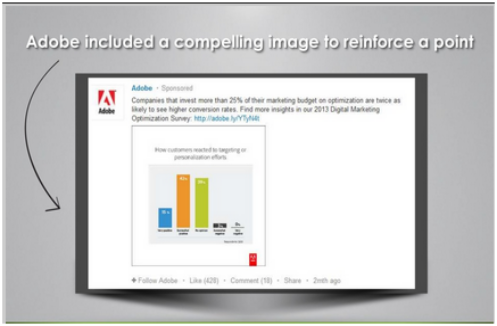
    Adobe Success StoryAdobe, a top B2B brand on LinkedIn, was a part of LinkedIn’s Sponsored Updates testing phase. The brand has continued using Sponsored Updates with impressive results after testing. Research indicated that after Adobe used Sponsored Updates, targeted decision makers were:

    • 50% more likely to agree that Adobe is shaping the future of digital marketing
    • 2.5x more likely to agree that Adobe’s Sponsored Updates captured their attention
    • 79% more likely to agree that Adobe can help them optimize their media spend

    Have LinkedIn Sponsored Updates been useful for your B2B brand in any other way? Tell us in your comments!

    Image Source: Tech Marketing Buffalo