Tag: Leads

  • Which Social Media Sites are B2B Buyers Using?

    Social media has had a huge influence on the way we live and work. For marketers, social media has allowed brands to start conversations practically in real time. It allows any business to engage with its audience in ways that were simply not possible 10 years ago. The ripple effect is felt across both B2C and B2B marketing.

    The social landscape is continuously evolving, and different platforms offer different—and changing—opportunities. But regardless of which platforms brands choose to use in their campaigns, social media will be one of the most affordable and effective methods at their disposal.

    Whatever the size of your business, you can tap into its potential and achieve impressive results—and social media’s influence on B2B purchases should not be underestimated.

    Who’s on social media in 2016?

    Social networks attract users of all ages, from all demographics across the globe.

    The number of young adults on social media has increased massively over the last decade. In 2005, around 12 per cent of this age group used social channels. Today, the figure is 90 per cent. When we talk about ‘young adults’, we’re essentially talking about tomorrow’s IT leaders. While some of these individuals are graduates, many are already making important brand decisions.

    The figures are significant for older internet users too. In the US, around two-thirds of the adult population uses one or more social networking sites, compared to 5 per cent 10 years ago.

    This cross-generational change has sent shock-waves through practically every sector. We all get our breaking news from Twitter, share memories on Instagram, and keep in touch with family through Facebook. In order to communicate with customers and service users, businesses have had to modernize their approach and get involved in this socially connected world.

    Why businesses must take note of social media

    Facebook is arguably the world’s best-known social network, with more than 1.4 billion active monthly users. 70 per cent of marketers use Facebook to generate more customers, and success is particularly pronounced in B2C marketing campaigns.

    Let’s not forget LinkedIn, which is responsible for more than 80 per cent of social media leads in business. Twitter is used by just over one-third of marketers, while Pinterest and Instagram have 20 million and 150 million active monthly users respectively, and offer great potential in the creative sectors, from home wares to fashion and beyond.

    So, what do businesses actually stand to gain?

    Increased brand awareness

    Social media is important in keeping a brand top-of-mind for a consumer. 37 per cent of internet users follow their favorite brands on social media, while 30 per cent use social networks when researching a purchase.

    Better consumer targeting

    Social media opens up two-way conversations, and gives you insight into the things your customers care about.

    Enhanced customer service

    Your customers are increasingly savvy, and they expect a great experience when they shop with you. Social media lets them get in touch directly, and that provides opportunities to offer rapid responses to support enquiries.

    Timely feedback

    Need to judge the reaction to a new campaign idea? Want to roll out a trial product and gauge the response? With social media, you have a direct connection to your audience.

    More leads

    Social media is a cornerstone of any inbound marketing campaign. Having a presence on key social channels lets you publish content, get your brand noticed, and create more leads.

    Increased sales

    There’s no magic formula for increasing sales through social media, but if you improve awareness, targeting and customer service, increased sales will follow.

    Social media is a fantastic tool for B2B marketing; 54 per cent of B2B marketers are already using it to generate new leads. As we head towards 2017, it’s estimated that US marketers will spend more than $100 billion on social media advertising.

    Ignore the trends at your peril

    We’ve reached a stage where the impact of social media can’t be denied. Since the mid-2000s, it has been a growing influence in the way we all live, work and shop. For businesses, it’s critical to have an active presence on social media, and to take interactions with customers seriously in order to drive profits and sales.

    Looking specifically at buyers in the IT sector, we know that 86 per cent use social media when making a purchase decision. These buyers tend to be the young adults that are also using social media for fun.

    We also know where these influential decision-makers tend to hang out:

    • 83 per cent research on LinkedIn
    • 80 per cent check out Twitter
    • 80 per cent look at Facebook business Pages
    • 61 per cent review YouTube videos
    • 39 per cent use Google+

    Social media is critical, not just because of the research angle, but because so many of these buyers will not contact a supplier until they’re more than half way to a decision.

    Social media can’t do your marketing for you, but it’s one of the key ways to reach the end of the marketing funnel. As such, marketers ignore it at their peril, and the consequences of neglecting social media could have a tangible impact on a business’ bottom line.
  • Plugging the Leaky Funnel: Preventing Lost Marketing Leads


    In most businesses, data is passed from marketing to sales in one direction. While this makes for a neat, tidy process, it isn’t necessarily the best way to close leads.

    Many strategists argue that sales and marketing should be considered one team, so that data can flow in and out of both of them. Before we look closely at this idea, let’s examine the reasons why uni-directional flow can be so problematic for your funnel.

    How Leads are Lost

    The word ‘funnel’ can be a misleading term, because it promises a neat flow in one direction. Often, the marketing process is not that straightforward. This is why so many leads lose their way.

    There are five key reasons why your business is losing leads. Essentially, all five leaks point to a mismatch between customer behaviour and business process:

    1. Leads get lost, ignored or discarded
    2. They are not scored, or have been scored incorrectly. MarketingSherpa found that 79 per cent of B2B marketers had not established any form of scoring
    3. They are not qualified, and not yet ready to spend
    4. There is a lack of communication, which may make it difficult to understand their position and whether they should be passed to the sales team
    5. They are not re-engaged after a sale. According to MarketingSherpa, 73 per cent have no process for nurturing leads after a sale has taken place

    Calling these ‘leaks’ makes the situation sound minor; a small margin of error, perhaps. But according to SiriusDecisions, 70 per cent of the qualified leads that are passed to sales end up being lost.

    DemandGen Report predicts that 80 per cent will go on to buy within 24 months – but they may not necessarily buy from you.

    Plugging the Leak

    Handling the constant flow of consumer enquiries is challenging for any business. But while data is still flowing one way, there will always be missed opportunities. Manual labor only makes control more difficult, because a CRM can only go so far to lighten the load.

    Marketing automation helps to prioritise leads that are ready to be passed to the sales team, using algorithms and scoring to automatically trigger the process. This includes automatic scoring, the critical piece of the puzzle that is missing in so many businesses. It factors in the realization that leads enter and exit the funnel in different places.

    Automation also lets you track real time developments in the buying cycle. If someone purchases a product, then comes back to make a second purchase, your sales team can respond with relevant information. Sure, they have the CRM already. But they’ll have the customer’s last time of visit, details of the pages they viewed, and the segment they have been assigned.

    Armed with all of this new data, they can engage in personal discussion, deliver the right information, and nurture that second sale.

    The Next Step

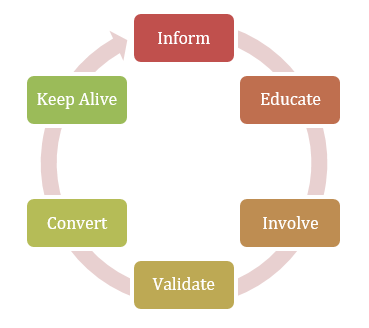
    This continuous monitoring, scoring and qualification automation transforms the marketing and sales process. From a fixed, linear and leaky funnel, it becomes a cycle; a way to re-engage, re-market and re-assess from minute to minute.

    If you haven’t implemented marketing automation, you might be amazed at the effect it will have on your ROI. Talk to us today about aligning your sales and marketing teams more effectively, using automation to drive efficiency and profit.

  • Drip Marketing vs. Lead Nurturing

    Old marketing aphorism

    He who confuses drip marketing for lead nurturing will see no results from either.

    Use drip marketing to nurture leads. But use lead nurturing to push those leads all the way through the buyer’s journey to its successful (for you) conclusion.

    While both campaigns benefit by automating and maintaining sustained engagement with prospects with direct email and social media — Facebook, Google+, Twitter, LinkedIn, etc. drip marketing engages a prospect and lead nurturing takes it from there by understanding the behavior of the prospect, their associated needs and other interests, all in service of developing a better, more qualified sales opportunity.

    By understanding the basic difference between these two you will improve your marketing programs, and your bottom line will swell. Organizations drive prospects and renewals by nurturing prospects in all stages of the lead life cycle. What’s important is a continuous process of education and engagement at every stage of a buyer’s journey, be it event communications, free trials, employee communication programs, etc.

    Drip Marketing

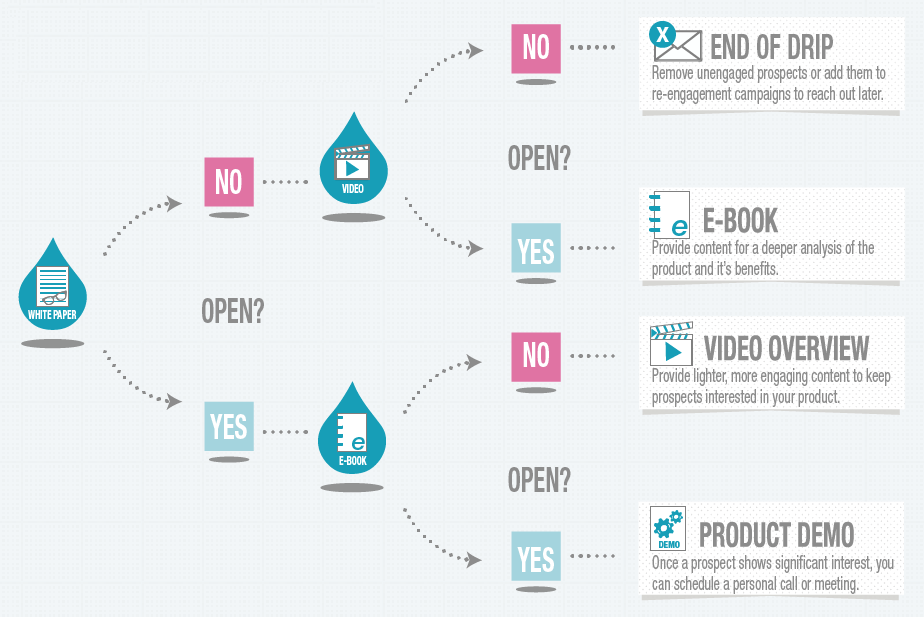
    Drip campaigns begin when people engage in common activities like signing up for an account or simply visiting your site. The people become a self-defined group and the drip campaign enables you to stay in touch. These campaigns typically consist of batches or triggers that change the nature of communication depending on the engagement or lead response. Every email originates from an archive of pre-written emails that are blasted using an automated process that allows for personalization of the name of the lead, the name of the organization, and much more.

    Drip Marketing Process

    Image Source

    Drip marketing is an effective way to push leads in a sales-ready direction. You educate the prospects about the product, build interest, and once ready, automatically move them to sales. Drip marketing is simpler and less customizable than a lead nurturing program but with continuous engagement it helps to keep your organization visible.

    Lead Nurturing

    Lead nurturing is about consistent communication with buyers throughout the lead life cycle, addressing key issues right from when interaction with the lead begins to when the lead is ready to purchase. Customers won’t appear overnight. It requires strategic marketing over time for potential customers to educate themselves and begin to build trust with the company. Lead nurturing successfully delivers valuable enough content that your leads remain engaged. Done right, lead nurturing develops strong brand and solution preferences in your prospects long before they’re actively engaged in the buying process.

    The successful lead nurturing program must be: lead nurture funnel

    • Able to maintain contact with the prospect
    • Use appropriate content
    • Target and Segment
    • Survey progress throughout the buying cycle

    To reduce the unsubscribe rate, keep all your communications simple and engaging. All of the content marketing rules for designing and sending effective emails apply to drip marketing and lead nurture. Begin with basic lead nurturing, going through the content on your website and blog to break it down into pieces that leads can easily and quickly consume. You need to map the content according to where your prospects land in the lead life cycle. A lead in the early-stages will have content requirements totally different than a lead in the late-stages. Your content has to be informative. It has to educate. And, to generate meaningful customer engagement, it has to be targeted. .

    Lead nurturing is a powerful way to automatically stay engaged with future buyers. Use targeting and segmentation to leverage prospects and ensure that communications remain relevant. By successfully implementing the nurturing process you gain valuable insights into buyer preferences and gain knowledge of the buyer’s timing and path. None of this is possible, of course, if your lead nurturing program delivers content of insufficient value or interest to your prospects.

  • Evolution of Facebook ‘For Business’, Voice search SEO and much more…| Best of the Week

    This week’s hot news, events and videos from the online marketing and social media world.
    Evolution of Facebook 'For Business'
    From the Position² Blog This Week:
    Evolution of Facebook ‘For Business’
    A facebook timeline that summarizes the impact of Facebook changes on businesses and marketers
    Top Stories this Week: Social Media
    Top Stories this Week: SEO, PPC and Digital Media
    Best of the Week Video Best of the Week Video
    Google Analytics Dashboard – Tips & Secrets
    White Paper: Increase Visibility for Your Content by 4x
    Today’s traditional SEO is inadequate: Ignite your search results by accelerating visibility in more places than ever before.Download this White Paper and learn:

    • SEO, why the way we know it is not enough
    • Introducing and implementing Enterprise Visibility Accelerator (EVA)
    • Using multi-channel tracking tools for effective monitoring
    • How EVA benefits businesses.

    Download the complimentary EVA White Paper now

    Know more about Enterprise Visibilty Accelerator(EVA)
    If you are reading this blog post via a RSS reader, please click here to subscribe.