Tag: Keywords

  • Bing Ads Launches Keyword Planner Tool In All US Accounts


    Do you need help finding relevant keywords to drive traffic to your page and lift your campaign’s performance? Or maybe you’re simply researching and expanding your keyword list. In either case, your life just got easier. Bing Ads announced on Tuesday the launch of Keyword Planner in the Tools section of the Web UI in US accounts.

    The Bing Ads Keyword Planner provides keyword and ad group suggestions. It shows average monthly search volume trends, relative competition and suggested bids. The update addresses the data limitations of the former Bing Ads keyword tools, bringing the Bing Ad Campaign UI in line with Google AdWords.

    Accessing Keyword Planner is very easy. Sign in to your Bing Ads account at http://bingads.microsoft.com, click Tools on the header and then select “Keyword Planner.”
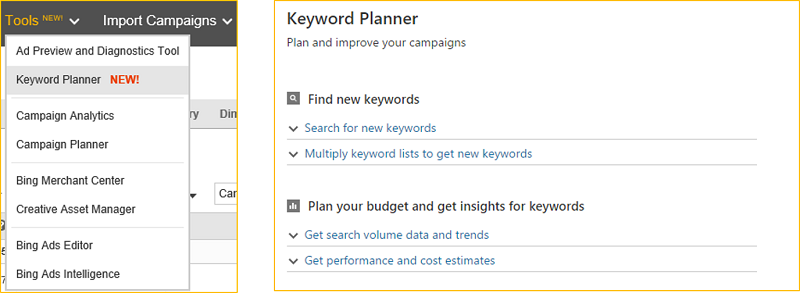
    bing ads launches keyword planner tool in all US accounts.jpg

    New features in the Keyword Planner

    The new features in the keyword planner will help with creative ideation, targeting and filtering, finding the profitable bid and budget, and much more.

    Keyword and Ad Group suggestions

    By analysing such historical statistics as search volume trends and marketplace competition intensity, marketers gain the insights they need to select the best keywords to use for a campaign. This analysis helps marketers find those long-tail keywords that don’t have much search volume, but are likely to drive conversions.
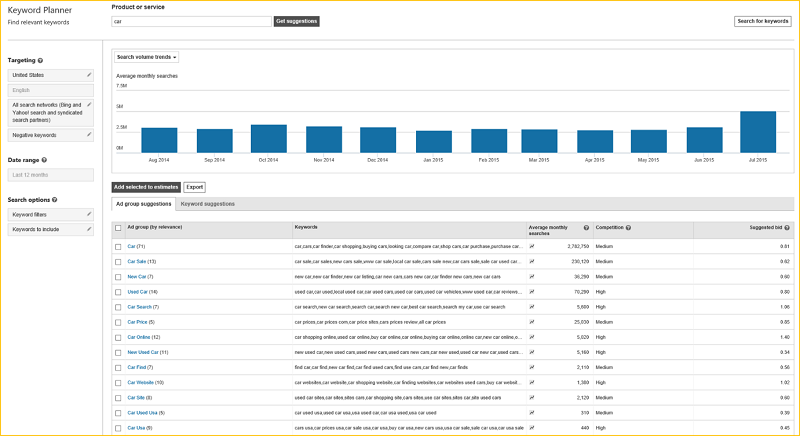
    keyword and ad group suggestions update

    Marketers can refine keyword suggestions by location and network targeting. They can filter by historical statistics and by keywords to include or exclude. They can also see search volume breakdown by device or location, in specific locations, or drilled-down to state, DMA or city level. The visual graph helps marketers understand the expected contribution from individual devices or locations.
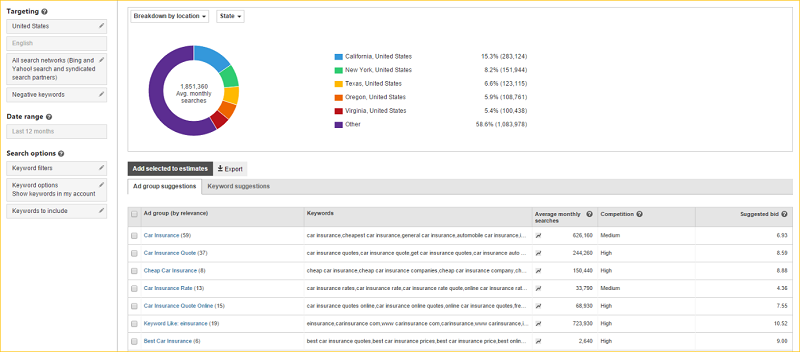
    graphical represenattion of contribution of devices or location

    Bid and Budget Optimization

    Marketers get an idea of how the keywords and ad groups might perform if added into an account by examining the bid amount and daily budget for performance and cost estimations that include impressions, clicks, spend, CTR, avg. CPC and avg. positions.
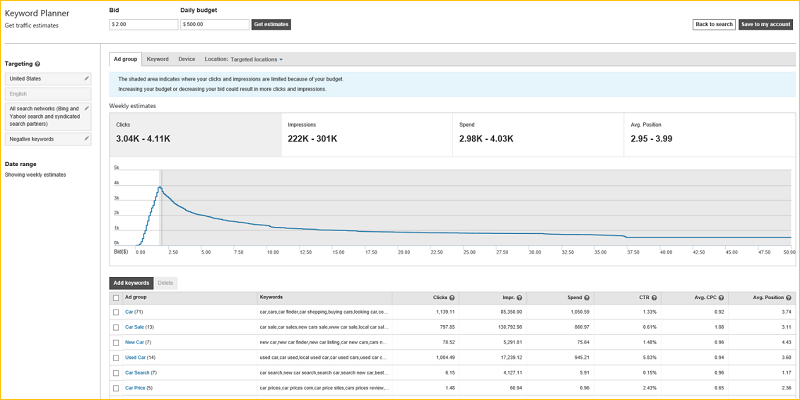
    bid and budget optimization

    Create a new campaign or add to an existing campaign

    If satisfied with the keyword research results, marketers can add the keywords and ad groups to an account by creating a new campaign or adding to an existing campaign. All that’s left to do is create the ad copy.
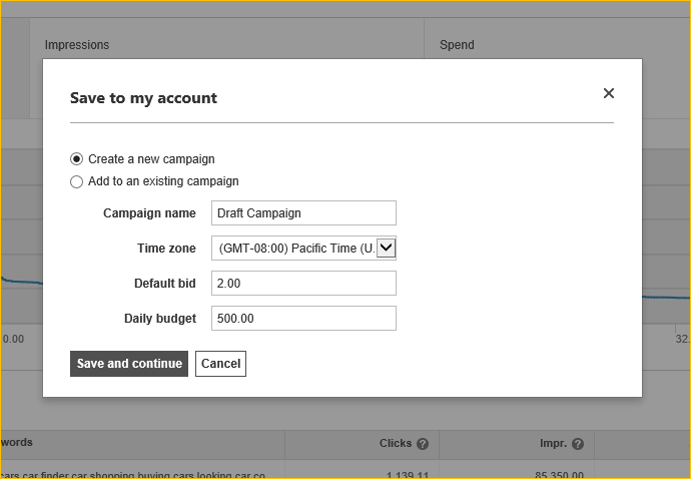
    new campaign or add to an existing campaign

    Bing Ads piloted the Keyword Planner in March and July. It began rolling out to some accounts in August, and it’s now available to all US advertisers. The Keyword Planner replaces the “Research Keywords” tool in US accounts.

    If you’re not seeing it in your accounts yet, you can get started here.

    Source: Search Engine Land | Bing Ads
  • Top PPC Tools for Keyword and Competitor Analysis

    Pay Per Click (PPC) evolves on a regular basis. New phrases are born every day in an ever changing landscape of keywords. Day in and day out digital marketers struggle to create the perfect PPC campaign that delivers consistent results and stays ahead of the competition. Success lies in a thorough analysis of a competitor’s PPC keywords and ads, extracting their data and discovering how it influences conversions. From that, analyze your own ads to see what is missing.

    To do this you’ll need to:

    1. Find out who your competitors are
    2. 2 Assess their effectiveness
    3. Determine how they sell
    4. Determine what to extract from their data
    5. Define the size of the opportunity
    6. Estimate how much your competitors invest in paid search
    7. Assess whether you are investing enough in paid search
    8. Optimize your campaigns based on the analysis

    Fortunately, there are a lot of third-party tools to help you with your PPC ad campaigns and issues related to keywords, ad copy, profit, budget, competitor analysis and other parameters.

    To dig deeper into your competitor’s strategies consider some of these top search marketing tools:

    Keyword Competitor - Pay Per Click tool

    KeywordCompetitor provides something that Google does not – the ability to access your competitors’ paid keywords, ads and landing pages. Updates are available on a daily basis.

    ispionage

    Use this PPC tool to gain insights into your competitor’s most effective keywords, ad copy and ad budgets.

    semrush

    Find your PPC competitors based on the keywords you plan to target. You can also access the ad copy used by the competition, and determine who tops paid search results.

    PPC tools for Keyword Analysis - Keyword Spy

    Uncover the competitive landscape and discover a competitor’s PPC campaign strategies with KeywordSpy. Pinpoint profitable keywords targeted by the competition and the successful ad copy in which they are used. There is also a unique ROI indicator you can use to judge the value of keywords.

    PPC tools for Competitor Analysis - Spyfu

    SpyFu maps every place a competitor’s ad has shown up on Google as well as all ad variations used by that competitor.

    Adbeat Logo - Pay Per Click tool

    Browse top ads and ads by format with Adbeat. It includes an ability to uncover competitor strategies and spy on ad copies with split testing. Adbeat also lists the number of days an ad was live, and the exact dates when it was first and last seen.

  • How to Write a Killer Ad Copy That Actually Sells

    We live in a world full of enticing propositions. As a digital marketer garnering the undivided attention of your customers is a challenge. The online arena is a complete world within itself where attention spans are shrinking and novel ideas come in all shapes and sizes.

    What the digital world lacks in attention spans, it makes up for with more focused advertising. Pay Per Click (PPC) advertising is a very targeted form of advertising. Your audience is already primed to buy or wants to know more about the product that you are selling for purchase at a future date. This makes PPC advertising more predictable and you pay the search engine only when somebody clicks on your ad copy. So as a digital marketer you need to make the best of this chance to win over your customers.

    Writing ad copy within the character limits set by the search engine giants however needs practice. The online market is very lucrative and everybody is vying for the same target audience. Then how do you differentiate yourself from the competitor? It’s a tall order but is achievable if you stick to some fundamentals of writing a ‘killer ad copy’.

    • Understand the Audience
    • Use a Psychological Trigger
    • Use Keywords
    • Use Prices & Promotions
    • Use a Strong CTA
    • Differentiate
    • Make it Relevant to Landing Page.
    • Filter Clicks
    • Make it a Continual Process of Testing & Refining.

    Pointers for a Great Ad Copy

    You need to make the most of the character limit that is standardized by search engines. Using the keywords wherever possible makes a crucial difference. Keywords are easily identifiable and are tagged by the search engines. Keywords that are highlighted in the ad copy give you better visibility and improve click through rates.

    Use of trigger words like ‘you’, ‘free’, ‘cheap’ are bound to garner your ad copy more attention. Every purchase is innately perceived with risks but more so in the online world where there is no touch-and-feel factor that we are so used to in the brick and mortar world. Hence, use reassuring words that can soothe your customers and assuage their anxieties.

    Use qualifiers wherever possible in order to give people a better idea of what you are selling and in the process discouraging people who don’t qualify from clicking your ads. Differentiate yourself from the competition by highlighting your unique value proposition. It could be some great offer or something that can add value to your ad copy in a way that can give you the edge over your competitors. Your ad should be in consonance with the landing page that you are going to use to convert your impressions to sales.

    Ask questions in your ad copy wherever possible. This gets the audience more involved. A question with the word ‘you’ is bound to earn your ad copy more attention. People feel you are directly addressing them and that it is not just a phony attempt of enticing people. It makes an emotional connect and people are more likely to buy from you if they are emotionally driven to want your product.

    A Process of Constant Evolution & Improvement:

    Remember ad writing is not a onetime process. You need to continually monitor the status and tweak the ad copy depending on what works and what doesn’t. Hence, you need to have more than one ad copies so that you can always split test and improve your chances of getting better leads. Track your performance using analytics tools available online, the chief being Google Analytics, and incorporate the feedback to get better click through rates.

    Now you might think that the character constraint set by the search engines is stymieing your creativity, but the fact is that people might not even read your entire ad copy. They might just be scanning for some trigger words and your ad copy better have it if you want to convert to sales. You cannot escape the fact that people today are always in a hurry and do not have the luxury of time to look at your ads at leisure. You need to constantly improvise, adapt and overcome in this new era of digital marketing.

    It’s a brave new world out there with ever-changing rules. But you can still conquer it with a killer ad copy.