Tag: indexing

  • Locale Adaptive Web-pages now Get Support from Google

    Google recently introduced the Googlebot Crawl configurations for local-aware pages and provided insights on how locale adaptive web pages are crawled and indexed.

    What are Locale-Adaptive pages?

    Web-pages which dynamically change content depending on the user’s origin country or language settings are called locale-adaptive pages.

    Barry Schwartz says Google will now be able to handle such content by sending Googlebot from different IPs across the world, as well as let it set language settings.

    Google will use two methods of crawling and indexing:

    1. Geo-distributed crawling: When Googlebot uses IP addresses coming from outside the USA in addition to the current IP addresses Googlebot uses that appear to be from the USA.
    2. Language-dependent crawling: When Googlebot starts to crawl with an Accept-Language HTTP header in the request.

    It is important to understand how Googlebot currently recognizes whether a website has locale-specific content and  uses different crawl settings.

    There are 3 approaches:

    1. Serving different content on the same URL—based on the user’s perceived country (geolocation)
    2. Serving different content on the same URL—based on the Accept-Language field set by the user’s browser in the HTTP request header
    3. Completely blocking access to requests from specific countries

    This update from Google solves the problem that Google crawlers have understanding sites that have utilized locale-adaptive techniques. On Webmaster support Google said that “new crawling configurations are enabled automatically for pages we detect to be locale-adaptive, you may notice changes in how we crawl and show your site in Google search results without you altering your CMS or server settings”.

    What does this mean to Webmasters?

    • Usage of different URLs or TLDs is important for sites having content specific for different countries or languages.
    • Usage of ‘rel=”alternate” hreflang’ annotations with separate URLs needs to be continued
    • Verification of Googlebot geo-distributed crawls can be done using reverse DNS lookup
    • Robot exclusion protocol needs to be consistent across the site; robots meta-tags and the robots.txt file should specify the same directives in each locale.

    Conclusion

    With the latest announcement by Google on support to locale-specific pages, it now becomes easier to get these dynamically changing content pages indexed on Search.

    Be ready to witness changes in crawl rates and appearances of web-pages on SERP’s over the next few weeks. Contact Position² to deploy locale-adaptive techniques for your website now!
  • Google Updates Technical Webmaster Guidelines

    The Googlebot that crawls all the web pages could until now only understand textual content and not image based content, CSS or JavaScript. But all that is going to change now, thanks to a recent Update to Google Webmaster Guidelines. Now you will have to optimize your site not just with respect to the textual content but also with respect to the images and the JavaScript too. You will have to do extensive optimization for your CSS (Cascading Style Sheets) too because the Google Spiders will now recognize them.

    If your website settings are such that your robots.txt file is preventing the Googlebot from accessing your Java files then you are at a loss and Google advises you to render access to the bots.  The Google Panda algorithm will negatively view your content if it is not up to the mark with respect to JavaScript or CSS file.

    If in case you are not sure JavaScript and CSS is getting indexed or not, then you can do a manual check by the following process.

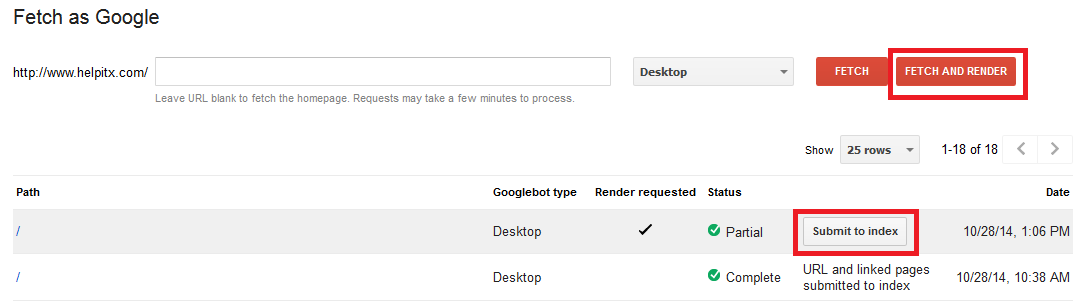
    Google fetch

    You need to first select Fetch option under the Crawl tools and then you need to enter the URL of the site that you want to check. If you want to test the homepage then you need to leave the field blank. Press Fetch and Render button so that the Googlebot will begin to crawl your website. Once the crawling is complete you can press the Submit to index button to see the detailed results of the indexing.

    Previously Google used to advise webmasters to check their content on text only browsers like Lynx but now with this new update you will have to check the content on regular browsers to see to it that the site is optimized keeping the new Google update in mind.

    Google offers the following advice for optimal indexing of your website.

    • Be sure to use only the most popular technologies on your website that support the maximum number of browsers.
    • Speed is an important factor for the Google indexing hence avoid all roadblocks to swift indexing like large downloads, et al.
    • Club your various CSS and JavaScript files together and also compress them for better and easier indexing.
    • Handling of full JavaScript and CSS can be tough at times due to various issues and hence optimize your website so that all these additional formatting styles are easily indexed at all times.

    Let us know how this new Update from Google will affect your SEO efforts, going forward.