Tag: Google Search

  • RankBrain: AI Comes To Google Search


    “If you say ‘Google’, people think of search,” Greg Corrado said. He’s a senior research scientist at Google working in artificial intelligence, computational neuroscience, and scalable machine learning. “Search is the cornerstone.” Corrado met with the press to highlight, for the first time, the important place of Artificial Intelligtence (AI) in search. At Google they call their AI system RankBrain.

    Making use of AI, RankBrain embeds vast amounts of written language into mathematical entities — called vectors — that the computer can understand. When RankBrain sees words or phrases for the first time it guesses what words or phrases it already knows that might have a similar meaning, and filters the result accordingly. This makes RankBrain extremely effective at handling never-seen- before search queries, of which there are more than a few.

    Google handles millions of search queries a second, 24/7/365. Let that sink in. Of that total number of daily queries, about 15% of them are completely new to Google.

    The hundreds of signals that contribute to Google’s regular search algorithm all kick in for any query, to be sure. And RankBrain is only one signal out of all those hundreds determining what results appear on a Google search page and where they are ranked. But in the months it has been deployed, according to Corrado, RankBrain has become the third-most important signal contributing to the result of a search query.

    “The other signals, they’re all based on discoveries and insights that people in information retrieval have had,” Corrado said, “but there’s no learning,”.

    And that’s the thing. RankBrain isn’t just precise in matching sites to queries. It also learns and improves its performance over time. Corrado says Google has used RankBrain to handle a massive search load over the past few months and has discovered that RankBrain is better at predicting top search results than Google’s own search engineers.

    The Google engineers who spend their days developing the algorithms that power Google Search were asked to review selected pages and guess which ones Google’s search engine technology would rank on top. They were correct a stunning 70% of the time. Rank Brain had an 80% success rate.

    RankBrain rolled out across all of Google search starting in early 2015 with the green light from Amit Singhal, Google’s senior vice president of search. The yearlong effort started with a team of about five Google engineers, including search specialist Yonghui Wu, and deep-learning expert Thomas Strohmann, before expanding to dozens of people. It took a long time to be certain the system was ranking things correctly.

    “It’s very carefully monitored,” Corrado explained. Google periodically updates the system by feeding it new data to help it better reason with new concepts.


  • Position² @ SMX West, San Jose, March 2014

    Position2 was at the SMX West event in San Jose last month represented by our Head of SEO, Rahul Banerjee.

    We think SMX West lived up to its expectations this year, especially from a SEO point of view. A look into the future of SEO was most intriguing. SMX shed light on a few key future trends to watch for:

    If you need additional information, feel free to reach out to us.

    • Conversational Search: Advancement is seen both in complexity and nature because of changing user behavior. Now, there is increased emphasis on conversational and voice search. An example of this is the Hummingbird update which emphasizes semantic search methodology (for example, Google Auto Complete option) and Natural Language Understanding (NLU) by looking at the relevance and meaning behind the query.

    Position2 shares an example of conversational search.

    Our content strategies are aligned with user experience and the optimization of search engines also powers better search results. For example, the use of blogs, forums, the Google authorship program, social media optimization etc. helps reach out to the target more with the natural language parameter of users.

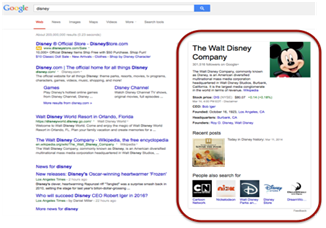
    • Knowledge Graph: It is a system that understands facts about people, places and objects and the interconnectivity between them.With the implementation of the Knowledge Graph, companies will now need to make more efforts to build their brand online. Google will include results about reputed brands of authority who are trusted. Online brand building efforts need to be an ongoing activity.

    Position2 shares an example of knowledge graph.

    However, Google is also testing ads on the Knowledge Graph and carousel.

    Position2 shares an example of knowledge graph ads.

    • Structure Data Markup: It helps Google understand the content architecture of a website better and facilitates faster and more relevant results.We recommend our clients implement structure data markup (eg. Schema.org) on their websites.

    Position2 shares an example of schema markup.

    Here are some more key relevant points for organic SEO:

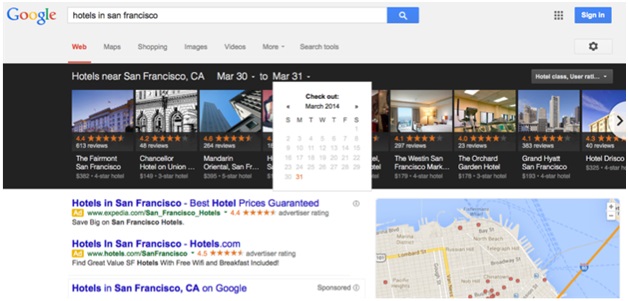
    • High competition: With Google testing out paid ads on search results, organic search results have less shelf space and are needed to compete more to be visible. For example, if you type “Hotels in San Francisco” in Google, the top scroll of the Google SERP includes only paid ads pushing the organic results lower.
    • Mobile will soon dominate: Google mobile queries are set to surpass PC search this year.


    Image Source: Google

    Mobile is another factor that is altering the nature of search. Mobile capabilities differ from device to device, which in turn impacts the content development, communication, engagement and measurement.

    Implementing and embracing personalization will make for better search experience.

    • Apps: There is a global opportunity to develop and market through apps. However, app stores must also be localized.
    • Social presence: Google may not able to read social signals completely from other channels like Facebook and Twitter yet. But, this is going to change soon, which is why we maintain a social presence for our clients and help them build the right influencer network. Google has already said that users who use their Google logins will experience better search results. Google will roll out a full fledged algorithm soon.
    • Natural link building: ‘The best links are not asked for’. Work on natural link building. Do not use shortcuts or indulge in explicit link sales. Let the target audience refer, like, comment and build links for you.

    If you have original content that is useful for people, you can ask for recommendations/references. But your intentions will matter. Google is constantly penalizing websites with vested interest towards link building as an activity.

    • Devalued content: Press releases, articles and guest blogging are now devalued content due to over optimization techniques used by most of the SEO experts. Content that offers value should be created for the target audience and not for search engines.
    • Build recognition, reputation and trust through well-devised content marketing plans. Authority plays a vital role for Google to rank a website. Consumers also look for brand reputation and trust levels before making online purchase decisions.
    • Google Panda updates: It is likely that Panda will be updated more frequently. Expect one soon. Google is constantly testing out search parameters to provide the best results to users.
    • World does not stop at ‘Not Provided’: Post the ‘Not Provided’ update, Google changed the way it harvests data from search to protect users’ privacy. First, all logged-in users were switched to “https” from “http”, where the referral data relating to that search is hidden. But, as already indicated, that refers now to the whole universe.

    Position2 recommends analyzing success with page-level metrics like page-level traffic, bounce rate, percentage of new visitors etc. to have an edge and understand user engagement metrics.

    • Generic Top Level Domains (gTLDs): These do not impact rankings. For example, a domain like www.buymycar.com need not be ranked for car related keywords if it does not have content related to buying cars.

    Share your thoughts on the event insights with us in the comments below.

    More to follow from Position2

    … keep in touch!

  • Improve SEO Effectiveness with Google Trends

    Good SEO needs more than an understanding of the technical aspects of search and client’s requirements. It also needs a thorough knowledge of search trends relevant to your line of business.

    Google Trends is a great tool to stay updated on these trends. Yes, it will also give you information on keywords that are not specific to your brand, but that’s how people search. It’s not enough to just optimize your website for brand search terms. You also need to include relevant non-brand related keywords.

    Just think about it. Your target audience may not necessarily be looking for information using your brand name. They may be using search terms related to your industry. Having a wide spread of relevant keywords, though more expensive, can give you a competitive edge.

    Using data from Google Trends will help beef up your SEO efforts as it will help you understand consumer behavior better.

    Google has been emphasizing the fact that, in the future, SEO will be driven to cater to consumer needs. Google is now evolving from being a search engine to an interface which helps users get what they exactly want.

    The settings in Google Trends offer different categories of data:

    • Web, Image, News, Product and YouTube search
    • Worldwide or region-wise search
    • Time ranges (extremely important to know how a keyword evolved)
    • Data is further available by interest categories such as, Arts and Entertainment, Autos and Vehicles etc.

    You can compare up to five terms or even groups of terms at one time with up to 25 terms in each grouping, such as:

    • Social + Icons + networking
    • Analysis + web + tools + spend
    • ROI + campaign

    As with regular search, the + sign here tells Google that you want to cover searches that include ROI and campaign both. Using ‘Hot Searches’ and ‘Top Charts’, you can also find out about the top searches for the day and by popular categories. It is small things like this that can give you a vital edge or insight that makes a huge difference in the effectiveness of your campaign.

    Avenues to Use Google Trends

    Assistance in keyword research

    Google Trends shows popularity of search terms over a period of time with a graph that indicates interest ‘levels’. While it gives you an idea of the trend for those words, it does not provide exact numbers that search marketers can use. However by using Google Trends with the AdWords Keyword Planner, you can check the interest levels for the keywords for a particular campaign. This helps weed out relevant but unpopular keywords you may have picked.

    Worldwide Keyword Popularity

    The above screenshot shows the interest levels for terms ‘social media’ and ‘social networking’. The graphical representation clearly indicates that people have searched using ‘social media’ more than ‘social networking’. For example, if you are promoting a webinar related to social media skills through Google AdWords, you would do better using the phrase ‘social media’ in the title rather than ‘social networking’.

    In geo-targeting for campaigns

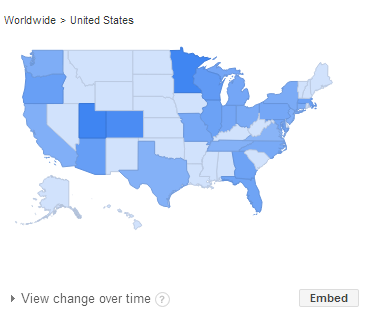
    You can access region-wise data on Google Trends and learn about the regions that exhibit the most interest in your keywords.

    Regional Keyword Popularity

    This depiction shows the maximum traction to be coming from Utah and Minnesota. You can even get data on the cities that top in these searches.

    Support in content marketing

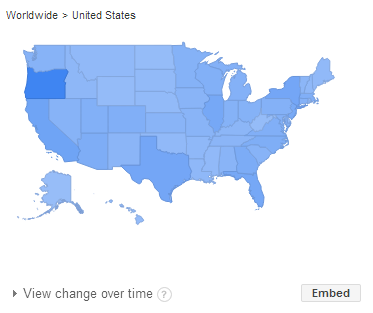
    You can use ‘Hot Searches’ and ‘Top Charts’ to learn about trending topics in your industry. Do a quick survey among your clients and find out their real-time problems. Post blogs that answer those problems and build your reputation as an industry thought leader. Let’s pick Google among the social platforms and see the region where the interest has spiked.

    Region wise Brand Popularity

    So, if you are planning on promoting an eBook on best practices for Google search optimization, Oregon should be a top contender in your list.

    Video content generation

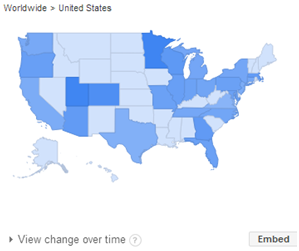
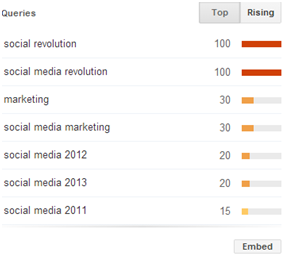
    A YouTube search for ‘social media’ and ‘social networking’ reveals that again Minnesota ranks highest again with ‘social revolution’ being the topmost key phrase.

    Maybe, you can convert your webinar on social media into a video or a series on how a brand can kick start a social revolution for itself by making the right moves. You can ensure your video features in YouTube search using these terms in your video title and description.

    Region wise Keyword Popularity on YoutubeTop Ranking Keywords on Youtube

    Another advantage of using Google Trends lies in estimating budgets to be allocated for paid campaigns. Data from Google Trends can be used to bid smartly on key search terms which users are actually using. This would help reach out to a larger section of the audience.

    Can you think of any other ways in which Google Trends can be used to boost SEO efforts? Tell us!

    Images Source: Google Trends