Tag: Geo targeting

  • Evolution of Content Marketing

    We trace the shift in the approach to marketing with higher than ever emphasis on “creating meaningful experiences” for the audience.

    Global Content Marketing

    The traditional content marketing was very limited in ways of reach and effect. Content marketers traditionally ‘push’ what they have, to potential customers rather than what potential customers demand. Majority of the websites in the past are example of this traditional content marketing where content was deployed using a single common language (usually English) for visitors across the globe.

    • A single website is developed online for the entire targeted areas to advertise or show all the available products, services and information
    • The content is created without any targeting for specific geographies or regions
    • The intent of the content is not customized to suit specific potential customers
    • The tone of the content seems like a one-way communication

    The traditional content marketing was just like a seller offering what he had, not what the buyers needed or demanded. The dissemination of information was straightforward and limited.

    Geo-based Marketing (Localization of content)

    Globalization influences the reach of content. With business expansion and scattered target audience, a single website is not the best solution to market to the whole world. Marketers realized that whatever content they marketed was to be understood by specific sets of target audience and hence had to be tailored accordingly – which is Localization of content based on the Geography.

    The whole information is translated and modified to suit each targeted consumer in terms of local preferences, languages, products and services demanded. Marketers realized that the perception of their website adversely affects the acceptance of their products in those geographies where content has not been localized and optimized.

    Coupa Software was in its rapid 120% growth stage with customers spread across 40+ countries. It had 150K+ users of its services in over 140 countries who used 20+ different languages. Coupa had no bandwidth to localize their marketing campaign to suit every specific region. But with the help of Cloudwords, a translation and content localization company, Coupa Software has managed to localize their products, thus, attaining a higher click through rate from the same audience. This audience now brings more than 50% higher conversion rate.

    Personalized Content Marketing

    Approach to content marketing has shifted from a global audience to local to a more individual level. The localization of content has been filtered further to a more accurate target. This involves real-time personalization of content.

    Personalization means identifying a person’s attributes such as potential, behavior, profile etc, and customizing their experience by presenting them with relevant content, call-to-action or visuals. Personalization can be B2B or B2C and has a unique process consisting of Who (target audience, potential, profile), What (content, case studies, videos, assets) and Where (website, email, mobile, ads).

    What personalized content marketers do is that they track the overall behavior of an individual engaging with the content. User preferences, likes, navigation history, pages navigated, sections of the content viewed and other such data is collected by the content marketer. The more the visitor frequents the website, the more personalized the content gets with every new visit due to his previous interactions. The content is generated based on the visitor’s profile like location of access, time, source, form factor, et al. This way the visitor is served when he is most interactive and engaging optimally with the website and its content.

    Take for example, Panaya has a visitor from a particular IP address who browses through the content and clicks on some link. In the first visit, the user is served a normal web content that Panaya offers to all visitors.
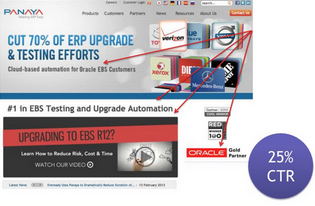
    Position2- An example of Panaya serving users with real-time personalization of content

    Based on the pages visited and the sections of contents read by the visitor, Panaya served a different content to the visitor when he returned back to the site. This highly personalized content marketing strategy is likely to boost conversion because the visitor has been served with content that he wants from the website.

    Contact Position2 to learn more about personalized content marketing

    How does Personalization help you?

    • It creates a meaningful interaction by serving the right content
    • It educates and nurtures top-of-funnel prospects
    • It optimizes budget and lowers cost per lead
    • It improves site performance, analytics and content consumption
    • Extends marketing automation reach
    • Turns anonymous prospects into qualified leads

    Contact us to learn more about personalized content marketing.

  • Geo-targeting – 7 Tips to Consider

    It’s a common scenario today for brands to have customers in many countries. But, targeting these customers and engaging them is a challenge, owing to their varying preferences and requirements.

    This is where geo-targeting steps in…

    Targeting customers by location is called Geo-targeting. It’s an important aspect of online marketing especially for brands targeting customers in different geographical locations.

    Geo-targeting helps brands address customers using their preferred language and target them with region-specific offers. This increases customers’ brand affinity, engagement and conversions. Google AdWords provides a variety of options and features for geo-targeting.

    However, there are certain important factors you need to consider while planning geo-targeting campaigns:

    1. Your site’s domain

    Some brands have Top Level Domains (TLD) specific to the country they want to provide information for. A ‘.co.uk’ site is specific to the UK and ‘.co.jp’ is specific to Japan. Country specific TLDs make it easy for Google to understand who you are targeting with your information and lets it rank your website appropriately in location specific search results.

    However, with a generic TLD like .com or .org, your website may not appear correctly in search results because Google doesn’t know which location you are targeting. If no information has been entered in the Webmaster tools, Google will look at multiple signals like the IP address, location information on your page, links to your page and any other relevant information from Google Places and pick your website’s country domain. These may not yield you the best results. With generic TLDs, it’s best to give Google the requisite information to improve search ranking for specific locations.

    2. Choose the right geographical areas

    This sounds like a no-brainer, but it’s surprising how often this is missed. Select geographical areas for your campaigns based on your product availability. If your product is available in certain regions of a country, picking those areas will increase the chances of better ad ROI. With Google AdWords, you can achieve precision targeting by postal code targeting.

    3. Optimize By Exclusion

    Optimize your effectiveness by leaving out areas that are delivering low responses. You can get back to these areas with a revised strategy. After the first run of your campaign, you may notice that your ads have low ROI in certain areas or your products may not have a market in some regions due to geographical factors. You can optimize your ROI by cutting out non-performing areas. Concentrate more on the areas that are generating the highest number of clicks. You can also try bidding less on the areas that have low traction.

    4. Include mobile devices

    If most of your target audience is on their mobile devices for considerable amounts of time, you should geo-target your mobile audience also. If you are using Google AdWords call extensions and tracing a significant part of your conversions through calls, geo-targeting on mobile devices will be even more beneficial for your business.

    People use mobile devices when they are on the go and would be looking for deals that are nearby. Geo-targeting mobile users is highly beneficial because, you can then target them with not only offers in establishments they are close to, you can also roll out geo-specific offers.

    5. Use the appropriate languages and currency

    Matching your web pages’ language with the main languages of the region is a major aspect of geo targeting that influences traffic and engagement. Provide content in different languages and use a drop down menu that allows users to select the language/region they are accessing the site from. This is an effective way to ensure users can consume content easily. Another way to make your site easy to use is to build it so that it reads the user’s IP address and displays content in the main language of that region.

    You also need to focus on the currencies that your site uses to process transactions. Offer the right currency depending on the geographical area the user is browsing from. You can also offer currency options and leave the choice up to customers.

    6. Offer coupons and deals

    The marketing strategy for each market is different. So, it’s important to sync your offers and deals with the visitor’s geographical area. You can either track users’ IP addresses or you can provide menus for users to select from before providing region-wise offers. Localized offers and deals are more relevant to visitors as they cater to specific market requirements and can therefore help in driving conversions.

    7. Run tests

    Everything may not go as planned so it’s best to run tests to see if your effectiveness is indeed going up or whether you need to tweak any part of your strategy. Different people react differently to changes, even minor ones and it’s best to use this as an opportunity to improvise further.

    Do you have anything to add to this? Let us know in your comments!

  • Improve SEO Effectiveness with Google Trends

    Good SEO needs more than an understanding of the technical aspects of search and client’s requirements. It also needs a thorough knowledge of search trends relevant to your line of business.

    Google Trends is a great tool to stay updated on these trends. Yes, it will also give you information on keywords that are not specific to your brand, but that’s how people search. It’s not enough to just optimize your website for brand search terms. You also need to include relevant non-brand related keywords.

    Just think about it. Your target audience may not necessarily be looking for information using your brand name. They may be using search terms related to your industry. Having a wide spread of relevant keywords, though more expensive, can give you a competitive edge.

    Using data from Google Trends will help beef up your SEO efforts as it will help you understand consumer behavior better.

    Google has been emphasizing the fact that, in the future, SEO will be driven to cater to consumer needs. Google is now evolving from being a search engine to an interface which helps users get what they exactly want.

    The settings in Google Trends offer different categories of data:

    • Web, Image, News, Product and YouTube search
    • Worldwide or region-wise search
    • Time ranges (extremely important to know how a keyword evolved)
    • Data is further available by interest categories such as, Arts and Entertainment, Autos and Vehicles etc.

    You can compare up to five terms or even groups of terms at one time with up to 25 terms in each grouping, such as:

    • Social + Icons + networking
    • Analysis + web + tools + spend
    • ROI + campaign

    As with regular search, the + sign here tells Google that you want to cover searches that include ROI and campaign both. Using ‘Hot Searches’ and ‘Top Charts’, you can also find out about the top searches for the day and by popular categories. It is small things like this that can give you a vital edge or insight that makes a huge difference in the effectiveness of your campaign.

    Avenues to Use Google Trends

    Assistance in keyword research

    Google Trends shows popularity of search terms over a period of time with a graph that indicates interest ‘levels’. While it gives you an idea of the trend for those words, it does not provide exact numbers that search marketers can use. However by using Google Trends with the AdWords Keyword Planner, you can check the interest levels for the keywords for a particular campaign. This helps weed out relevant but unpopular keywords you may have picked.

    Worldwide Keyword Popularity

    The above screenshot shows the interest levels for terms ‘social media’ and ‘social networking’. The graphical representation clearly indicates that people have searched using ‘social media’ more than ‘social networking’. For example, if you are promoting a webinar related to social media skills through Google AdWords, you would do better using the phrase ‘social media’ in the title rather than ‘social networking’.

    In geo-targeting for campaigns

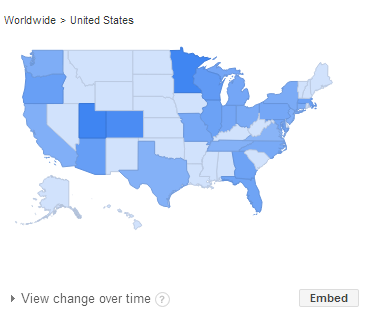
    You can access region-wise data on Google Trends and learn about the regions that exhibit the most interest in your keywords.

    Regional Keyword Popularity

    This depiction shows the maximum traction to be coming from Utah and Minnesota. You can even get data on the cities that top in these searches.

    Support in content marketing

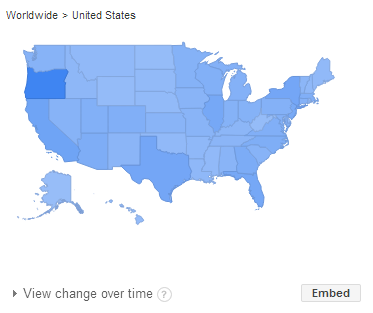
    You can use ‘Hot Searches’ and ‘Top Charts’ to learn about trending topics in your industry. Do a quick survey among your clients and find out their real-time problems. Post blogs that answer those problems and build your reputation as an industry thought leader. Let’s pick Google among the social platforms and see the region where the interest has spiked.

    Region wise Brand Popularity

    So, if you are planning on promoting an eBook on best practices for Google search optimization, Oregon should be a top contender in your list.

    Video content generation

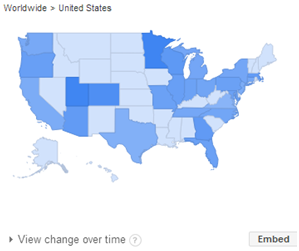
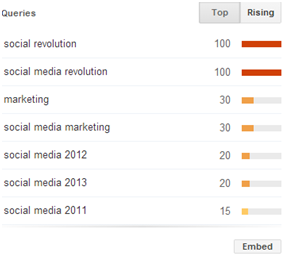
    A YouTube search for ‘social media’ and ‘social networking’ reveals that again Minnesota ranks highest again with ‘social revolution’ being the topmost key phrase.

    Maybe, you can convert your webinar on social media into a video or a series on how a brand can kick start a social revolution for itself by making the right moves. You can ensure your video features in YouTube search using these terms in your video title and description.

    Region wise Keyword Popularity on YoutubeTop Ranking Keywords on Youtube

    Another advantage of using Google Trends lies in estimating budgets to be allocated for paid campaigns. Data from Google Trends can be used to bid smartly on key search terms which users are actually using. This would help reach out to a larger section of the audience.

    Can you think of any other ways in which Google Trends can be used to boost SEO efforts? Tell us!

    Images Source: Google Trends