Tag: Digital advertising

  • Top Trends That Will Dominate Digital in 2016

    We’ve already looked at our takeaways for 2015, and the trends that dominated the digital marketing space over the last 12 months. Now, it’s time to look ahead at what 2016 will bring for us all.

    If you want to stay ahead, you’ll need to adapt your strategy. There’s more focus on video than ever, and the Internet of Things is going to present some vital new opportunities.

    6 Trends For 2016

    Digital marketing is changing, and the coming year will shake up your plan. Here are our six key predictions for digital marketing in the coming year.

    1. Video, Video and More Video

    If you aren’t already using video to boost your online marketing, 2016 is the year that you’ll simply have to embrace it. According to Cisco, online video users are expected to double in 2016, providing an audience of 1.5 billion people. Video is particularly critical to capture the youth market, with a huge number of young consumers now favouring video over all other content.

    Social media sites are already tapping into this trend: Vine, Periscope, YouTube, Snapchat, Twitter and Instagram are all key platforms for video. As with written content, the key here is quality content that can stand up against slick competition. To compete, you’ll need a top-notch production team that can deliver accurate, branded messaging, while building a fully-engaged following across all the platforms you use.

    Online video now accounts for 50 per cent of all mobile traffic, according to Bytemobile, and that will increase to 74 per cent by 2017. This increasing focus on mobile plays out in two more of our key predictions, and we’ll look at these next.

    2. Desktop is Dying

    Video isn’t the only way that mobile is taking over, and marketers can’t afford to ignore the march towards mobile usage.

    In 2016, we’re going to see this trend continue, to the point where the desktop is going to be pretty much dominated by mobile. E-commerce on mobile devices is going to account for more than 24 per cent of total ecommerce revenue, and mobile ad spend will top $100 billion globally.

    Our collective use of social media backs up this trend. For every marketer that scales down its Facebook spend, there’s another pumping more money into Instagram. It’s this shift towards hand-held, pocketable content that will leave desktop firmly in second place.

    3. Digital Ad Spend is Exploding

    Online video advertising revenue is set to reach almost $5 billion in 2016, a huge increase from our 2013 spend of $2.8 billion. TV advertising revenue is set to decline.

    The visibility of video is increasing, and that’s leading to a massive increase in video advertising views. In December 2013, ad views on video platform topped 35 billion, which is a 100 per cent increase, year on year.

    As digital ad spend increases, we’ll see digital marketers looking at new ways to eliminate fraud and ad blocking. As we become more sophisticated at using native ads, we’ll see an uplift in efficiency. As a result, ROI will naturally increase – although there’s work to be done to improve users’ trust before that can happen.

    4. Consumers Will Expect Hyper-Personalization

    In 2016, consumers are going to expect a personal connection. Digital marketers need to embrace this thirst for one to one contact, and develop personal campaigns with joined-up, personalized campaigns.

    Personalization extends to every corner of your marketing spreadsheet, from PPC ads through to social messaging. Customer Match will be key for AdWords campaigns, while apps mobile will be instrumental in driving loyalty programs. For the best results, channels need to be joined to create a single customer view.

    Treating people like individuals marks a sea change for digital marketers, and will require analytics in a depth we’ve never seen before. Hyper-personalization is a perfect blend of big data and extreme refinement: if you can carve accurate customer profiles from your data silos, you’ll improve your chances of speaking directly to the people who will spend.

    5. Wearable Tech Has Come of Age

    Wearable technology has gone from being a niche interest to a mainstream consumer product, with smart watches and fitness bands leading the market. In 2014, wearable device shipments are set to reach 19 million units, with worldwide spending on wearables hitting $1.4 billion in 2016.

    The increase through 2016 will be even more marked, with wearable shipments hitting 111.9 million by 2018. That means we’re going to have more and more data about what people do, what they buy, and where those transactions take place.

    We’ll also see increased investment in the Internet of Things, both in the home and in the workplace, and that’s going to take marketers on an exciting new journey. While wearables tell us about people, the IoT will tell us about their homes, health and habits, giving us opportunities to optimize every step of their journey.

    6. Marketing Automation

    As our access to data is expanded, and our focus on data quality improves, marketers are going to be increasingly reliant on marketing automation. This technology allows us to tap into consumer habits, react quickly to trends and make contact with our audience more efficiently.

    Marketing automation is a key cost saving measure, and two of the world’s biggest think tanks back this up; Gartner estimates 15 per cent savings on creative production, and Forrester research suggests that automation yields 50 per cent more sales-ready leads, at 33 per cent lower cost.

    2016: Time to Expand Your Horizons

    Content may still be king, but you’ll need to transform your campaigns to stay relevant. That means expanding the scope of content you offer, broadening your reach, and looking for opportunities in new and interactive technologies. Video and the Internet of Things will be key drivers of change, and the insight we have into audiences will multiply. In 2016, marketers are going to need to equip themselves accordingly, embracing and analyzing huge amounts of data to improve the way they connect with individuals.
  • Digital Marketing & Behavioral Targeting

    You can’t be limiting your marketing strategies to one or two channels today, not with digital media on board. If the difficulty of marketing to potential customers on this labyrinthine playing field tweaks your pain threshold, then you need to focus on behavioral targeting.

    It is nothing new. Marketers have used behavioral targeting since analog times to get better ROI. But not necessarily in the digital age. Only 24% of digital marketers actively utilize behavioral targeting techniques, no matter how straight forward those techniques might be.

    So let’s look at some ways to implement behavioral targeting in the digital world. In its simplest form, behavioral targeting means gathering information from a user’s browsing history then using it to tailor a marketing strategy. Consumers leave behind a digital footprint when they visit a website. Customer profiles can be created from page visits, time spent, links visited, search history, etc., and can then be used to deploy behavioral targeting, like pushing highly relevant (“targeted”) advertising. Statistics demonstrate that the chances are high that a targeted advertisement will convert a user into a customer.

    When Amazon seems to follow you to any website you visit and then throws up highly relevant ads, that’s behavioral targeting used by an online ecommerce behemoth. The days of one size fits all are long gone. The Internet of the future will be an even more personalized affair. Behavioral targeting might be costly to deploy but the returns more than compensate.

    The Right Approach

    It is an interconnected world all the way around and the idea of remaining incognito while on the Internet is, well, quaint. Digital marketers can turn this quality to their advantage. With each passing day the prices of ads rise and the cost of customer acquisition follows suit. This has given rise to technology firms masquerading as ad networks that partner with tens of hundreds of websites simply to obtain information on user behavior. In other words, a whole new digital industry. These ad networks use sophisticated software tools and advanced analytics to slice and dice the raw data they gather and produce readily deployable digital marketing information..

    It is not how much information you have but what you do with that information that matters. You can target your users via “cookies”, small bits of code deposited on your users’ hard drive. From this their browsing behavior can be tracked, the websites they visit, their social networking interests. If they send a tweet or publish a post on Facebook, you can keep a tab on it, too. All this information pertaining to your users can then be organized, aggregated and distributed so you can make sense of it and target them with ads that, hopefully, make sense to them. When someone shops on an ecommerce site their shopping behavior reveals itself, in detail. And so user personas are built and targeted ads are delivered. But here’s the trick for digital marketers: whenever they tracking users, they should make sure the users have a knowledge of it. In other words, the users have to buy in. Otherwise, it’s spying. It’s invading privacy.

    If done the right way your users won’t complain about behavioral targeting. It can be a win-win situation, but not if it  becomes intrusive, a perceived breach of trust. That’s when it becomes an issue with your users. You simply cannot intrude on your users’ privacy. Everybody appreciates their needs being met, actions being anticipated before they are manifested. But no one likes their privacy hacked by advertisers. The opportunity you have is to build trust. Then you not only convert a customer, you retain a customer for life.

    What do you think of behavioral targeting and its vast benefits? Contact us to deliver personalized advertising to your target group now!

  • Mobile Advertising Set to Dominate

    The stage is set for the explosion of mobile advertising in the year 2015. Finally digital marketers are able to connect all the dots, tie all the loose ends, dot the i’s and cross the t’s. As a digital marketer your digital advertising strategy should be more mobile-centric, in order to reap rich dividends.

    Today’s users don’t need bulky desktops or laptops to enjoy a seamless web experience. As far as mobile form factor is concerned, smartphone and tablet screen size is large, the data speeds are awesome, and prices are affordable. More people today are browsing the Internet on the go. All this makes targeting prospects using mobile devices, lucrative and irresistible.

    The Mobile Paradox

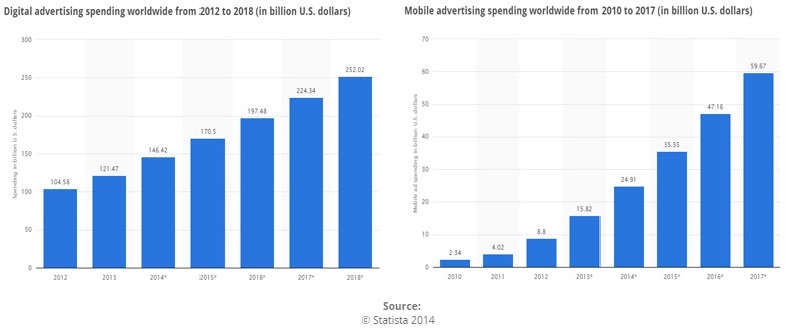
    igital_mobile-ad-spending

    Comparing the above two spending, it is apparent that mobile advertising is still in its infancy. But that doesn’t mean that the mobile Internet users are a minority, anymore. For the first time since Internet was conceptualized, mobile internet users have actually overtaken non-mobile internet users. This gap will only widen in the days and years to come.

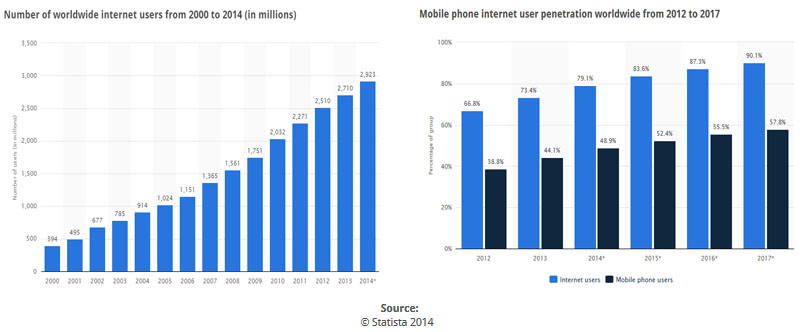
    internet_mobile-internet-penetration

    The above charts show a comparison of number of mobile ‘Internet users‘ vs. the total number of ‘Mobile phone users‘. The mobile Internet users’ statistics can no longer be ignored. Digital marketers not having a mobile marketing strategy will feel the heat, come 2015.

     A Peek into the Mobile Internet Paradigm

    Having a mobile-friendly version of all your online assets, be it demos, applications, sales materials, communications, et al is no longer optional. It is critical. People use the Internet for not just checking emails and catching up with friends on social networking sites but also to research about products and services. As a B2B digital marketer, it is high time you realize that your target audience is making influential business decisions while on the move.

    You cannot have a mobile marketing strategy just as an add-on to your overall digital marketing strategy. You need to deliver top-notch mobile experience at all times. Have a mobile-first strategy for marketing, sales, advertising, SEO, CRM and such other things in order to stay ahead of the curve in 2015 and beyond.

    How will the mobile form factor shape your advertising strategy in 2015 and beyond? Do let us know.

    Contact us now for a targeted mobile advertising campaign.