Tag: CTR

  • How to Write a Killer Ad Copy That Actually Sells

    We live in a world full of enticing propositions. As a digital marketer garnering the undivided attention of your customers is a challenge. The online arena is a complete world within itself where attention spans are shrinking and novel ideas come in all shapes and sizes.

    What the digital world lacks in attention spans, it makes up for with more focused advertising. Pay Per Click (PPC) advertising is a very targeted form of advertising. Your audience is already primed to buy or wants to know more about the product that you are selling for purchase at a future date. This makes PPC advertising more predictable and you pay the search engine only when somebody clicks on your ad copy. So as a digital marketer you need to make the best of this chance to win over your customers.

    Writing ad copy within the character limits set by the search engine giants however needs practice. The online market is very lucrative and everybody is vying for the same target audience. Then how do you differentiate yourself from the competitor? It’s a tall order but is achievable if you stick to some fundamentals of writing a ‘killer ad copy’.

    • Understand the Audience
    • Use a Psychological Trigger
    • Use Keywords
    • Use Prices & Promotions
    • Use a Strong CTA
    • Differentiate
    • Make it Relevant to Landing Page.
    • Filter Clicks
    • Make it a Continual Process of Testing & Refining.

    Pointers for a Great Ad Copy

    You need to make the most of the character limit that is standardized by search engines. Using the keywords wherever possible makes a crucial difference. Keywords are easily identifiable and are tagged by the search engines. Keywords that are highlighted in the ad copy give you better visibility and improve click through rates.

    Use of trigger words like ‘you’, ‘free’, ‘cheap’ are bound to garner your ad copy more attention. Every purchase is innately perceived with risks but more so in the online world where there is no touch-and-feel factor that we are so used to in the brick and mortar world. Hence, use reassuring words that can soothe your customers and assuage their anxieties.

    Use qualifiers wherever possible in order to give people a better idea of what you are selling and in the process discouraging people who don’t qualify from clicking your ads. Differentiate yourself from the competition by highlighting your unique value proposition. It could be some great offer or something that can add value to your ad copy in a way that can give you the edge over your competitors. Your ad should be in consonance with the landing page that you are going to use to convert your impressions to sales.

    Ask questions in your ad copy wherever possible. This gets the audience more involved. A question with the word ‘you’ is bound to earn your ad copy more attention. People feel you are directly addressing them and that it is not just a phony attempt of enticing people. It makes an emotional connect and people are more likely to buy from you if they are emotionally driven to want your product.

    A Process of Constant Evolution & Improvement:

    Remember ad writing is not a onetime process. You need to continually monitor the status and tweak the ad copy depending on what works and what doesn’t. Hence, you need to have more than one ad copies so that you can always split test and improve your chances of getting better leads. Track your performance using analytics tools available online, the chief being Google Analytics, and incorporate the feedback to get better click through rates.

    Now you might think that the character constraint set by the search engines is stymieing your creativity, but the fact is that people might not even read your entire ad copy. They might just be scanning for some trigger words and your ad copy better have it if you want to convert to sales. You cannot escape the fact that people today are always in a hurry and do not have the luxury of time to look at your ads at leisure. You need to constantly improvise, adapt and overcome in this new era of digital marketing.

    It’s a brave new world out there with ever-changing rules. But you can still conquer it with a killer ad copy.


  • How to Improve Organic CTR – does your SEO take care of this?

    What is the best ROI that you can get through SEO campaigns? How do you know the end results that can be derived from SEO?

    Is it engagement, traffic, brand building and reputation management? Or is it simply lead generation?

    How do you know the end results that can be derived from SEO?                                                                                                                                                                                                 

    You need to keep some best practices in mind while generating higher ROI vs. KPIs with SEO.

    Search engines are vital in fulfilling the ‘intent’ of finding information. SEO efforts cannot be directly tied to the final purchase of products and services like paid media/advertising. Constant and dynamic updates are made every day by search engines, making it more difficult for marketers to understand it.

    The basic rules are simple and straight: stick to the ‘intent of doing good for users’.

    Users come first and then the search engines. In fact, the very foundation of success of search engines is users. Search engines want to serve the best information to their audience. The concept of optimizing content for a visitor plays a very vital role for the marketers.

    Boost Organic CTR

    Here are few tips on how you can boost organic CTR for your website and also within the internal web pages:

    1. Focus on people and consider the latest technology as support

    People are our ultimate target audience. Users/searchers use technology to attain their goals.

    Online marketers should not forget that technology is user-driven. Focus on people and consider the latest technology as support

    Tips:

    • We need to think and adapt to what the users want and need and not the search engines.
    • Get to know your audience – conduct offline and online market research. Their feedback will be useful for your success.
    • Develop strategies around human beings (target audience) and deploy them to balance both target audience and search engines.                                 Image source

    2. Keyword Research and Mapping

    Let’s start with the basics. It is important that we have all the right keywords mapped to the right content.

    Keyword research and mapping                                                                                                                                                                                     Image source

    In other words, keywords should develop out of content and not otherwise. Combine long tail keywords and conversational keywords for balanced conversions. This increases conversions on the website with better targeted content.

    Tips:

    • With the keyword level data vanishing from Google Analytics (‘not provided’), you need to benchmark page level metrics such as KPIs for your success (page level: traffic, engagement, bounce rate, new visits, etc.).
    • With unique keywords mapped to each page, track performance of the page level traffic to mark success.
    • Have a content strategy around conversational keyword targeting (with natural language understanding) that includes blogs, forums, etc.

    3. Search Engine Results Page (SERP) Ranking

    Your SERP Ranking is an indicator of a certain level of success of your SEO efforts. But it is not the complete picture. Your SERP ranking is an indicator of a certain level of success of your SEO efforts

    We need to remember that organic rankings on Page 1 are just indicators of doing the right optimization. You need an SEO strategy that is defined better to consider these as success parameters.

    However, when your audience is finding information on search engines, it is important that you hit the sweet spot on the first page of Google. In short, ranking between 1st and 10th on Google Page 1 does matter. However, rankings above the fold (the part of the screen visible without scroll; usually rankings 1-4) have more visibility; have higher CTR and direct more traffic to the website.

    In other words, higher the rankings on search engines, higher the probability of directing relevant traffic to the website and hence conversions.  Image source

    Tips:

    • Make sure your basic SEO and technical parameters are in place.
    • Move inch by inch. Have a detailed plan to test out your SEO strategies, both short and long-term. Create content accordingly.
    • Remember to create content for your target audience and not search engines. Analyze your audience’s wants and needs.

    4. Title Tag

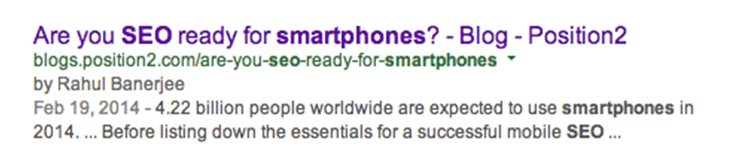
    The title tag describes the theme page in short and appears as a blue link on SERPs. These appear when a searcher types in a query to find information on search engines.

    A page title catches attention and influences the searchers to click on the link to your page. A well-defined page title has higher CTR on SERPs.

    Are you SEO ready for smartphonesTips:

    • Make your page title as natural, relevant and attractive as possible so that the target audience is compelled to click.
    • Include your target keywords to impact organic rankings.
    • Keep the title within 65 characters.

    Make it simple, short, interesting and natural to increase search inquest.

    5. Meta Description

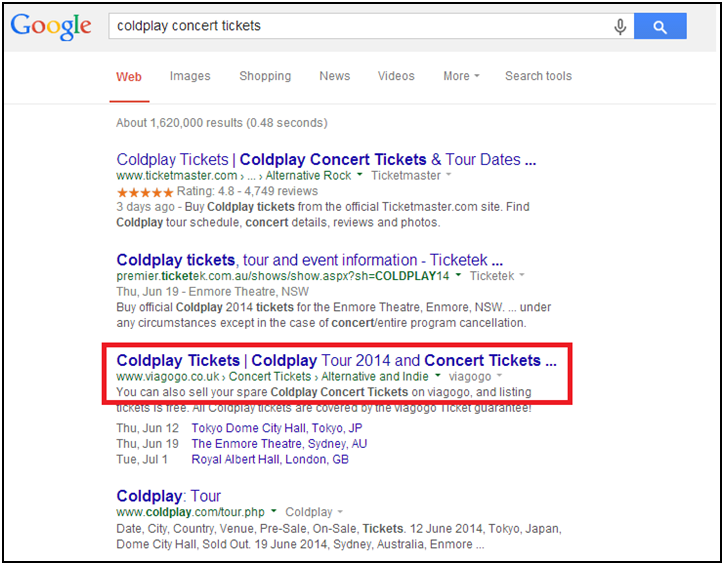
    While the meta title gives an idea about the page users see on SERPs, meta descriptions help the audience understand what the web page content is about before they actually reach it. While search engines consider meta descriptions as ranking factors, when constructed well, they also influence searchers to click. You need to briefly describe what the page is offering.

    Tips:

    • Use it tactically. Have an objective for defining your webpage.
    • Keep it natural and understandable for your target audience. Include keywords that snag users’ attention and lead to chances of higher CTR.
    • Maintain the optimal character limits for the descriptions. It should be around 150-160 characters with spaces. Write what markets the unique content of the page. Include USPs, value adds, discounts and offers.
    • Meta descriptions are indicative of the page theme and may not show in the SERPs. Google also uses other publicly available sources of authority like Wikipedia to show relevant results. So, have a content marketing plan along with website optimization.

    6. URL Optimization

    The best approach is to frame URLs for people that are crisp, easy to read and remember.

    Clear and concise URLs on SERPs reassure readers that a page will deliver on their search and enable better CTRs.

    URL optimization

    7. Rich Snippets (Structured Data Markup)

    a) On-page markup using Schema

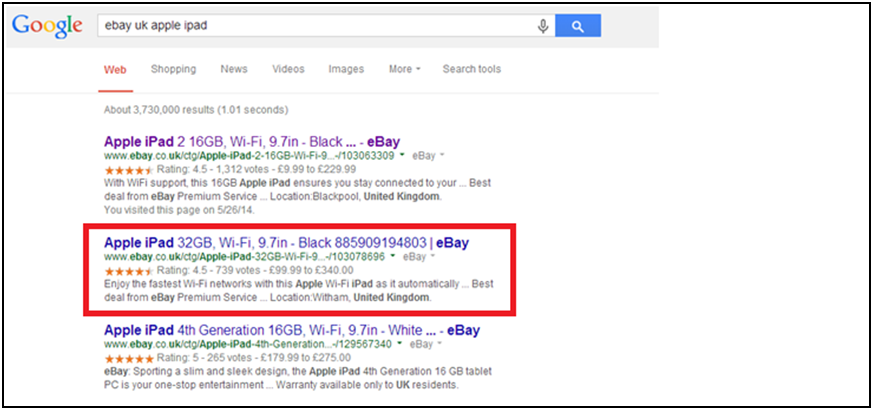
    Inclusion of Schema markup enables search engines to understand and categorize unstructured data on web pages. This helps provide richer search results and makes it easier for users to find relevant information on the SERPs thereby driving better CTRs.

    On-page markup using schema

    Customer rating markup on a product page: Improves credibility of the product leading to better CTRs.

    b) Google Authorship markup

    Linking the content of the author with his/her Google+ profile enables a headshot of the author to appear next to the search listing. This leads to better CTRs for blog posts and articles from SERPs.

    Google authorship markup

    8. Call-to-Action (CTA) – Visibility

    Apart from techniques to increase CTR through search, the final touch should be well-judged placements of CTAs on the website. This would increase the probability of CTRs and hence, conversions on the website. Call to action

    As mentioned earlier, it is necessary to rank above to fold in search engines and have CTAs (buttons, forms, etc.) above the fold.

    Call to action

    Call to action     Tips:

    • Test the important pages of the website, the home page, products and solutions pages with Heat Map. Monitor your audience’s movements on your website pages. Then place the CTAs accordingly.
    • Competitive analysis tells you how your competition is doing. Draw inputs through the comparison.
    • Work on your website design based on your budget and look to improve user experience.

    Contributed by Rahul Banerjee – Head SEO, Position2