Tag: Cross Channel Marketing

  • Mobile World Congress 2015 – Mobile Advertising

    For the first time the Mobile World Congress (MWC), which just wound up in Barcelona in early March, anointed mobile marketing and advertising as a standalone entity. Talks were given that highlighted the finest work in mobile advertising. And a lot of new trends and technologies that will have a major impact on the mobile landscape took center stage.

    Mobile Marketer’s Takeaway

    Some of the important points for the mobile marketer to consider:

    1. The rise of social media
    2. The inevitable fragmentation of social attention
    3. How cross-channel attribution demands more attention
    4. The emphasis on data-driven creativity

    1. The Rise of Social Media

    In a world where more people own cell phones than toothbrushes, most major social platforms have transitioned to the mobile platform. Mobile ads now account for 69% of advertising revenue for Facebook. Tools like Facebook Atlas emerge. It targets people across multiple devices to support people-based marketing campaigns. It’s a customer tracking tool that does not rely on cookies and finds a lot of use in mobile advertising. This is a radical shift that paves the way for a holistic mobile marketing experience.
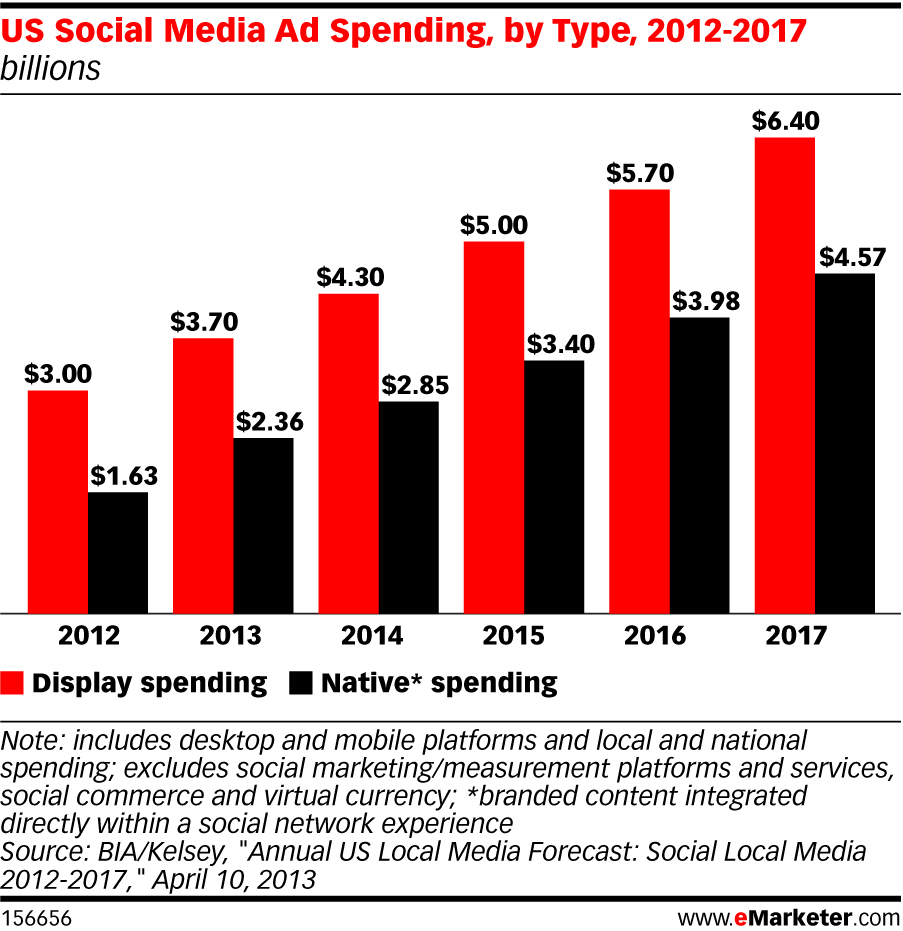
    US-Social-Media-Ad-Spending-2012-2017

    2. The inevitable fragmentation of social attention

    The breakneck speed at which the social landscape expands and proliferates has given rise to dedicated messaging apps. As a consequence, dark social (which is social sharing that can’t be tracked using web analytics, because sharers are sending content off the social platform via email or IM, for example),  may account for as much as 70% of social sharing on the Internet today. This is a challenge Mobile marketers need to size up and understand. Truly knowing what users are talking on social platforms supports better targeting.
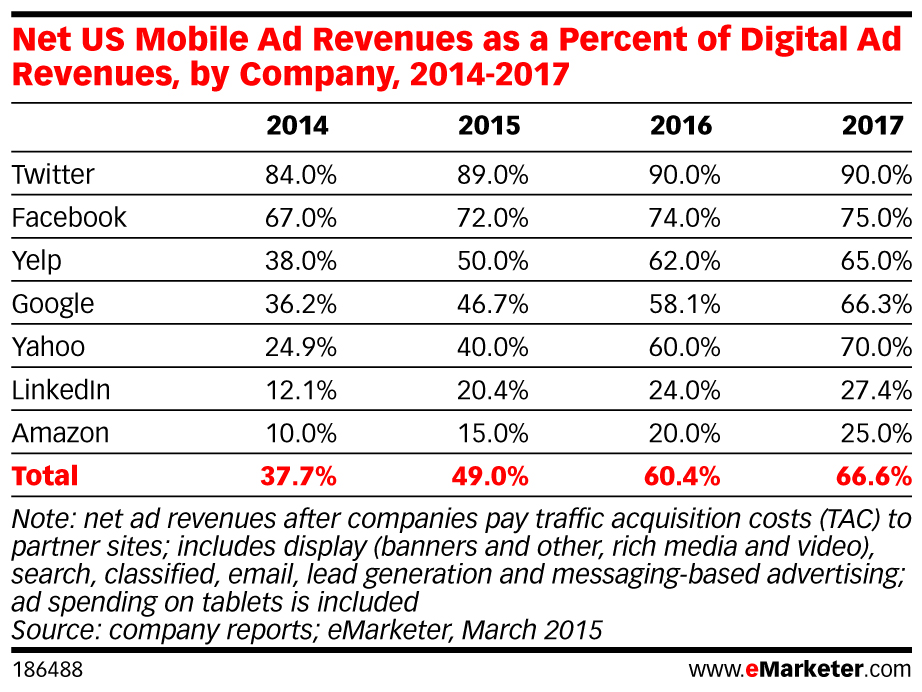
    Net-US-Mobile-Ad-Revenues-as-a-Percent_of-Digital-Ad-Revenues-by-Company-2014-2017

    3. Cross-channel attribution

    Cross-channel attribution uses advanced analytics to track various marketing touch points across channels. US adults have an average of three connected devices and they all offer crumbs of data from the channels. Consumers today easily switch between devices. They might browse and add a product to the shopping cart on a smartphone. When they switch to their desktop they expect the same shopping cart with all the history to be carried across, seamlessly.

    It’s imperative that brands and companies ensure a fluid online journey that is commensurate with what the customer needs. That is the only way for digital marketers to aid conversions, establish customer satisfaction, and ascertain return visits.

    4. Data Driven Creativity

    Data-driven creativity meets programmatic buying to deliver a 360 degree customer experience. It’s the new world of the buying and selling of media in an automated, data-driven way.
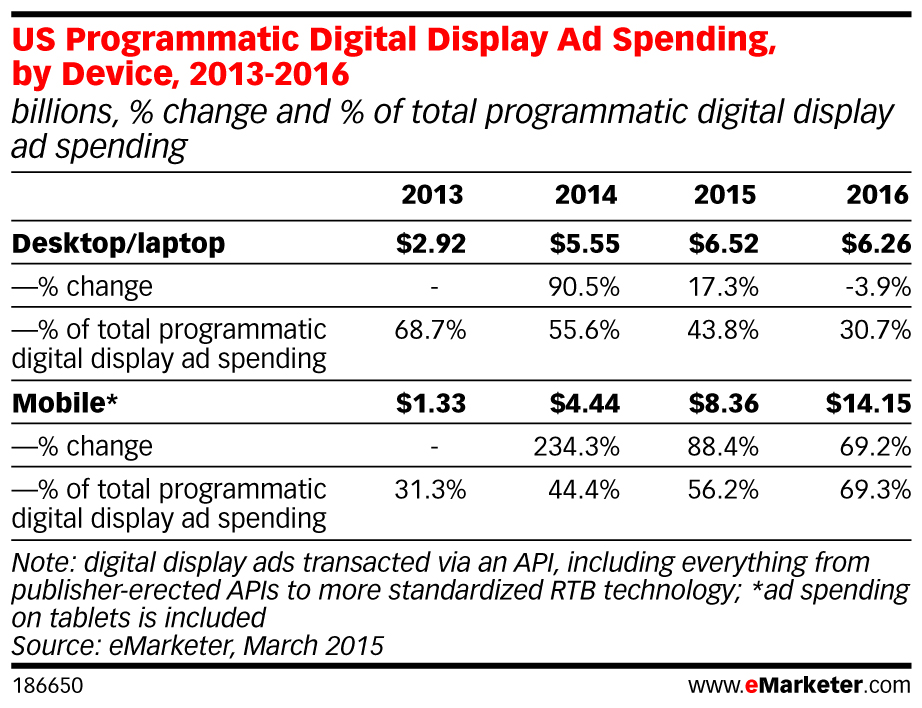
     US-Programmatic-Digital-Display-Ad-Spending-by-Device-2013-2016

    It makes it possible to deliver personalized ad messaging on a massive scale, an experience that is in sync with the customer’s needs, thus ensuring a deeper brand engagement.

    Share your thoughts on the just concluded Mobile World Congress 2015!

    Contact Position² to deploy a ‘mobile first’ marketing strategy for your B2B brand now!

  • 6 Important ‘Must Haves’ for a Successful Personalization Strategy

    Personalization strategy

    Personalization is a major focus area for digital marketers with mobile, cross channel marketing and marketing automation. According to a recent study, one-third of marketers said that personalization will be a key component in the future.

    Customers have a lot of information on products with less time to focus and decide. So, it makes sense for marketers to deliver a marketing experience that’s personalized and relevant. This means personalized messages, offers, products, communication and more.

    We have already written about the importance of personalization, not just in generic marketing, but also in cross channel marketing. Cross channel marketing is closely tied to personalization because of the changes in the way users are doing product research today (read on for more on this).

    Now, for the ‘must have’s’…

    • Audience Segments

    The way you have segmented your target audience plays a vital role in formulating your personalization strategy.

    Your target audience comprises of several different aspects, each of which plays a role in determining marketing effectiveness. Identifying each of these aspects and tailoring them to suit your audience is at the heart of personalized marketing. The more granular your understanding and the more personalized your approach, the more effective your marketing will be.

    For example, your customers may come from different regions – the US, Canada, France etc. and personalizing your marketing to cater to different languages and cultures can increase ROI. From within the same market, different individuals may have different information needs. Knowing what each individual in your audience wants enables successful personalization.

    • Prospect/Customer Data

    Data is central to understanding an audience. A robust and comprehensive database of prospects/ customers is extremely important while preparing a personalization strategy. Marketers recognize this – recent eMarketer research shows that marketers are increasing their efforts to gather customer data. Marketers also are broadening the boundaries of their data collection. Working without data makes marketing ineffective.

    Every bit of data can help fine tune personalization further. So, it’s important to meticulously gather information on a variety of aspects such as:

    • Demographics and zip codes
    • Loyalty membership
    • Device/s used
    • Referral sources such as websites, social network sites, ads, email campaigns etc.
    • Keyword referral data
    • Site search data
    • Past browsing and purchase history
    • Email campaign responses

    For example, using techniques like geo-targeting, you will be able to target prospects with offers personalized to their location. Add tracking codes on your website that allow you to follow prospect trails through your website and gather information about prospects’ likes and habits.

    Prospects have a plethora of channels at their disposal today and they use all of them for product research. Tracking prospects can help you follow the digital footprints they leave through channels they use. In the hands of a savvy marketer, these footprints are like gold nuggets!

    If you analyze your business’s data, you will spot many opportunities for personalization. The more relevant data you get, the greater the likelihood of fine tuning your personalization.

    • Prospect/Customer Journeys

    The customer journey offers many important cues for personalization especially in terms of personalizing information and offers.

    You want the customer journey to be smooth and quick but that doesn’t happen often. Understanding who gets stuck and where and for what reasons – this forms the basis for developing an appropriate personalization strategy. You may need to repurpose your content or develop fresh content to help the prospect get over his information road blocks or even reconfigure your offers to make him get over his inertia.

    • Personalization Technologies

    Before implementing your personalization strategy, you need to check if your technological capabilities match your strategy requirements. If you aim to collect prospect/customer data such as those mentioned above, you need to ensure that your website and marketing campaigns use technology and tools that enable collection and unification of such data. Infrastructure normally follows ambition. So, once you know your destination, you can acquire the appropriate technologies in a phased manner corresponding with your marketing readiness.

    • Strategy Cost

    Keep a close eye on the cost of building and implementing your personalization strategy. Some tools and technologies required can cost a lot. Build a basic personalization strategy that fits your budget and then make changes or retain the same depending on the availability of funds. As mentioned in the earlier point – set a high ambition in terms of where you want to reach in personalization, but get there based on what’s possible.

    • Product Suite/Service Offerings

    Your product/service spread determines your brand’s relevance to your audience. There will be people with diverse tastes and preferences in your target audience. While it’s not possible to have products for each one of them, the more relevant products you have, the more relevant you will be to individuals in your audience. This helps a lot of customers migrate across products as their requirements evolve or prospects to try out an entry level model. It’s this relevance that can lead to higher effectiveness.

    Personalization is an integrated process of constant fine tuning. You can keep adding dimensions and improve on what you are doing, but these 6 pointers should set you firmly down the road to success.

    Are there any other important pointers to consider while putting together a personalization strategy? Let us know through your comments below!

  • Implementing Cross-Channel Personalization

    How to implement cross channel personalization

    Personalization is the name of the game.

    Whether it’s for your email campaigns or your website, personalization is an essential ingredient. Now that cross-channel campaigns are gaining popularity, it’s logical that one applies personalization across channels.

    Revisiting cross-channel marketing

    Cross-channel marketing refers to the practice of integrating marketing campaigns that are being run across different channels. This means making sure your website, email and social campaigns are talking to the same person in the same way.

    Getting down to business…

    The Need for Personalization in Cross-channel Marketing

    As you would have noticed in our blog posts, we’ve been talking about how consumer attention today is getting divided between multiple media. This is necessitating marketing communication to be sent through different platforms. Every channel has unique characteristics and lends itself to a specific style of messaging. This often leads to inconsistent messaging in terms of tone and manner and occasionally messaging that seems irrelevant.

    It is not easy to tailor your messages to suit each platform’s conditions and still capture audience attention. This is where personalization can come to your rescue. By personalizing cross-channel marketing, you tend to catch your prospects attention because the message is developed keeping in mind his interests, habits and other data you have picked up about him. It’s more relevant and therefore, more likely to strike home. Also, when you personalize your marketing, you stay with the prospect all through the communication cycle, otherwise the same brand may sound inconsistent or disconnected while talking to the same person at different stages of communication.

    Important Factors for Implementation of Cross-channel Personalization

    Identify available data

    Personalization is dependent on data. Brands have different types of data about customers stored in different sections of the company. Create a culture of company-wide appreciation of the importance of data. Collate all data into a single database, which can help build an integrated view of the customer and enable creation of personalization strategies. You will be well prepared for more possible scenarios and can build a robust analytics strategy for your cross-channel personalization efforts.

    Unify data sets

    Brands typically have different data sets about the same customer. There is often disconnect between offline and online data sets. Consolidating all the data against one customer ID helps get an integrated image of the customer. As the database gets richer in terms of data, different user personalities emerge, each with a set of homogenous customers. This enables segregation of customers into different segments from your core audience to less prominent yet important segments.

    Develop a connected profile across the customer journey

    Customer touch points are many: onsite behavior, email campaign offers & responses, display ads, search terms used, customer support conversations and social media interactions. You will also have data from on-site customer behavior, the transactions they conduct and data from references:

    • Device related factors – IP address, device type, browser details etc.
    • Onsite behavioral factors – Time spent on site, site paths followed, product interests etc.
    • Offline factors – CRM system used, brand loyalty, data from third parties etc.
    • Time related factors – Time of day during site visit/engagement, day of the week, frequency of visits etc.
    • Reference related factors – PPC ads, natural search, referring domain etc.

    All the above touch points are a part of the customer’s journey. Joining these dots will give you the big picture about the customer segment and specific cues about individuals’ profile.

    Stay consistent across channels

    Share the available profile data across all the channels that are a part of your cross channel personalization strategy. All your channels should carry the same message since they would be talking to the same customer depending on the channel the customer has chosen. If customers approach you through two different channels and see different offers, it will lead to confusion and indecision.

    Build engagement rules

    Establish rules that define engagement. Decide how you are going to engage customer profiles on different platforms. Have a plan in place that outlines your strategy after each customer engagement action on every platform. Base these campaign tactics on unique customer profiles.

    Implement personalization across touch points

    Provide personalized experiences for customers across various touch points. Coordinate these experiences by leveraging customer profiles and recommendations.

    Reporting and Analysis

    Generating reports and analyzing data will enable you to meet customer requirements better by optimizing your cross channel experiences. However, reporting and analysis can get complex due to the involvement of multiple channels. Knowing the end requirement from every channel can help you channelize the sub-points under every channel to drive towards that end need.

    Do you run cross-channel campaigns? What have you learned?

  • Measuring ROI in Cross-Channel Marketing

    How to measure Cross Channel Marketing

    Mobile, TV, mobile.

    Newspaper, TV, tablet.

    The combinations vary.

    People these days aren’t just consuming digital media but juggling content across platforms. They do not want to miss out on anything while doing everything that they want to do.

    Media multi-tasking has necessitated cross channel marketing and it is here to stay.

    So, what is cross channel marketing?

    Cross channel marketing is the integration of marketing campaigns across channels.

    So, marketers now need to plan their content strategies in such a way that they can target users across different channels. However, the needs of people differ with every channel. You may be able to keep up with changing needs but:

    • How do you measure campaign performance across channels with different parameters?
    • Can you take the right decisions about budget allocations with measurement data on such different parameters?

    A recent study by CMO Club and Visual IQ has revealed that only 1 in 5 CMOs are confident about their ability to quantify the impact of one channel on another and only 1 in 4 marketers think they can quantify the impact of offline and online channels. Due to the different ways in which people engage on different channels, marketers are finding it tough to collate and manage data.

    Here are a few pointers that can aid you in measuring campaign performance across channels on different parameters:

    • It is very important to know the parameters you can compare with each other and the ones you cannot. You need to predetermine the weightage of the various measurement parameters:
      • Should Facebook likes, Google+ ‘+1’, Pinterest re-pins and Instagram likes be categorized as a measure of basic interaction only? Do they have equal weightage?
      • Are LinkedIn shares and Twitter re-tweets to be rated as a superior level of engagement?
      • Are online video ad views and TV ads comparable because they both are ads in the same format?
      • Can you compare radio ads with other mainstream ads’ performance?
    • Based on your measurement data, make adjustments to your channel-wise budget allocation.
    • Invest more on channels that are better suited for you and so, yield more ROI. Pick out the best mix for your brand, keeping in mind your industry, budget, campaign aims and so forth. As per the above mentioned study, only 6.7% marketers think that they can determine the best touch point/channel mix for their brand.

    Using attribution models helps take the right decisions about budget allocations even with measurement data on different parameters. Attribution models assign credit to each channel depending on the time the marketing communication happened. For example, if you are using the ‘First Interaction’ attribution model and TV is your first point of contact, TV is where you should focus the most. Choose the attribution model best suited for you.

    • Do you think the first touch point/channel deserves all the credit?
    • Or, is it the last channel that is most important?
    • Check out these different attribution models:
      • First Interaction – This attribution model gives all credit to the first touch point/channel that started the marketing communication sequence.
      • Last Interaction – The last touch point before the conversion gets all the credit. According to the CMO Club and Visual IQ study, 47% marketers use this attribution model.
      • Linear – This model spreads the credit equally among all the channels irrespective of their position along the path to conversion.
      • Time Decay – The channel right before the conversion gets the most credit while the first touch point gets the least. As for the touch points in between, they get lower credits as the progression moves away from the conversion to the first channel.
      • Position Based – This model gives the first and last channels equal credit. The touch point in the middle gets the lowest credit. The other touch points get more credit as they get closer to the first and last touch points.

    Do you think anything else is important when measuring ROI for cross channel marketing?

    Image Source: skylinetradeshowtips