Quality Score (QS) is easily the most mysterious metric in Google AdWords. PPC gurus have passionately spoken about its importance. As digital marketers, we’re constantly working towards improving the QS of our keywords. Let’s take a look at how we worked on improving QS for a client who we’ve been servicing for three years.
The client’s selected keywords were of medium priority in terms of conversions, but had relatively low QS. The only way to get the best possible results from them was to improve their QS and lower CPCs.
How did we achieve this? The effort was twofold. The first and most important step was to ensure relevance between our ad copies, keywords, and LPs. We tested using the keyword in headlines and display URLs, and tailored landing pages to include the keywords.
The second step was to ensure that we were giving the keywords a chance to see a good CTR through a better average position. This was done by increasing bids for a few days.
One of our key phrases was “quick business funds.” The ad copy running at that time looked like this:
Business Funding
Get The Capital You Need Now.
Fast & Easy. Sign Up Online!
Xyz.com
As you can see, the messaging was generic. We then introduced ad copy that included the key phrase:
Quick business funds
Get The Capital You Need Now.
Fast & Easy. Sign Up Online!
Xyz.com
Did we notice an instant change in QS? No, but our patience and investments in CPC paid off. After a couple of months, we found that 11 out of 23 keywords had score improvements. The table below highlights the improvements in three of the tested keywords:
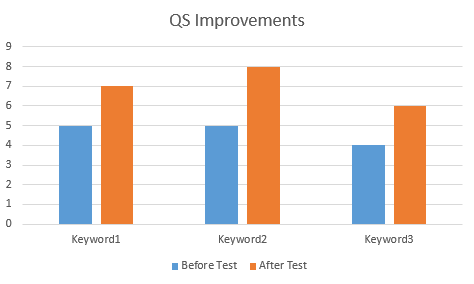 The improvements in QS had a positive impact on Average Positions, CTR, and Average CPC as you can see below. It’s important to mention that the bid prices for these keywords remained the same.

A combination of ad copy testing and bids brought about the improvements we were chasing. In due course of time, we found our average CPC dropping, marginally at first, but significantly in the case of expensive keywords.
The basis for such a strategy was to insert the keyword into the ad copy in a clever way. You’re often confronted by keywords that don’t directly speak to your product or service. But if these keywords can be highlighted with a unique perspective, there is a lot you can gain as a pay per click advertiser. For example, you’re offering just headphones for sale. Though you don’t offer earphones, keywords around that theme could be crucial for you. If you were to target a user with messaging such as “Why go for Earphones? Get more with Headphones”, you could possibly strike gold on Google. Your Quality Score is bound to increase for such keywords, provided your landing page offers the right experience.
In addition to this strategy, never underestimate the importance of Ad Extensions catered to the keyword. Google offers advertisers an array of ways to connect with a user, given that there is only so much one can do with 130 characters worth of ad copy. Using Sitelinks, Callouts, Snippets, and other extensions, there are many ways to achieve improved performance. Tailoring your extensions to a particular campaign, ad group, or even a keyword can help you boost Quality Score in unimaginable ways. The more relevance you earn, the more value you can obtain.