| This week’s hot news, events and videos from the online marketing and social media world. | ||||||||
 |
||||||||
 |
||||||||
|
||||||||
|
||||||||
| If you are reading this blog post via a RSS reader, please click here to subscribe. |
Tag: conversions
-
Best of the Week | Web Design Trends for 2015, and much more…
-
View-through Conversions
You are as likely to click on a website immediately on seeing a banner ad as much as you would walk immediately into a store on seeing an attractive out-of-home display ad. We are less inclined to stop what we are doing in order to respond to ads, be it online or when we are out in the city.
In the world of search marketing, click-through conversion is all that matters. Search, by its very nature, has a pre-qualified audience based on their intent to seek out information. Clicks reign supreme because ‘Clicks’ from search ads connect your brand with a sought after need.
On the other hand view-through conversions – VTCs (a.k.a post-impression conversions) happen when a person is exposed to a display advertisement, does not click, but goes on later to visit the website or search for the brand on search engines and converts. The driving force behind display advertisement is to create an influence. As a marketer we must endeavor to reach the right type of person, at the right time, at the right location and with an offer /service they simply cannot refuse. Even when all these factors are present in a precise way, a person might be inclined to click only when an impression is served and is compelled by what he sees in order to take some action. In display advertising, the ‘Impression’ still reigns supreme.
So that brings us to some interesting questions:
Q – Are VTCs just duplicates of the other conversions in the interface?
View-through conversions are not able to get the rightful credit mainly due to the way people view it in DSP buying. Many DSPs will group the VTCs along with the Click-through conversions while filling leads form thus giving a distorted figure. These DSPs will then promise a CPA model to the client which can only be fulfilled with the help of duplicated view-through conversions.
You can be on top of all such things by checking the validity of this metric:
- You have to run a split or A/B test campaign. For one group you need to show the banner ad and for the other show a PSA ad. You then have to find out the incremental conversions for the group that viewed the banner ads.
A/B Testing vs a Blank Ad

- You have to demand that the view-through conversions be shown separately from last click conversions. That way you can have the actual break down of the conversions.
- Based on the industry conversion duration norms, set a custom backtrack durations for view-through look ups. Do not take view-through conversions that are registered beyond the set conversion duration.
Q – What is the view-through conversion window?
A view-through conversion window reckons a conversion after an ad is viewed depending on the number of days that you allow for the conversion to happen. You can customize it as per your needs to only record a VTC if it happens within the window of time frame post ad view that you have selected. The shorter the ad window the more accurate is the result. A 24-hour window is very reliable since the stickiness factor will definitely influence the customer’s decision to click the ad. A 30 days ad window may or may not be so accurate which is again wholly dependent on the type of product or service that you are selling, sales cycle, industry, and other factors.
Q – Even if I believe that VTCs are valuable, how should I value them?
We have to get used to the fact that impressions are indeed influential. This needs a radical change in the mindset of marketers that strictly value ROI and CPA goals. Studies have shown that lift and influence are very real and give a fair amount of conversion rate improvement. If you look at the following table you will see that VTC does help.
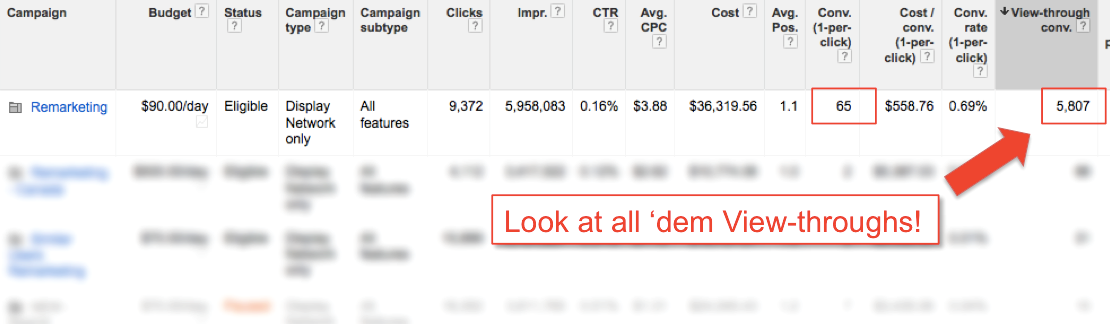
Influence of View-through conversion
Even if it is just a 10% improvement it still can make a difference. It could mean ratcheting up a good ROI to a great ROI. If you closely look at users clicking on your ads or otherwise you will surely see that they might not convert immediately. They can come back to your website later and convert. This is the overwhelming underpinning validation of view-through conversions. You can now measure the success of your display ad campaigns via the view-through conversion paradigm. Search engines like Google have taken cognizance of this and provide you insights into it so you get a holistic value of your display campaigns.
View-through conversions is a tracking metrics available in the AdWords account that can give you a clear understanding of your campaigns as it can measure assisted conversions. This happens when a user views your ad but comes back to it later, may be through another channel and converts into a customer.
Display advertising plays an important role in improving your digital marketing returns. Taking into account view-through conversions (VTC) can get you a comprehensive understanding of your efforts. It offers you a lifting effect of display advertising which hitherto you had no idea about. VTC helps to drive conversions even though it might not produce direct clicks. A visitor might return to your site via a bookmark, an organic listing or a regular URL and convert. You can then conclude that the original display ad did make a difference.
Now, we have a formula in order to find the efficacy of VTC that can help you reckon your digital ROI.
Actionable items
- Segregate you target group into two parts, 90% for brand and 10% as control group with no room for overlap.
- Use your Branded ads in the first campaign and PSA control ads for the second
- Run the ads for a conveniently long period to collate good amount of data
Compare results after normalizing the data

An Example
Impressions VTC Brand Ads 1,000,000 1000 PSA 800,000 720 We need to multiply the PSA campaign results by a factor of 1.25, to normalize the data
Impressions VTC Brand Ads 1,000,000 1000 PSA 1,000,000 900 Weighted VTC = (1000 – 900)/1000 = 10%
Result: One in ten VTC has indeed influenced someone to take action.
This is a holistic view of your digital return on investment. Most digital marketers might not be initially convinced of the benefits of VTC. In today’s world, people more often than not, are multitasking. So somebody might see your display ad while visiting some website at work. Now that somebody might not click immediately on that ad or even take any action at that point of time. Your ad might not even get due appreciation by the person. But the brain can register more than the eyes can see. So you might not get an immediate conversion for your display ads but that does not mean that your ad spend is completely wasted. It does create an impression and next time that person sees your ad he can immediately relate to it. There are more chances of conversion on that pay per click ad that you are going to serve him for his specific query. But then if you give 100% of the credit to the PPC ad, then it is not completely accurate. The initial display ad did have its own impact and all we say is that we now have a robust method to measure that impression leading to conversion called as view-through conversion.
This is a new frontier in a digital marketing world addicted to clicks and quick results. VTC is an avenue that you need to explore further in your quest for improved results for digital marketing dollars spent.
Let us know your views on View Through Conversions!
Contact us now to make your display ads go the extra mile for you!
-
Effective Ways of Measuring Your Content Marketing Efforts
Did you know that 92% of companies that blogged multiple times a day acquired customers via their blogs this year? It is time to take full advantage of this content marketing craze by reaching out to your customers with the right content.
The Rise of Content Marketing
All Google updates have led to one conclusion by SEO experts: Content is King. It all started in 2011, when the search query “content marketing” began its rising trend, and has now grown to be extremely common. Creating quality content for your business has major benefits for your search engine optimization, social media marketing, and your company’s overall branding.
What is Content Marketing?
Content Marketing is the new way to get higher search rankings and increased sales by creating useful, informative content that is appealing both to your target group and also to Google and other search engines. The motive is to attract, obtain and engage a clearly defined target audience in order to drive profitable customer interactions.
By answering the most frequently asked questions with respect to your content, your company can become the most credible resource for your domain and gain new leads that convert to customers in the long term.

Image Source: Iciweb
What types of content should you create?
If you are looking for opportunities to generate more results from your marketing efforts, you need to look at establishing a content marketing strategy. This Pyramid highlights a variety of different types of content that need to be taken into consideration:
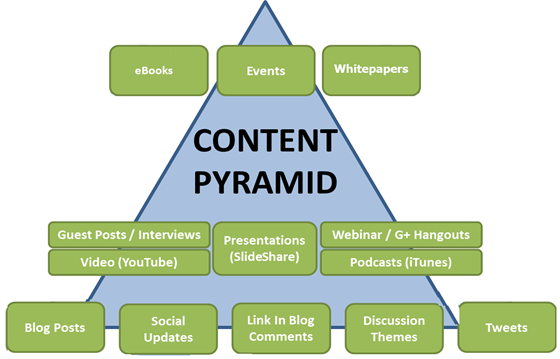
Content Marketing: Parts as a whole
- Creating Valuable Content: Content needs to be created for your audience with the objective of informing and educating them, by simultaneously boosting your credibility and connections with consumers. This can be done in the form of articles, eBooks, press releases, white papers, blogs, webinars, posts, infographics, etc.
- Distributing that Content: This unique content needs to be then shared with users through social networking websites, blogs, through e-mail marketing and other platforms where your viewers are active, provided your content is suitable for that particular platform. Once your content strategy has been recognized, metrics need to be defined in order to accurately measure and monitor your success.
Take a look at metrics to effectively measure the content marketing efforts:
- Brand Lift: “Brand lift” is the blanket term for a brand’s increase in customer or audience perception. This is a concept that has its roots in online advertising (brand advertising, to be more specific) and refers to an increased awareness of the brand (product, or contribution), attitude (view on quality, value and appeal), recall (ability to evoke), favorability (likelihood to recommend), and intent (likelihood to purchase)-all of which can be a challenge to measure.One way to measure the rise or fall in the sentiment of your brand in the long run is through social media. Once we have a plan in place, we create content that promotes your brand and conveys your expertise, distributing it over the right channels to ensure effective placement. When highly consumable content gets published in front of your target audience, you can begin to gain authority and thought leadership in your industry. Increased authority in your space not only helps to retain customers, but also generate awareness and trust in your brand. This creates an organic sales funnel that can dramatically increase conversions.Ultimately, this increased inbound traffic improves your overall branding.
- Social Media Success: This is a metric that allows you to better understand where the social traffic is coming from. By observing the gross amount of social media success, your business will be able to understand what type of content was well received, on what platforms and by which users. It also helps explain how these social actions are affecting your other marketing channels too.The “social media content” widget looks at how many “social actions” were taken while viewing your content. These can include:Interactions – Likes, Comments, Shares, Replies, Retweets, and so on.Reach – The percentage of fans that have seen your post from your page.Engagement Rates –A formula for quantifying a brand’s success.This is a valuable performance measure, as it displays that visitors didn’t just passively leave the web page open for an extent of time, or click through to other web pages because they were bored. It shows that they actually appreciated your content enough to share it within their network.
- Onsite Engagement and content effectiveness: Once traffic is driven to your website from the variety of content that has been distributed to your audiences, the hope is that this effort will drive repeat traffic to your web site. The metrics in Google Analytics helps measure whether the content you’re creating is engaging enough to draw traffic to your website from the search engines. This allows you to make two conclusions about those pieces of content that are attracting a lot of readers and giving you a lot of their time.Firstly, that content is building relationships by compelling readers to return. Secondly, that valuable content is creating an increase by facilitating repeat exposures.This is a valuable way of determining if your content marketing efforts are driving real value to your business. If your content efforts are often the most viewed part of your website, it might be safe to say that your audience is finding value and that you are educating them on a particular expertise.
- Google Analytics audience Widget: Google Analytics is a collection of widgets that allows you to quickly visualize your data. The audience related widgets on the Google Analytics dashboard provide information about viewers. The visitor’s pie chart gives an idea of the number of visitors that revisited the website because they found well optimized content in search engines.Some of these are:“Content behavior metrics” Helps to determine the number of new/revisiting users. Also helps to check whether the content you are creating is engaging enough to draw traffic to your website or not.“Site Content metrics effects” Shows the website’s ALL/ landing pages performance metrics which helps in determining which page content played an important role to get the visitors on the website.Lastly, “GEO metrics effects on content strategy” shows you where in the world your visitors are from. You can use this data to improve your content in all kinds of ways, such as:‘Visitor Language use’ helps in optimizing multi-language websites.‘Location area’: helps to determine the place / nearby places of the visitor, hence it can be helpful in optimization / filtering the content related to location.By using Google Analytics we can measure the content effectiveness using real data. It is always helpful to see what is effective and to avoid what is not.
- Lead Generation: One of the most valuable metrics to monitor when it comes to your content marketing efforts is if lead generation efforts have increased. Lead generation is important because leads are the most likely people to convert and make your business revenue grow. This is where we start determining whether the content marketing efforts are making financial sense.When a visitor signs up on a website, he/she enters his/her contact information to have access to exclusive content created by the company about business. This visitor is a new lead who can eventually become a paying customer. It is important to measure the rate at which leads are being generated from the website content to see what type of content is working to get more traction from your web visitors.Successful content solicits a certain response from your target audience. For instance, taking advantage of a special gift or promo being offered and filling up information sheets that converts visits into leads.
- Conversions: Consumption is the most basic and most measurable type of metric you can use to measure content marketing success. It is straightforward and deals with real figures and statistics. It states how many people actually consumed your content. Google Analytics, Website platforms and social media insights already have these tools available for you to use and the only thing left for you to do is use them and gain better insights about your content consumption. Content marketers and conversion optimization professionals have a glorious collaboration ahead.
- Thought Leadership: Content marketing can describe a business as being an expert or a thought leader in an industry which can lead to many invaluable benefits. Becoming a thought leader and a trusted source of information will gradually gain more traffic, follows, and subscriptions, leads, and conversions over time. Social signals get a boost when website owners refer your work and when social media followers share the content. Take a step back and observe the media mentions of your content, if other thought leaders refer to your content, if the media is requesting for your contribution on certain topics or requests the leaders to speak at business events.Look at how your content is performing and helping you to position your company as a thought leader. By becoming an industry known expert, your content could continue to gain more traffic, follows, subscriptions, leads, and conversions over time. Overall, there are several ways to measure the performance of content marketing strategies.What metrics does your organization use to measure your content marketing? How often are you analyzing the results of your content strategy? I’d love to hear about your experience with your content marketing strategy. Share your thoughts in the comments below!
Blog contributed by Anu Gupta, SEO Analyst, Position2
-
6 Tips for Conversion Rate Optimization
SEO is an important component of most companies’ online marketing investment. But good SEO is a job half done, because it only brings in prospects. To support your SEO, you need to run Conversion Rate Optimization (CRO) initiatives to see that the prospects you have brought in actually end up doing what you want them to do – buy from you, subscribe to your email newsletter, recommend friends to buy your product, share your content, etc.
Your website SEO will get you traffic. But that’s just the beginning. There is a lot to consider after that. For example:
- How relevant is that traffic?
- What are your conversion rates and how can they be improved?
- Is enough of your audience converting? If not, what can you do about it?
Here is a 6 step checklist that will help you in your CRO efforts:
1. Setting your objectives
It’s important to define your objectives. This is the basis for building your website to make your audience take actions that will help you achieve your objectives. Want them to buy? Set up an ecom store. Want them to leave their contact details? Provide a form for them to fill in. Align your website with your objectives.
2. Research
Effective CRO requires thorough research. Understanding your audience and their online behavior is crucial for conversions. If you know what they are looking for, what the drivers of their behavior are, then you know what you need to do to get conversions. It’s important to remember that research is a continuous process and its inputs help you fine tune your initiatives to keep conversions improving.
3. Understand your website and its effectiveness
This understanding will help build your web pages so that they contribute to more conversions. A conversion is the end result you want out of every site visit. It’s important that you determine what constitutes a conversion for you: product subscriptions, service sign-ups, collateral downloads/ subscriptions, enquiry calls etc.
The advantage is that everything that happens on your site can be tracked. This creates a wealth of data for you to analyze and see what’s working and what isn’t.
Record current statistics on number of site visits, bounce rates, conversion rates and amount of time spent on site. Mark up the landing pages that were visited the most. Nailing these details will give you a clear view of conversion goals for your website. Focus on strengthening those pages that are falling behind in contributing to conversions. The clearer the conversion goals are, the easier it is to turn traffic into conversions.
Outline your sales funnel by combining analytics, research and landing page optimization. You can visualize your sales pipeline better by knowing the landing pages that are performing the best.
4. Website design and layout
Designing your website and planning the layout is crucial in the plan to lead website visitors on the path towards conversions. Your website should guide the visitor’s journey to conversion. Interlink pages so that it is easier for visitors to move from one page to another. Your CRO strategy should include a plan for developing necessary collateral that will move website visitors from being a browser, to making a choice and finally to a buyer. Your CRO and landing page optimization practices should support improvement of conversion rates.
5. Testing
It’s important to test your pages and see which are working best. Testing has to be continuous because what works tends to change with time and the audience. You don’t want to be in a position where your pages are not working any longer and you don’t know it. There are two important kinds of tests you can run:
- A/B testing
Build multiple designs for entire web pages in need of conversion optimization and test them out. Monitor and note behavior on all designs you are testing. - Multivariate testing
Develop multiple new designs for selected elements on the web pages you are optimizing while considering the elements that interact with each other. Your website traffic will come across combinations of the elements you have targeted and you can record their actions.
6. Integrate social efforts
Your CRO strategy can start early – even before visitors come to your site. When you integrate social efforts with CRO, you know why your audience is visiting your site and your chances of conversion are much higher than otherwise. Your social media campaigns can prime your audience and bring them to your site, ready for conversion.
What do you think helps improve conversion rates? Have you worked on your CRO? Let us know.