Tag: comscore

  • Changing US smartphone dynamics: A by-the-numbers opportunity

    A quick look at comScore’s Q4 data spells out a digital marketing fact of life: It’s no longer a “mobile too” world out there. It’s all about “mobile first”.

    • United States smartphone penetration jumped to 76%
    • 3% of total US population now owns a smartphone
    • 84% of all US social media users access the platform via a mobile app or browser

    This does not presage the end of the desktop or the laptop. But it does underline, with data, that users want access to the Internet anytime, anywhere, with any device – but primarily with a smartphone.

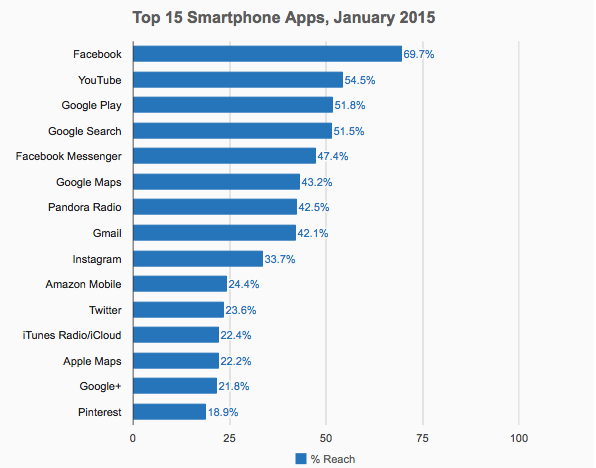
    And of that Internet usage? A lot of Facebook time, followed by You Tube. And making a first time appearance to the Top 15 Smartphone Apps list: Pinterest.

    What are people doing on their smartphones?

    mobile-usage-stats-applications

    Image Source

    Social networking, watching videos, searching for information, messaging, accessing email are all top activities on the smartphone. This spells opportunity for digital marketers, and the platforms know it. Facebook has made advertising easier to its massive, lucrative audience thanks to the mobile app it recently released to manage your ads. Twitter, with a 23.6% share, has improved ad campaign tracking tools, giving you a new and better way to manage your Twitter ads.

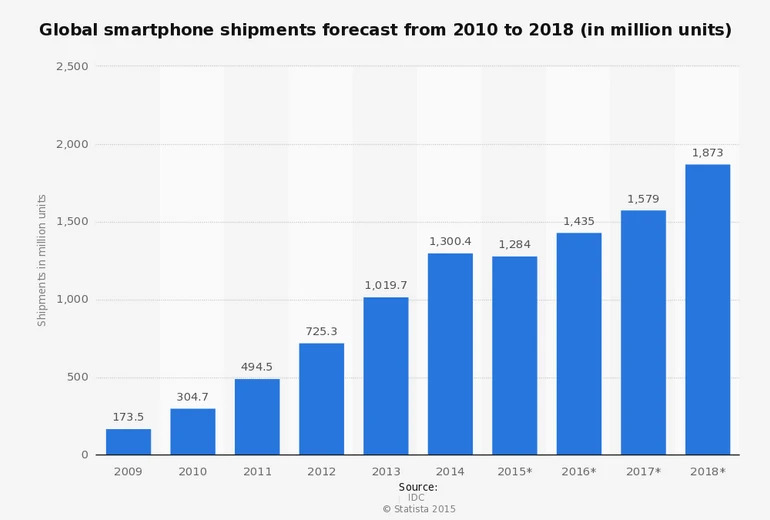
    Smartphone sales are going one way – Up

    global-smartphone-shipments-forecast-2010-2018

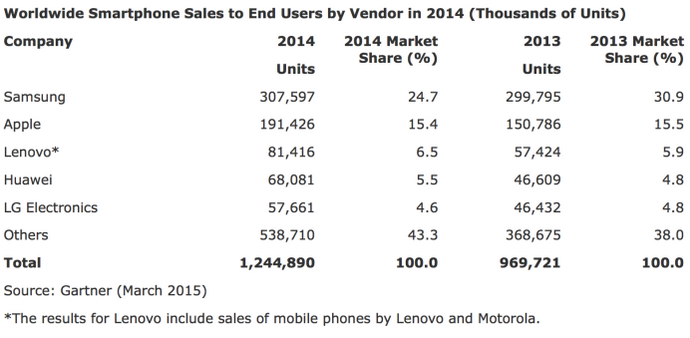
    Of the 1 billion+ smartphones sold worldwide in 2014, Samsung lead the pack. Apple, on the other hand, cornered nearly 90% of the global smartphone profits.

    Here is a breakdown by brand of worldwide smartphone sales in 2014:

    smartphone-sales-to-end-user-statistics

    As smartphone dynamics change so too must your digital marketing campaigns. Mobile centric is the way to go. It’s all in the numbers.

    Contact Position² for all your media and advertising needs targeted towards your mobile customer!

  • UI and UX Trends in 2015

    Digital marketing has been trending for a couple of years, and now it’s in constant flux.  In 2014, we saw changes in mobile, HTML 5, scrolling, micro UX, flat UI and all time design principles.

    user-experience

    What’s likely in 2015?

    Responsive Design:

    According to comScore Report, smartphones and tablets account for 60% of all online transactions. Mobile devices and mobile apps currently drive 50% of traffic, and Cisco Systems forecasts that by 2018  the number will rise to more than 75% of traffic.

    In recent months, there has been an increase in the number of sites designed with mobile app-like  navigation, this as opposed to the traditional desktop navigation bars with several drop-down menus that are toggled when rendered on small screen devices.

    Today there is a need to design for the mobile form factor and your desktop version should be mobile friendly as well. Mobile ubiquity is the new mantra, not mobile-first. Designing for the mobile platform forces designers to streamline their web content according to user needs. Mobile was the platform that made digital marketers first listen to the users, and now the market has responded with “give me that for the desktop, too!”

    In 2015 and beyond, the mobile ubiquitous trend will continue to grow. Navigation will continue to simplify with fixed headers and minimalist design reducing clicks and clutter. Visitors are attracted to easy-to-use sites that allow them to quickly find what they’re looking. But don’t give up on visual appeal! Users still want to be dazzled by stunning visual elements.

    Long Scroll

    Scrolling is still predicted to dominate clicking in the future – simply because it works best in the mobile environment. It is easy and intuitive to use. It improves user experience. It limits the load time of the page with more interactive kinds of experience that users can have with the website.

    Flat Design

    No more patterns, shadows, gradients or bubbles. Now’s the time to embrace the simplicity of the flat design. It channels the key trend in recent web design – invincible minimalism. Perfect for all kinds of hand held devices, flat user interfaces provide a smooth and uncluttered page structure. Google engineered their future on mobile with a flat design or material design based on metaphors, bold graphics and meaningful motion. This could easily become a new trend in the already prominent flat design.

    Videos

    Users are looking to be entertained and large blocks of text are not the best way to do that. Video is easier, cost effective to produce and a great way to quickly deliver a message. There’s a science behind it. Our brain processes visuals more rapidly than other forms of information. By using video, even as a background element, you can highlight your core strengths and services to make an impact in a matter of seconds.

    Personalization of UX

    Showing users relevant content will improve their overall experience with your website. That’s why we all use cookies. But the ways in which we do it will change in 2015 to create a sense of continuity. Brands will use the recently read or visited functionality to render their websites more familiar and relevant. Knowing the user’s activity on your website, you can also try to propose some new content for his or her consideration, and cookies can help you do  it.

    These are some of the trends that can be expected in 2015 — that render to UI & UX.

    Get in touch with us to get your website optimized based on UI & UX now!
  • Yahoo Market Share Rises after Mozilla Deal!

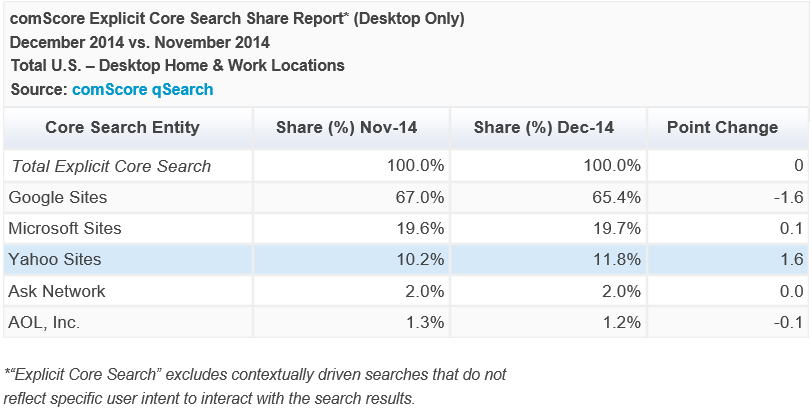
    Yahoo had got into an exclusive agreement with Mozilla in November 2014. As per this deal, Yahoo became the default search engine for Mozilla PC and mobile browsers. This was a “strategic five-year partnership” and as part of the deal, Yahoo started offering enhanced search experiences. Yahoo featured a clear, modern and immersive design with inputs from the Mozilla team.

    yahoo_market_share_rise

    Source

    This deal seems to have paid Yahoo rich dividends. This is clearly evident in the latest comScore released for US desktop search engine rankings. As per this data, Yahoo has seen an increase of 1.6% in US desktop search market for the month of December. This is the first month since the five year partnership with Mozilla came into effect. Unsurprisingly this comes at the cost of Google which saw a decline of 1.6% of its market share. Any rise of more than 1% is significant for Yahoo, considering the vice-like grip that the numero uno search engine Google has on the US online search market. This is Yahoo’s highest market share since 2009 for the United States.

    How do you view Yahoo’s ascent in the online search market share!

    Contact us for enhanced search engine optimization of your website now!

  • Google Joins Hands with comScore for Real-Time Ad Measurement

    Google

    A few months ago, Google opened its doors to Nielsen to place measurement tags on YouTube ads. This move was to help marketers get a better handle on the performance of their video ads and also increase the credibility of Google’s ad ROI data.

    Advertisers take many factors into consideration when it comes to choosing a website to advertise on. Quality and accountability are two main factors and Google is working on delivering both of these.

    comScore is no stranger to Google. It was one of their first partners in the area of audience measurement through application of its Validated Campaign Essentials (vCE) solution on YouTube.

    And now, in an effort to draw more marketers into buying ads, Google has signed a new deal with comScore. This deal will allow real-time ad performance measurement in different formats, across the web on Google’s DoubleClick ad server.

    Here are a few important aspects you should know about the deal:

    • comScore’s vCE solution will be integrated with Google’s DoubleClick ad server.
    • This multi-year Google deal with comScore covers measurement of display ads, video ads and ads on mobile devices.
    • You can also measure ad performance across websites and device screen sizes.

    The main advantages of this development are:

    • This allows for real-time measurement of ads and delivery of insights.
    • This will help manage campaign spends better, with increased investment in campaigns that deliver and withdrawal of funds from those that don’t.
    • Marketers will be able to access more data about people who are exposed to their ads and learn about their interests.
    • This insight into audiences can help in fine tuning retargeting campaigns later.
    • Makes the Google ad offering more complete with credible ROI data.
    • It makes cross-screen metric measurement easier with its ability to monitor ads on multiple screen sizes.
    • This development comes at a time when there is greater emphasis on video marketing and display ads.
    • It allows marketers to use these powerful tools, knowing well that they have appropriate measurement tools.

    Initially, these capabilities will be available in the US for desktop-based display and video ads. It will be expanded to include mobile devices and cross-platform measurement later.

    With this development, Google has shown that, though late, they do listen to marketers and work on making advertising on their network beneficial for the latter.

    What do you think of this Google-comScore tie-up? Do you think it will deliver all that it is promising and entice more marketers to buy ads?

    Image Courtesy: Campaign India