Tag: Branding

  • Which Social Media Sites are B2B Buyers Using?

    Social media has had a huge influence on the way we live and work. For marketers, social media has allowed brands to start conversations practically in real time. It allows any business to engage with its audience in ways that were simply not possible 10 years ago. The ripple effect is felt across both B2C and B2B marketing.

    The social landscape is continuously evolving, and different platforms offer different—and changing—opportunities. But regardless of which platforms brands choose to use in their campaigns, social media will be one of the most affordable and effective methods at their disposal.

    Whatever the size of your business, you can tap into its potential and achieve impressive results—and social media’s influence on B2B purchases should not be underestimated.

    Who’s on social media in 2016?

    Social networks attract users of all ages, from all demographics across the globe.

    The number of young adults on social media has increased massively over the last decade. In 2005, around 12 per cent of this age group used social channels. Today, the figure is 90 per cent. When we talk about ‘young adults’, we’re essentially talking about tomorrow’s IT leaders. While some of these individuals are graduates, many are already making important brand decisions.

    The figures are significant for older internet users too. In the US, around two-thirds of the adult population uses one or more social networking sites, compared to 5 per cent 10 years ago.

    This cross-generational change has sent shock-waves through practically every sector. We all get our breaking news from Twitter, share memories on Instagram, and keep in touch with family through Facebook. In order to communicate with customers and service users, businesses have had to modernize their approach and get involved in this socially connected world.

    Why businesses must take note of social media

    Facebook is arguably the world’s best-known social network, with more than 1.4 billion active monthly users. 70 per cent of marketers use Facebook to generate more customers, and success is particularly pronounced in B2C marketing campaigns.

    Let’s not forget LinkedIn, which is responsible for more than 80 per cent of social media leads in business. Twitter is used by just over one-third of marketers, while Pinterest and Instagram have 20 million and 150 million active monthly users respectively, and offer great potential in the creative sectors, from home wares to fashion and beyond.

    So, what do businesses actually stand to gain?

    Increased brand awareness

    Social media is important in keeping a brand top-of-mind for a consumer. 37 per cent of internet users follow their favorite brands on social media, while 30 per cent use social networks when researching a purchase.

    Better consumer targeting

    Social media opens up two-way conversations, and gives you insight into the things your customers care about.

    Enhanced customer service

    Your customers are increasingly savvy, and they expect a great experience when they shop with you. Social media lets them get in touch directly, and that provides opportunities to offer rapid responses to support enquiries.

    Timely feedback

    Need to judge the reaction to a new campaign idea? Want to roll out a trial product and gauge the response? With social media, you have a direct connection to your audience.

    More leads

    Social media is a cornerstone of any inbound marketing campaign. Having a presence on key social channels lets you publish content, get your brand noticed, and create more leads.

    Increased sales

    There’s no magic formula for increasing sales through social media, but if you improve awareness, targeting and customer service, increased sales will follow.

    Social media is a fantastic tool for B2B marketing; 54 per cent of B2B marketers are already using it to generate new leads. As we head towards 2017, it’s estimated that US marketers will spend more than $100 billion on social media advertising.

    Ignore the trends at your peril

    We’ve reached a stage where the impact of social media can’t be denied. Since the mid-2000s, it has been a growing influence in the way we all live, work and shop. For businesses, it’s critical to have an active presence on social media, and to take interactions with customers seriously in order to drive profits and sales.

    Looking specifically at buyers in the IT sector, we know that 86 per cent use social media when making a purchase decision. These buyers tend to be the young adults that are also using social media for fun.

    We also know where these influential decision-makers tend to hang out:

    • 83 per cent research on LinkedIn
    • 80 per cent check out Twitter
    • 80 per cent look at Facebook business Pages
    • 61 per cent review YouTube videos
    • 39 per cent use Google+

    Social media is critical, not just because of the research angle, but because so many of these buyers will not contact a supplier until they’re more than half way to a decision.

    Social media can’t do your marketing for you, but it’s one of the key ways to reach the end of the marketing funnel. As such, marketers ignore it at their peril, and the consequences of neglecting social media could have a tangible impact on a business’ bottom line.

  • A Shoe Manufacturer’s Success Story

    ‘How Local SEO helps small retailers and manufacturers survive and thrive in a competitive world.’

    Shoe manufacturers success story-Local seo

    Image Source

    David and Goliath: the victory of small over big, the triumph of the nimble entity over the ponderous entity. In his time David did it with a well-chosen stone. Today, the Davids of the world turn to SEO.

    Despite the potential generated by one of the largest and fastest growing economies in the world, small businesses in India struggle to keep up with sales and are often overwhelmed with the cost of running traditional businesses. The wonders of the Internet, the way it can boost business at breakneck speed, has barely penetrated this market. It’s not totally the fault of small business and manufacturing entities in India. There has been scant strategic support from associations or regulatory bodies to raise awareness of all things digital, and the first steps taken by by local bodies to educate small businesses have yet to bear fruit.

    But there are Davids in the Indian e-commerce industry to point out, demonstrating the potential and success that’s possible by utilizing the immense power of the Internet and its all-encompassing nature. How else to explain Flipkart rising dramatically in a world dominated by the Goliath Amazon?

    The small players in the world of Indian manufacturing will either have to embrace change and start harnessing the power of the Internet or remain just another player satisfied with what it has while not wanting much change.

    Some Stats

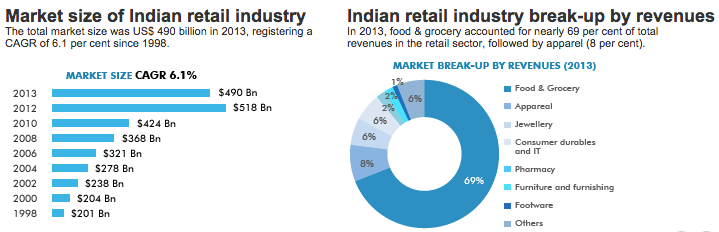
    Retail Industry in India

    retail industry in india

    Image Source

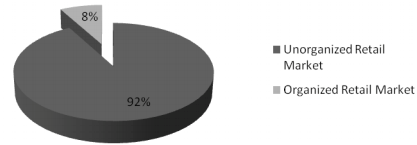
    Unorganized Retail vs. Organized Retail Market in India

    unorganized vs organized retail market in india

    Image Source

    A Short and Simple Story

    Lalu Dass Shoe Maker, a small shoe manufacturer located in the heart of Bangalore on Brigade Road, specializes in custom made leather shoes for men and women. While Mr. Lalu Dass has been in business for the past 60 years, very little has been known about him online until very recently. In the brick and mortar world, however, his reputation is monumental. Customers speak at length about the quality, comfort, and price of his shoes as well as the humility of this great artisan.

    I have known Mr. Lalu Dass for quite some time, and for all the right reasons. Despite our relationship, I have found it very difficult to help this shoe manufacturer (generally what we refer to as a ‘cobbler’) understand the world of online business and the potential it represents to elevate the fortunes of small business enterprises. No matter how hard I tried I could not persuade him to use his brand ‘Name’ for his own merchandise online. His rigidity in thought, his desire to maintain status quo, simply would not give way.

    Then I used another tactic. It’s one that works with almost everyone. I proposed that if he allowed me to use his brand ‘Name’ online, I would double his business. “Money talks and nobody walks,” as the saying goes. I can say I won at least the preliminary round.

    Results within 2-3 weeks

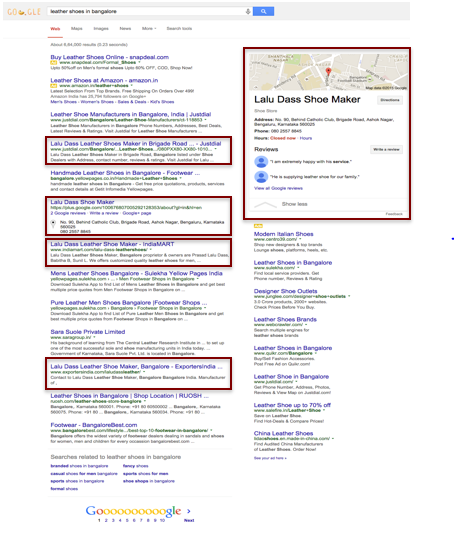
    1. Google Page 1 Take Over

    google page takeover

    seo

    1. Conversion Rate: More business enquiries from online, almost 10X customer enquiries (than the offline customer footfalls), out of which 3X more customers placed orders. This is a whopping 30% Conversion Rate.
    1. Branding & Awareness: Lalu Dass Shoes has become a brand name by itself online. Search for it and you will get all the relevant details.

    Just by doing a bit of Local SEO in whatever time I had

    1. Researched Conversion Keywords:

    It is important that you quickly check what your online audience is looking for. How they will find you is the question needing an answer. Google AdWords helped me cut through the Keywords with moderately high search, comparatively low competition and high conversions.

    2. Research on Competition and Relevant Directories:

    While keywords are important, it is crucial to know where your competition is. I quickly Googled a few directories with relevant categories and included the shoe business and descriptions.

    • Create email Ids, Title, Business/Product Descriptions, Phone Numbers, Address, Keywords, Product Specifications
    • Make sure the directories you include your business in are Mobile Friendly. Quite a large number of your audience search through mobile devices. So do not ignore them at any cost.

    local seo

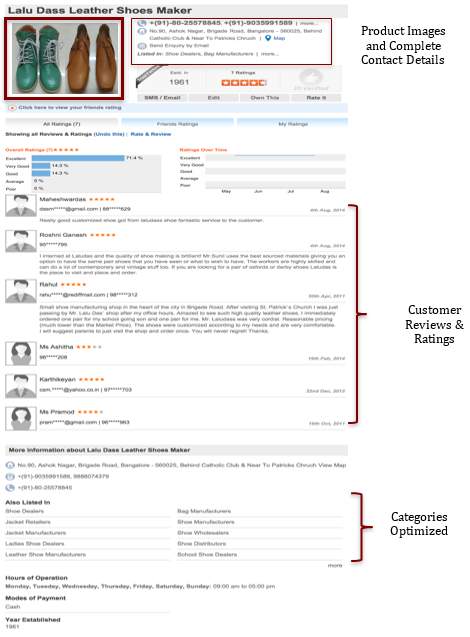
    3. Created Image Gallery of the shoes:

    Took pictures of the shoes with my Android phone and uploaded them on directories. A few of them rank on Google image search

    local seo

    Screen grab of an Optimized Directory Listing

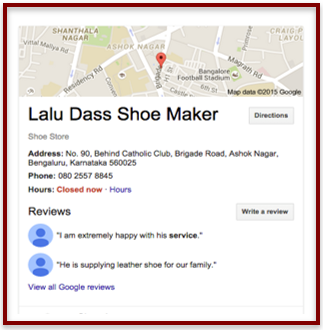
    4. Created Google Business Page and verified details:

    Google Business Page

    5. Initiated Facebook Page and conversation with audience:

    Started conversation with 80/20 rule. 80% content of what audience needed, 20% about the products/services/promotions

    6. Market Research for 2 Weekends:

    • Went to the shop and mingled with customers. Quite a few of them were from the elite class and I asked them to write reviews for the Shoe Maker
    • Learned about different styles/types of leather shoes – this helped me write about different shoe features
    • Watched shoe making techniques/tools – It’s interesting to see how shoes are crafted. It’s a totally different art altogether.

    Offline Activities, which also attributed to sales

    • Got business Cards and small Hoarding done for the shop with contact details (mobile, email ids, etc.) and Google business page URL
    • Land-line Connection in working condition – This was done mainly for customer follow-ups and tracking online customer requirements. Quite a few prospective customers call the business directly when they find contact details online.

    There is lot more to do. There are many Local SEO white hat techniques to easily increase your sales online.

    BTW, Mr. Lalu Dass is my Father-in-Law and I am happy to see the big smile on his face every time I meet him. Ironically, Mr. Lalu Dass still owes me a pair of Oxford Leather Shoes which he promised as a part of the deal. But that’s another story, the one about the cobbler’s children.


  • The Future of Native Ads

    The Future of Native Ads

    Image Source: oDesk

    Native advertising has been called ‘ads dressed as content’. It is slowly changing the face of ads in the digital space. Native advertising has not only spawned a host of new ad types, it has also captured marketers’ fancy due to its ROI capabilities.

    In this blog post, we attempt to answer the following questions with respect to native advertising:

    • Why are publishers focusing on native advertising?
    • What is influencing the growth of native advertising today?
    • What is it being used for?
    • What does the future hold for native ads?

    Native Advertising to the Rescue

    The rise of native advertising will compensate media publishers who have been hit by dwindling print ad revenues. According to eMarketer, US print ad revenues will reduce from $32.16 billion this year to $31.29 billion in 2018; digital ad spending on newspapers and magazines will increase from $7.48 billion in 2014 to $8.41 billion by 2018. This shift in ad dollars is encouraging media publishers to turn towards native advertising.

    Drivers of Growth

    Web users have become so used to seeing display ads that they overlook them very easily as soon as they identify them as ads. The increasing immunity of consumers to regular display ads has prompted advertisers to adopt native advertising to regain consumers’ lost interest. Designed in the format of the host site’s content, native ads blend in to the content and lure users into engagement.

    Social media has quickly adapted to native ads’ format (for example, Facebook’s newsfeed redesign). Understandably, native ad spending is strongly focused on social media platforms. However, native ads are also flourishing on content portals, news properties, video sharing sites and streaming services, wherever fresh content is to be found.

    As per a BIA/Kelsey research, native ad spends will continue to grow in the coming years driven by mobile devices. As more people take to mobile devices, marketers will increase their focus on mobile marketing and native advertising.

    The Usage of Native Advertising

    According to the eMarketer study mentioned above, the top 3 reasons brands are using native advertising on mobile devices are for:

    • Raising awareness
    • Branding
    • Brand affinity

    Other lead-related reasons like purchase intent and customer acquisition come later in the list of priority reasons. Brand native advertising on mobile devices is more a branding exercise than a sales initiative.

    The Road Ahead

    Despite being a relatively new concept in digital marketing, native advertising has grown considerably and is poised for further growth.

    According to the BIA/Kelsey report mentioned above, in 2014, marketers plan to spend $3.1 billion on native ads in social networks. Growth projections for native ad spending are pegged at a significant 42.4% in 2014. Native advertising offers an interesting opportunity for brands who want consumers to engage with them and they are putting money on this opportunity.

    Have you tried native ads? What is your opinion about them?