You are as likely to click on a website immediately on seeing a banner ad as much as you would walk immediately into a store on seeing an attractive out-of-home display ad. We are less inclined to stop what we are doing in order to respond to ads, be it online or when we are out in the city.
In the world of search marketing, click-through conversion is all that matters. Search, by its very nature, has a pre-qualified audience based on their intent to seek out information. Clicks reign supreme because ‘Clicks’ from search ads connect your brand with a sought after need.
On the other hand view-through conversions – VTCs (a.k.a post-impression conversions) happen when a person is exposed to a display advertisement, does not click, but goes on later to visit the website or search for the brand on search engines and converts. The driving force behind display advertisement is to create an influence. As a marketer we must endeavor to reach the right type of person, at the right time, at the right location and with an offer /service they simply cannot refuse. Even when all these factors are present in a precise way, a person might be inclined to click only when an impression is served and is compelled by what he sees in order to take some action. In display advertising, the ‘Impression’ still reigns supreme.
So that brings us to some interesting questions:
Q – Are VTCs just duplicates of the other conversions in the interface?
View-through conversions are not able to get the rightful credit mainly due to the way people view it in DSP buying. Many DSPs will group the VTCs along with the Click-through conversions while filling leads form thus giving a distorted figure. These DSPs will then promise a CPA model to the client which can only be fulfilled with the help of duplicated view-through conversions.
You can be on top of all such things by checking the validity of this metric:
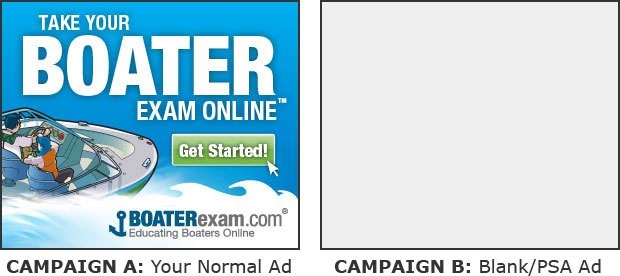
- You have to run a split or A/B test campaign. For one group you need to show the banner ad and for the other show a PSA ad. You then have to find out the incremental conversions for the group that viewed the banner ads.
A/B Testing vs a Blank Ad
- You have to demand that the view-through conversions be shown separately from last click conversions. That way you can have the actual break down of the conversions.
- Based on the industry conversion duration norms, set a custom backtrack durations for view-through look ups. Do not take view-through conversions that are registered beyond the set conversion duration.
Q – What is the view-through conversion window?
A view-through conversion window reckons a conversion after an ad is viewed depending on the number of days that you allow for the conversion to happen. You can customize it as per your needs to only record a VTC if it happens within the window of time frame post ad view that you have selected. The shorter the ad window the more accurate is the result. A 24-hour window is very reliable since the stickiness factor will definitely influence the customer’s decision to click the ad. A 30 days ad window may or may not be so accurate which is again wholly dependent on the type of product or service that you are selling, sales cycle, industry, and other factors.
Q – Even if I believe that VTCs are valuable, how should I value them?
We have to get used to the fact that impressions are indeed influential. This needs a radical change in the mindset of marketers that strictly value ROI and CPA goals. Studies have shown that lift and influence are very real and give a fair amount of conversion rate improvement. If you look at the following table you will see that VTC does help.
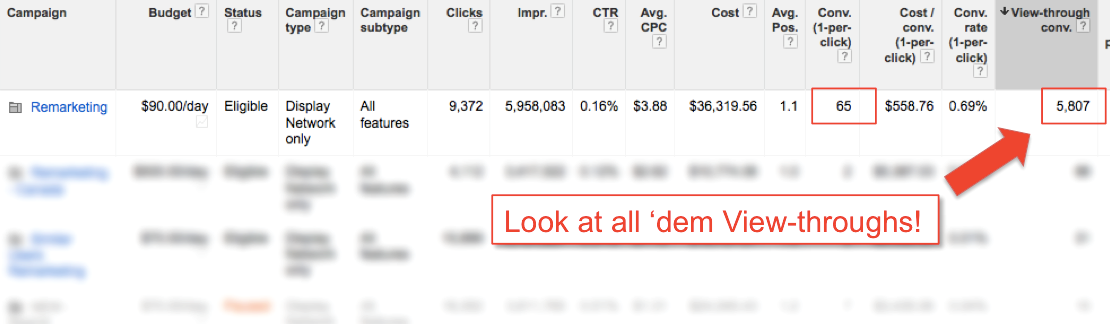
Influence of View-through conversion
Even if it is just a 10% improvement it still can make a difference. It could mean ratcheting up a good ROI to a great ROI. If you closely look at users clicking on your ads or otherwise you will surely see that they might not convert immediately. They can come back to your website later and convert. This is the overwhelming underpinning validation of view-through conversions. You can now measure the success of your display ad campaigns via the view-through conversion paradigm. Search engines like Google have taken cognizance of this and provide you insights into it so you get a holistic value of your display campaigns.
View-through conversions is a tracking metrics available in the AdWords account that can give you a clear understanding of your campaigns as it can measure assisted conversions. This happens when a user views your ad but comes back to it later, may be through another channel and converts into a customer.
Display advertising plays an important role in improving your digital marketing returns. Taking into account view-through conversions (VTC) can get you a comprehensive understanding of your efforts. It offers you a lifting effect of display advertising which hitherto you had no idea about. VTC helps to drive conversions even though it might not produce direct clicks. A visitor might return to your site via a bookmark, an organic listing or a regular URL and convert. You can then conclude that the original display ad did make a difference.
Now, we have a formula in order to find the efficacy of VTC that can help you reckon your digital ROI.
Actionable items
- Segregate you target group into two parts, 90% for brand and 10% as control group with no room for overlap.
- Use your Branded ads in the first campaign and PSA control ads for the second
- Run the ads for a conveniently long period to collate good amount of data
Compare results after normalizing the data

An Example
| Impressions | VTC | |
| Brand Ads | 1,000,000 | 1000 |
| PSA | 800,000 | 720 |
We need to multiply the PSA campaign results by a factor of 1.25, to normalize the data
| Impressions | VTC | |
| Brand Ads | 1,000,000 | 1000 |
| PSA | 1,000,000 | 900 |
Weighted VTC = (1000 – 900)/1000 = 10%
Result: One in ten VTC has indeed influenced someone to take action.
This is a holistic view of your digital return on investment. Most digital marketers might not be initially convinced of the benefits of VTC. In today’s world, people more often than not, are multitasking. So somebody might see your display ad while visiting some website at work. Now that somebody might not click immediately on that ad or even take any action at that point of time. Your ad might not even get due appreciation by the person. But the brain can register more than the eyes can see. So you might not get an immediate conversion for your display ads but that does not mean that your ad spend is completely wasted. It does create an impression and next time that person sees your ad he can immediately relate to it. There are more chances of conversion on that pay per click ad that you are going to serve him for his specific query. But then if you give 100% of the credit to the PPC ad, then it is not completely accurate. The initial display ad did have its own impact and all we say is that we now have a robust method to measure that impression leading to conversion called as view-through conversion.
This is a new frontier in a digital marketing world addicted to clicks and quick results. VTC is an avenue that you need to explore further in your quest for improved results for digital marketing dollars spent.
Let us know your views on View Through Conversions!
Contact us now to make your display ads go the extra mile for you!