Tag: analytics

  • How To Optimize Content For Conversions

    If the content you create to captivate your target audience is filled with deep insights and captures attention with your expert grasp of the subject matter you will convert your audience to clients who willingly advocate your brand or organization by sharing your content – infographics, blogs, and social media posts. Follow the step-by-step formula in this blog to optimize your content for conversions.

    Step 1: Take a Tried and True Asset

    Just 22% of US marketers have a specific process in place to reuse and repurpose their content. More often than not, marketers are sitting on a gold mine of unused content. A content inventory will help you get started. It gives you a clear picture of where existing content can be found, how well it performs, and what gaps remain unfilled.

    For example: A 20 page whitepaper created three months ago, can be repurposed into an infographic, PDF, a video with voice-over and a 10-slide powerpoint (TWEET THIS!).

    P.S. This blog is a repurposed infographic.
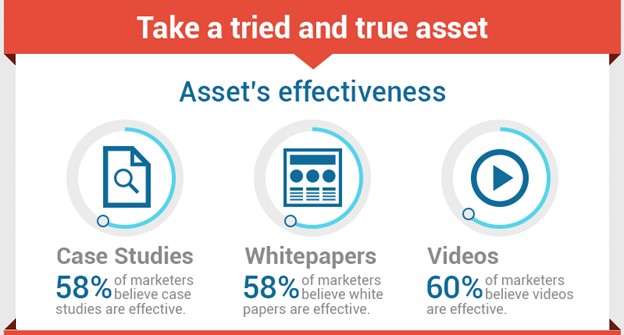
    Effectiveness of various assets

    Step 2: Create Multiple Compelling and Cool Looking Formats

    Great content can make a significant impact when repurposed across multiple delivery methods. Relevant portions from an eBook or whitepaper can be used both as blog and social media posts. Convert webinars into videos; create a blog post from the slide show.

    People respond to visual information better than plain text. A picture is worth a thousand words because everyone is naturally wired to remember images far longer than they will ever recall a clever tag line.

    Posters are one of the most effective types of visual content. Make sure to use a poster maker to create visually compelling posters that will leave a long-lasting effect on people.
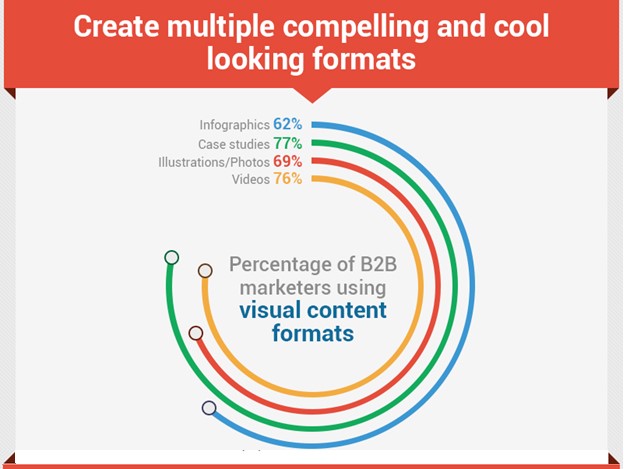
    Visual content formats used by marketers

    Step 3: Syndicate and Link Back to Your Website

    Even though you have created stellar content that is relevant to the needs of your audience, there’s so much competition and content it’s easy to get lost in the crowd. So double down. Submit your content everywhere: social media, blog directories, online PR websites, niche communities, forums and user groups for your products or solutions.

    Over a period of time you will see:

    • Increase in website traffic
    • Upward boost in sign-ups (newsletter, gated resources, contact us, etc.)
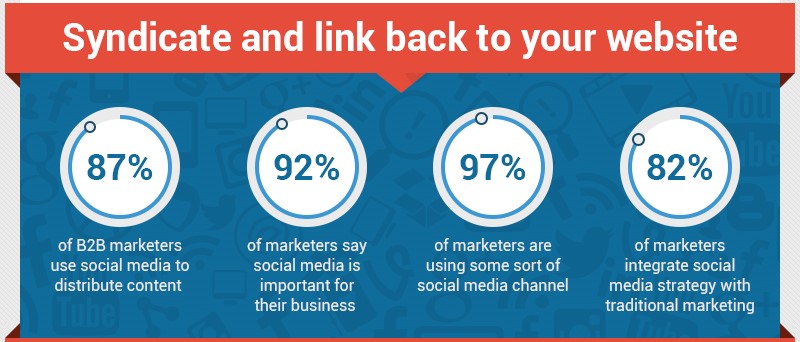
    Asset syndication platforms used by marketers

    Step 4: Build Lead Capturing Landing Pages

    Kudos! You are just over the hump and you are seeing a significant rise in your website traffic. But where is all this traffic going?

    According to MarketingSherpa’s Landing Page Handbook (2nd edition), 44% of clicks for B2B companies are directed to the business’ homepage, not a special landing page. Furthermore, of the B2B companies that are using landing pages, 62% have six or fewer total landing pages.

    MarketingSherpa cites the number one reason for landing page failure is a marketing department that doesn’t know how to set one up or a marketing department that’s too overloaded to get the job done. (TWEET THIS!).

    Ideally, every offer should have its own landing page. The user who clicks a specific post or link and gets to your landing page remains engaged with the same messaging, and that leads him to your call to action (CTA). The advantages of landing pages are multi-fold:

    • Landing pages help generate more leads
    • One offer = One Landing page: Gated offers are a crucial lead generation source in your marketing efforts
    • Capture information about your prospects and understand your audience better
    • Thank You Pages and Email Responders will help you close the loop with your leads in real-time

    Our verdict: The More Landing Pages You Have, The Merrier Your Numbers Shall Be!
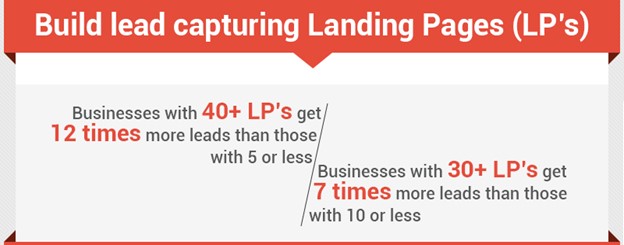
    Build lead capturing landing pages

    Step 5: Don’t Forget Your Tracking Codes

    If you cannot measure content, you cannot manage content. Decide on your KPIs and then measure all your content efforts against the baseline KPI numbers. Broad KPI areas to track for different types of content are:

    • Consumption metrics
    • Sharing metrics
    • Lead metrics
    • Sales metrics

    The process of content creation, distribution, tracking and analysis is an iterative cycle. You learn each cycle what your audience likes, and improve the process. The continual improvement results in enhanced lead quality, brand advocacy, happier prospects and loyal customers.
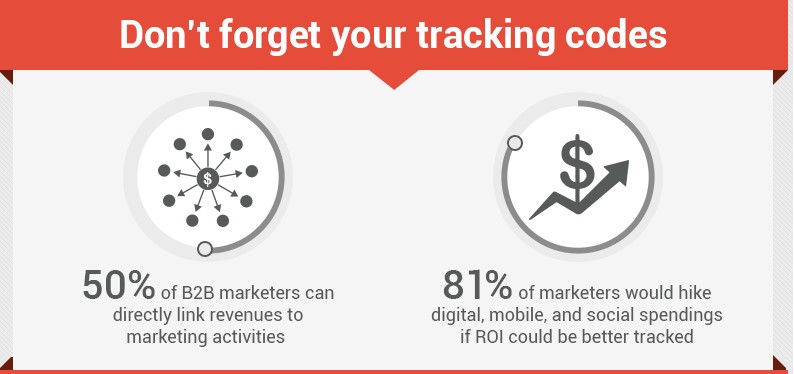
    Measure content with analytics tracking code

    Bravo, if your numbers are off the charts! If not, continue reading…

    Challenges Marketers Face

    Marketers face serious challenges when creating and implementing in-house a sustainable content marketing strategy. The 2015 B2B Content Marketing Trends—North America highlights the major challenges that B2B Marketers face:

    • Producing engaging content 54%
    • Producing content consistently 50%
    • Measuring content effectiveness 49%
    • Producing a variety of content 42%
    • Gaps in Knowledge and Skills of Internal Team, Lack of Integration Across Marketing and Budget were a few other challenges

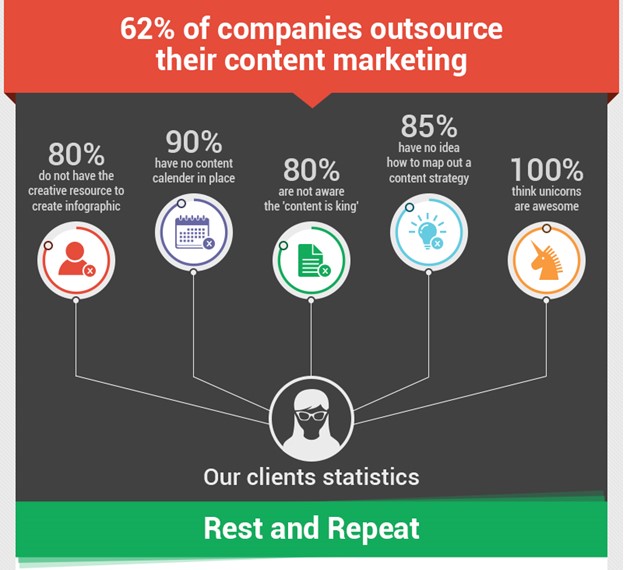
    I Can’t Do It All – Outsource Content Marketing

    Creating a culture of capturing expertise within the organization and converting it into engaging content takes consistent time and effort. Bringing in an agency can help you fill some or all of the gaps in content strategy, content creation and distribution – right now.

    An agency partnership provides:

    • a different perspective
    • variety and diversity in skills
    • functional expertise
    • industry specific expertise

    Content marketing statistics

    “Marketing has changed more in the last two years than in the previous fifty.” – John Watton, EMEA Marketing Director, Adobe Marketing Cloud.

    Is your marketing organization equipped to take advantage of every opportunity and overcome these challenges? Let us know your thoughts on content marketing, the pain points, the best practices or how unicorns are awesome!


  • Best of the Week | Optimizing Knowledge Graph for B2B Brands, and much more…

    This week’s hot news, events and videos from the online marketing and social media world.
    Optimizing Knowledge Graph for B2B Brands
    From the Position² Blog This Week:
    Optimizing Knowledge Graph for B2B Brands
    For users, Google’s Knowledge Graph showcases structured and detailed information about a topic based on their search. Read this blog to understand how to highlight relevant information about your brand in ways best understood by Google crawlers and algorithms.
    Top Stories this Week: Social Media
    Top Stories this Week: SEO, PPC and Digital Media
    Email Benchmarks Where do you stand? Best of the Week Video
    Email performance across 3,000+ Marketo customers was tracked and the results are in! Tune in to see how you stack up against your peers. Watch this video for some best practices on how to improve your email performance!
    White Paper: The Rapidly Changing World of SEO
    Get a head start in your quest for search engine optimization by going through this insightful white paper. Download this White Paper to know:


    • How important SEO is & why it should concern you?
    • Various ways in which you can deploy SEO
    • How to combine Social Media with SEO?
    • SEO best practices and a road map to getting there

    Download the complimentary SEO White Paper now

    Search-Engine-Optimization-White-Paper-position2
    If you are reading this blog post via a RSS reader, please click here to subscribe.
  • Twitter’s Audience Insights


    Audience Insights, a valuable and powerful tool from Twitter delivers a lot of useful information about your audience and how best to connect with them.

    How to Access Twitter’s Audience Insights

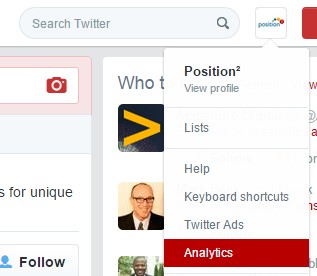
    To access Audience Insights, click on the profile picture displayed in the top right corner, which opens a drop-down menu. Click on “Analytics”.

    audience insights

    Once in the Analytics section, click on the “Followers” tab..

    Analytics section of Twitter

    The Insights

    Twitter slices and dices your audience into different categories, showing what percentage of audience fits into which category. To do this, Twitter uses information it gleans from users’ onsite usage, as well as off-site information provided by Datalogix.

    The overview at the top of the page tells you the most common interest of a user category, what type of lifestyle they follow, what type of buying style is most common, and their most commonly used wireless carrier.

    Audience insights categories

    Other statistics Twitter provides about your audience include:

    • Interests
    • Consumer buying styles
    • Wireless carrier
    • Education (highest level completed)
    • Marital status
    • Net worth
    • Household income categories
    • Gender

    In its blog Twitter provides an overview of the potential power of the Audience Insight tool. “With audience insights, you can easily discover valuable information about your followers and the people who have engaged with your organic Tweets. You can also identify new, relevant audiences to target for an upcoming campaign. Your audience insights dashboard provides aggregate information about user demographics, interests, purchasing behavior and more.”

    Audience Insights is now available to all Twitter advertisers and analytics users. Marketers may think that have the appropriate target audience ‘following’ them. Audience Insights can tell them if that is true. Twitter’s Audience Insights helps marketers analyze their audience and its response to their messaging. It gives them important nuggets of information to realign content and messaging strategy as per the current trends and information needs of their audience.

    Are you using Twitter’s Audience Insights? Has it helped you learn anything about how to better connect with your audience? Share your thoughts in a comment below.

  • Google Phantom 2 Algorithm Update

     ‘What does it mean to the businesses and search marketers?’

    Google’s on a roll. From the “Mobilegeddon” update last month to its recent secretive “Phantom 2” algorithm update, it’s delivering the best possible search results to users. And then going back for more. Google silently tweaks its algorithm much frequently than most marketers imagine.

    While the Mobilegeddon algorithm update was designed to boost the rankings of mobile friendly sites on mobile devices, Google’s Phantom 2 update will penalize sites with low quality content, specifically impacting “how-to” style content. Additionally, the impact will be felt by the entire domain not just standalone low quality website pages.

    What “Phantom” should mean for Search marketer?

    It’s a swift silent punisher of sites with thin content. They will lose the bulk of their rankings, traffic and conversions overnight.

     google phantom 2 update

    Image Source

    What does Phantom do to the actual business?

    • Your entire website is punished or sand-boxed
    • You rapidly lose a lot of traffic
    • You can’t see your high traffic ranking keywords on Google search results pages (SERPs)
    • Traffic conversions drop faster than you think
    • Your Return on Investment (ROI) disintegrates

    Essentially, you lose almost everything online you were working on the site (whether intentional or unintentional).

    It sounds scary, right?

    Reasons why a website is hit by Google Phantom 2 algorithm

    1. Sites with Low Quality Content

    Google has been cautioning everyone for quite some time now with Panda algorithm updates. Sites that add very little or no value to the audience are hit with the Phantom 2 algorithm update. This includes poor representation and lack of uniqueness in the content to the users.

    2. Engagement

    If your website content is not able to provide value to the audience, the engagement level is bound to be low on the website. The Phantom update emphasizes this fact. And the current Phantom 2 updates are a lot more strict than Panda updates

    3. User Experience (UX)

    • While content is one major aspect, others include the website load time, 404 errors, user flow, page architecture (design), color combinations, user navigation all of which should be taken very seriously by the webmasters. Make sure the website functions perfectly without distracting your audience and the search engines
    • Supplement, template content or using auto generate content tools slanders the uniqueness and the usefulness of the content for users. Marketers should be very careful and should maintain the relevance of the content for the users
    • Use of distractive and/or sponsored ads: Ads are meant to help users make the right decisions or provide information they intend to use during the buying process. Many businesses overdo by forcing users to click on these ads
    • Affiliate networks, which keep on bombarding and showcasing users with irrelevant ads
    • Sometimes ad links and content are in the same flow & color and users can’t determine the difference. Applying these tactics hurts the sites rather than helping. Remember, Google has already included human bots in deciphering these tactics
    • Pop-up’s annoy the audience if not used judiciously. Google algorithm has been optimized to identify these
    • Pages only containing images and videos without considering the theme of the webpage or over exposing the aspect of rich media are a negative impact
    • Pages with just links that point to subdomains or other websites with less/no content, are of little help. No more old school link farm techniques

    4. No Corrective Action Taken

    If your website has been hit by Google Panda or had elements hit by the update earlier, and you have done nothing to make content more appealing, fresh, and unique to the users, Phantom 2 will definitely have an impact.

    5. Duplicate Content and Canonical issues

    Happens frequently but often ignored by webmasters. Make sure you remove duplicate pages/content. Just remove them or block duplicate content from search engine indexing. Use proper canonical tags to make sure that one version of pages exist.

    6. Doorway Pages

    Doorway pages–Don’t try to deceive Search Engines and create similar pages to gain multiple rankings on SERPs. Google is smart enough to identify these and punish websites accordingly. Read here

    7. User Generated (spam content)

    Make sure user-generated conversations are relevant and checked for spam. Lots of low quality and thin ineffective user generated content raises an alarm and will be hit by the Phantom update. Ensure that community/forums are not used as junkyards for link and ad promotions. Have guidelines for the users to comment. Do periodic checks and edit/remove comments, which have negative user experiences.

    More to consider

    • Understand Your Target Audience/Personas before you write content. Attribute content across the funnel of the buyer’s journey
    • Have in place a content marketing strategy and plan. Make sure you generate genuine and unique content for the users, not for search engines
    • Try to develop a mix of content/asset types to keep users engaged. Distribute your content to relevant channels where your target audience generally visits. Content is King, but Distribution is ‘Queen’
    • Start with small. If you have constraints generating content, take small steps. Use Social Media to interact with your audience
    • Optimize your online channels Facebook, Google+, LinkedIn, etc., and reach out to your audience
    • Generate small content pieces. The traditional rule for audience engagement is 80/20. Eighty percent of your content should be for your audience, and 20% should be for your business (sales, marketing, self-promotion, etc.)
    • Have a social calendar in place to communicate with your audience
    • Regular Website Health Check up – Make sure all the technical aspects of the website are taken care of like page load time, design, navigation, etc. Regular checks on website hygiene ensures removing any major issues and creates better user and search engine experience
    • Make sure you track your content performance using analytical tools
    • Conduct regular analytics audits to make sure you are on top of your user engagement metrics. Understand what your audience needs and generate content accordingly

    At Position2 we utilize an Integrated Digital Marketing Approach to make sure our clients achieve premium results. Our proprietary Website Calibrator™ technology, a 41-point technical SEO audit, keeps our client websites equipped for any Search Engine algorithm updates.

  • Improved Ad Campaign Tracking Tools on Twitter

    For Internet advertisers of all kinds, Twitter is fast becoming the place to be. Consider the numbers:

    • 288 million active users tweeting monthly
    • 500 million tweets sent daily
    • 80% of active tweeters using mobile (Twitter)

    With this in mind, advertisers will need a better way to manage their Twitter ads. Fortunately the micro-blogging site has just launched two new ad conversion tracking tools, both of which will help advertisers gain better insight into ad campaigns run on Twitter.

    The two new tools are:

    • Transaction Values
    • Key Conversion Tags

    Transaction Values

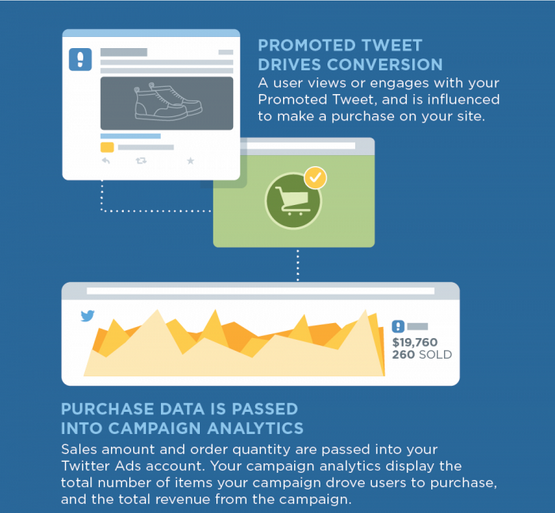
    While advertisers may have previously used website tag for remarketing, now they can use it to track their sales figures as well. By making some simple changes begin collecting order quantities and conversion values for each conversion. Twitter Ads analytics dashboard will then display the aggregated value and reporting.

    improved-ad-campaign-tools-on-twitter

    Advertisers will be able to see their ROI from their Promoted Tweet Campaigns. If not already using conversion tracking, now would be a good time to start. Simply create a tag in Twitter Ads UI and begin implementing it within a website. This new feature allows digital marketers to measure sales that were directly driven by Promoted Tweets.

    improved-ad-campaign-tracking-tools-on-twitter

    LiveNation, a Beverly Hills, California-based company that promotes concerts and  live-events, finds Twitter’s real-time platform a natural fit for its business model. Live Nation beta tested the Transaction Values feature on Twitter for over a month with Promoted Tweet campaigns using the Website Card to increase ticket sales, and the results they logged were impressive. The analytics of @LiveNation reveal that the company earned a ROAS of 819% in the test phase.

    Key Conversion Tags

    With the key conversion tag feature advertisers can select the single conversion event that is most important to them and optimize for it. They then receive gleaned analytics within their Twitter Ads UI that show only that conversion type. And they can still get all their conversion type reporting for their campaigns within their analytics dashboard at any time.

    As an example, a boutique bakery might turn to Twitter to drive more sales of its cakes for a specific holiday. All it needs to do is place a website tag on the final conversion page of the cake sale and then select this tag as the key campaign tag. Twitter will then optimize the bakery’s campaign to generate more conversions on the cake sale page. The bakery will be able to view all the cake purchases within the Twitter Ads analytics dashboard, all in real time.

    Contact Position² to deploy B2B advertising campaigns on Twitter now!

  • Google’s Data Platform Changes Imminent

    Google is the market leader as far as online advertising is concerned. But of late there are a few other competitors that are threatening Google’s hegemony in this space. This has obviously got the search engine giant quite perturbed and it is no mood to give away its share of the lucrative online ad business without a fight. The Facebook Atlas platform seems to be one of the toughest competitors that the Google ad network had to face since a very long time.

    Google intends to respond to such threats by restricting its ad network to data management platforms. This has naturally got digital marketers quite concerned. This move could curtail the freedom that ad tech firms enjoyed till now. But there is definitely more to this move from Google than meets the eye.

    Going forward, Google will restrict ad technology partners from gathering data while running campaigns on the Google Display Network. Now this move seems to have been timed with the launch of Facebook’s ad server and data platform, Atlas. But there are people on the other end of the spectrum who say that Google has been working on this for quite some time now.

    Whatever be the spur, Google will not allow ad networks to fire pixels on certain ads. Pixels help advertisers to keep track of user views and interactions so that the ads can be better managed. Standalone entities who do not have a hybrid model of deploying ads will be the most affected. Beginning March 2015, Google will implement its policy to restrain certain data management platforms from firing tracking pixels on the Google Display Network. The DMPs that will get the short end of the stick are the ones that do not own a demand-side platform or DSP to execute the transaction.

    But ad tech companies are afraid that in due course, Google might bring sweeping changes to the ads served on its various platforms including its DoubleClick Ad Exchange. Now that calls for a detailed discussion which we shall be covering as and when it happens. Watch this space for more.

    What is your take away from this new move from Google? Contact us now for 360° online advertising!

  • Google to Roll Out Viewability Reporting

    At the Consumer Electronics Show (CES) in Las Vegas, Google announced the roll out of viewability reporting across its ad platforms. They’ve also added over 30 broadcasters, premium publishers, and major brands to Google Partner Select, the premium video service they launched last year. This move will help marketing professionals understand whether consumers are actually watching their online video ads.

    Google will report the percentage of an advertiser’s or publishers’ video ads which were at least 50% in view for at least two seconds in keeping with the Media Ratings Council’s standard. Statistics will be available for campaigns powered via Google’s DoubleClick ad-technology, including the ad exchange. These viewability reports will be available to advertisers and publishers using Google’s DoubleClick reporting tools.

    Allstate, BMW and Netflix are a few of Google Partner Select’s early adopters. During the marketplace’s tests, the video ads had 74 percent completion rates. In the coming months, Google plans to offer its marketers the ability to target viewable impressions in DoubleClick and buy viewable video impressions across the Google Display Network, as well as reports on audibility and the total time their video ads were viewable.

    Video promotion is 6 times more effective than print or online, 67.3% marketers plan on increasing their video budget, and adding videos to landing pages increases conversions by 90%. Interesting video content, appropriate distribution channels and real-time analytics are key to a successful video centric campaign. Talk to our Visibility Accelerators on how to take your video viral.

  • Slideshare Throws Open the Analytics Tool

    It’s the age of integrated marketing wherein you will see a host of features being added to online resources that will aid you in 360 digital marketing. In a bid to help publishers get a feedback on their presentations, the eponymous slide sharing website ‘Slideshare’ has sprung on a pleasant pre-Christmas surprise! You get a free analytics tool to assess your content’s performance so you can better tweak it to your user requirements.

    If you are a webmaster or a web content publisher then this tool helps you get information on your- top slides, recent sources of traffic, recent visitors, traffic originating geographies, engagement statistics and such other useful nuggets of information. You can also get a detailed feedback on how people are engaging with your presentation and the channels that they are using to get to you.

    If you closely look at the social media platforms lately, it is not hard to deduce a pattern here. Every site worth its salt wants to get on the free analytics tool offerings bandwagon in order to give of all people, the digital marketers, a better way to curate their online campaigns.  Henceforth you will be able to precisely monitor what people like so as to tailor make your content to exacting user needs. You will be able to keep tabs on user likes, emails, comments, downloads, and embedded link clicks.

    Since the advent of the Web 2.0 technologies, the web is slowly but surely going towards being more and more interactive. It’s a two way street, all the way! Now that’s exactly what the Father of the World Wide Web Sir Tim Berners-Lee had envisioned when he threw open one of the greatest technological gifts that the modern man has ever received! This latest development from Slideshare is a small step in fulfilling what Sir Berners-Lee had earnestly espoused a long time ago.

    Let us know what you think of this new offering from Slideshare.

    Contact us to benefit from Integrated Digital Marketing now!

  • How to Improve your Digital Marketing ROI Using Big Data

    Today we are in the middle of a radical shift in the way we interact and communicate with one another. Factors like democratization of data, mobile computing, broadband Internet ubiquity, faster and cheaper computing prowess have all contributed in making big data so momentous today. Big data might happen to become as important as Internet itself to businesses and the society in general in the not so distant future. You don’t need to be intimidated by big data as that is clearly not going to help you in any way. All you have to do is implement these big data essentials to enjoy better ROI for all your digital marketing campaigns.

    Use Data Analytics

    You can find exactly how your website is faring using any data analytics that is available online. Google Analytics is a very useful tool if you want to get an accurate feedback on your website. All you have to do is register for Google Analytics and you can begin monitoring your website. It gives you an accurate idea about how many people visited your website and how long they stayed. You can find out how exactly they landed on your page i.e. the external site that directed them here. This is useful if you are already into digital marketing since now you know which are the campaigns that are working for you.

    Go for Retargeting


    retargeting

    Image Source

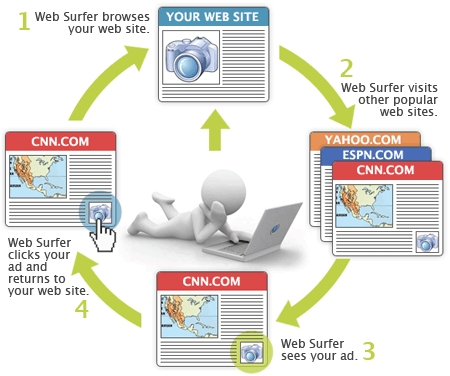
    Today it is not enough if you track your users on your website, you need to keep tabs on them even after they leave your website. It is an essential part of retargeting wherein when they go to some relevant website you can again target them and have better chances of converting them to customers. Since the user has already seen your ad before, he is more likely to reciprocate positively to your ad this time around. But for this you need to use cookies in order to keep track of your user whenever he is online.

    Exploit Social Media

    The explosion of social networking sites is one of the hallmarks of the Internet since the rise of the search engines during the early part of the millennium. Today everybody is connected via Facebook, Twitter, Pinterest, Instagram, et al. This makes your job easier since all you have to do is find out what these people are saying about you and your competitors thus offering you a lot of insight into customer opinions and proclivities. You can then dovetail your digital marketing strategy accordingly and make the most of this new found knowledge.

    social media

    Image Source

    Learn from People’s Searches

    Learning from people’s search queries can be a very rewarding experience for you if you do it analytically, diligently and persistently. This can throw light on what people are demanding and what are their expectations from any product or service. Google Trends is a very good platform to delve into people’s search patterns. You might not get too excited in the beginning since it is a whole lot of data that you have to sift in order to get anything valuable out of it.  But if you do it with perseverance then you would be surprised to find out how much insights you can gain about your customers both existing and prospective. You can get a detailed list of what people are searching, the frequency with which they are doing it, the websites that they click on the results page and such other useful nuggets of information.

    Put your House in Order

    Before you go about looking for data anywhere on the World Wide Web do organize the data that is lying in your own data centers. This can be immensely helpful in ways you would have never imagined possible. You can do detailed research about your customers and profile them as per their past interactions with your website and the result that it delivered to you. You can compare two instances where you received different results and find out the exact reasons for such a disparity; sales is one parameter to consider here.

    DBMS (Database Management Systems) from marquee names like Oracle, IBM and Microsoft cost prohibitively high and are beyond the reach of small business enterprises. In such a scenario, you can consider buying the software from small suppliers who differentiate themselves by focusing on niche markets. You can even try Linux operating system as a database platform since it is an open source product. According to Forrester Research’s product evaluation, open source databases viz. Ingres, PostgreSQL and MySQL come out as some of the best.

    You can find out the exact reasons why you could not convert your leads to sales in a particular scenario as you are now backed by compelling data from your own database. This shall help you fine-tune your digital marketing strategy saving you precious resources by offering you better insights into conducting highly targeted campaigns.

    Position² Point of View

    Today we are living in a world where information is generated at an unprecedented rate and off-the-shelf raw computational power is getting better by each passing day. Now these are the two parameters that make big data so widely popular and sensational. You might love it or you might hate it but you just cannot ignore big data. The field of big data analytics is still in its infancy. The explosion of data in today’s world is really mind-boggling to say the least. Data scientists today are the new age rock stars (excuse the metaphor). There is highly valuable information out there in all that raw data that is zipping from one end of the globe to the other in the blink of an eye. Though it is still nebulous as to where we are headed in terms of exploiting big data to our advantage, one thing is for sure that big data analytics has evolved today from being a business initiative to a business imperative. The faster you realize that, the better it is for the fortunes of your company.

  • Social Media for Enterprise [Infographic]

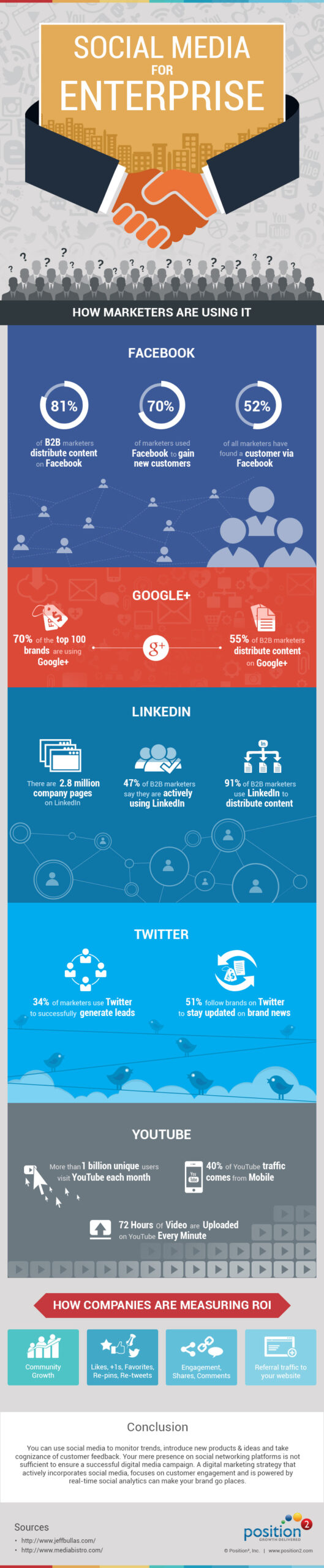
    Today if your brand is not present on social networking sites you are unwittingly losing out to your competition. Companies around the world are investing heavily in social media marketing in order to ensure favorable customer engagement. Here’s a quick primer of what the social media world looks like in terms of enterprise participation. This might just spur you to take the plunge and actively incorporate an integrated social media strategy backed by real-time analytics, to power your digital marketing campaigns.

    Social Media for Enterprise Infographic