Category: Paid Acquisition

  • How to use the valuation rules to improve your Google ads performance

    Google’s new Valuation Rules are the most impactful addition to the Google Ads arsenal since the launch of Retargeting. However, I’ve yet to see anyone write about this topic and I’m not entirely sure why. Hopefully, I can explain how extremely valuable this addition to the Google Ads arsenal is.

    In recent years, Google Ads has become more audience-driven, and less keyword-driven. Marketers know that they can look for audiences that are relevant (or not) to their product/service offering – bidding them up or down (or excluding them entirely).

    When I audit accounts from other agencies, I frequently see such setups that are implemented because they “feel” right but it’s often difficult to determine any factual underpinning for these choices. This kind of setup becomes irrelevant when you employ Smart Bidding Strategies. If your audience bidding strategies only change the bids – you’re still using a manual bidding strategy – which means you’re not delivering optimum performance for your clients.

    If you’re running an eCommerce Google Ads Account, you definitely need to run Target ROAS Campaigns to maximize sales performance. That type of campaign allows Google Ads fully automate and manage your bids in any shopping campaign.

    For any Lead Generation Account (B2B or B2C), we recommend implementing Source to Close Tracking – assigning relative values for each funnel stage, utilizing your CRM to capture the updated lead status, and passing back to Google relative values representative of how likely the lead is to close.

    So… how can you fully utilize Google Valuation Rules to help your client’s Google Ads performance?

    Google has about 900 In-Market / Affinity audiences that can be added to any Search Campaigns in Observation Mode – you need to do this for each of your Search Campaigns.

    How do you get started?

    First, go to your Google Analytics instance and look for the following interest categories: Affinity categories and In-Market segments (refer to the image below)
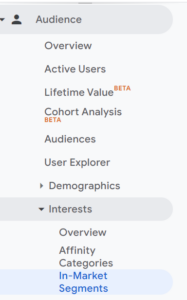
    Affinity categories and In-Market segments

    Next, do a long lookback and download the complete list of audiences available to you. After a little bit of format manipulation, upload the complete audience list in observation mode to Google Ads (with no bid adjustments) to each Search Campaign in Google Ads Editor (excluding Performance Max where this tactic is not permitted).

    It’ll take from 2 to 12 weeks while Google Ads compiles enough data on all of the audiences in your campaigns – allowing statistically significant differentiations between the audiences to become apparent.

    We’re making an assumption that you, the reader already know how to run a Target ROAS Bidding Strategy for your clients – maybe you’ve achieved some success with it. Here’s how we can make Target ROAS even more effective.

    Within those 900+ audiences, Google has been tracking on your behalf – a series of outlier audiences that will perform either much better or much worse than the account average. In the image below – you’ll see sample data from an account that has an account-wide ROAS of 4, but as you can see from the image there is a subset of audiences where the ROAS diverges greatly from the average:
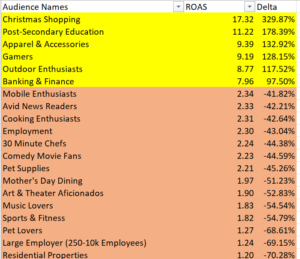
    Subset of Audiences

    Target ROAS is working well for this account, but there is still a group of audiences that are either being underrepresented (with higher-than-average ROAS) or overrepresented (with lower-than-average ROAS) in the traffic that Google is sending over.

    How can we optimize for these outlier audiences?

    Go to the Conversions Tab and click on “Value Rules”.
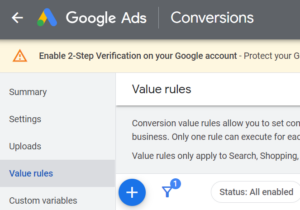
    Value Rules

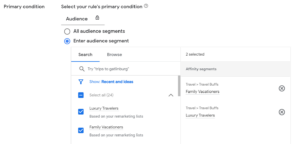
    Add the relevant audience segments:

    Rlevant Audience Segments

    You need to choose a value adjustment. For these audience segments, the top audiences have achieved a ROAS of 2x the Account Average. So it’s logical to 2x the value associated with conversions in these audiences.

    Taking an action like that will help ‘seed’ Google’s algorithm to be more aggressive in bidding for future people who are part of these “favored” audiences. Conversely, the audiences that have generated a much lower ROAS than the account average – you can reduce the multiple to as low as .5x.
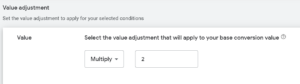
    Base Conversation Value

    As this is scaled and over time, Google will be more aggressive in pushing bids higher for people in “profitable” audiences and lower for people in “less profitable” audiences which will make your Target ROAS Bidding strategy much more efficient. Depending on the account, I review audience data every 2-4 weeks and adjust these numbers because audience performance isn’t consistent over time.

    You can also run a similar strategy with Geographical Segments.

    The U.S. contains 210 distinct DMAs (Designated Market Areas) – you can run a similar setup comparing ROAS data at the DMA level, making the same types of adjustments as you can with Google’s Audiences.

    Personally, I’ve found that using Google’s Audiences as my Value Rules foundation is more impactful to my clients than just using DMAs, your situation might vary. I hope you found this helpful – feel free to leave comments below!
  • Google AdWords & the Era of AI

    Digital advertising has changed tremendously in the past few years. The growth of the internet and advancements in technology have contributed to immense innovation in the world of online advertising. However, with growth comes challenges that are faced by today’s digital marketers.

    The rise of ad blockers, ad fraud, flawed data collection and analysis, complicated ad technology, and lack of training are a few roadblocks marketers face today. This prevents them from tapping the full potential of online advertising channels. The rise of Artificial Intelligence (AI), or machine learning, could be the answer to these challenges and has the potential to mold the entire marketing landscape as we know it.

    During Google’s I/O keynote in 2017, CEO Sundar Pichai shared Google’s shift in approach from a mobile first world to an AI first world. So, what does Google have in store for the digital marketers in 2018? As quoted by Google experts, “Machine learning can analyze countless signals in real time and reach consumers with more useful ads at the right moments.” Google AdWords can now help marketers gain more control over owning the right audience segment to target. People consume information, make online purchases, read and research on their mobile phones and tablets, and continue the same over their desktops and laptops. Mapping this journey across multiple devices used to be a difficult task, but it is now possible because of AI.

    Thanks to machine learning, here are some of the AdWords search features that will benefit marketers:

    1. Improved Smart Bidding – When a Google search is performed, AdWords optimizes bids considering multiple signals, which include device, location (physical and intent), day, time, and demographics. However, the improved smart bidding system now strategizes to “maximize conversions,” which doesn’t need a max CPA bid to work. It’s useful in determining the optimal CPA of a campaign and working backwards to meet the ROI targets.
    2. In-Market Search Audience – Previously, this feature was only available for display and YouTube advertising. Now that this feature is available for search, advertisers can target users or audiences who are actively looking for their products or services and can bid up on those searches where the user has relevant research history. The abilities of machine learning has made this possible by analyzing numerous search queries to figure out the intent trends of the users. Then, it shows the most relevant ads to the users which is closest to their interests.
    3. Life Event Search Audiences – Like the In-Market Search Audiences feature, Google also launched Life Event Targeting in 2017. This targeting option allows advertisers to target users around a few major life events including graduation, moving houses, and getting married. Google is planning on expanding this list in the future.
      Just like Search, Google also launched Smart Display Campaigns. Advertisers need to provide a target CPA, budget, and ad assets such as images and text headlines. The system learns on its own to optimize towards the goals.
    4. Data Driven Attribution – On the reporting front, Google AdWords uses machine learning to give credit to user touch-points for conversions or leads while finding a correlation between multiple unique ways in which a user’s path could lead to a conversion.
      AdWords AI is helping today’s advertisers save time daily when it comes to handling regular PPC campaign activities and management. This technology has free up time on account manager’s schedules to think of bigger things for their clients. However, advertisers still need to contribute their expertise, time, and effort to ensure the right inputs are fed into the systems for the machines to learn effectively.

    AI has begun to make its mark across the world. As technology continues to evolve, marketing technology will as well. Advertisers need to stay tuned, keep up, map the consumer response, and determine the right course of action for each new feature. After all, the machines learn from humans.

    Reference:

    https://adwords.googleblog.com/2017/05/ powering-ads-and-analytics-innovations.html

  • R.E.M. – Why Mobile is Essential

    The first and second blog in this series discussed the importance of relevance and engagement when it comes to your paid acquisition landing page. The third key to success is mobile experience. An increasingly large audience use Mobile devices to search, access their Facebook feed, read content, interact with businesses, and make purchases. However, many companies haven’t optimized their sites for mobile yet. As a result, they suffer from slow load times, which in turn increases user abandonment and impacts SEO and Adwords ranking.

    Here are a few critical elements to keep in mind:

    1. As a marketer, you need to make sure your landing page loads quickly once a user clicks on your ad.
      A mobile friendly site is essential for making sure your site’s visitors complete their objective. Therefore, the mobile site has to be optimized, keeping in mind the ‘Mobile Customers’ and their interactions on the site.
    2. With restricted real estate, mobile and the on-the-go consumer mind-set, you want to make sure your prospects or customers quickly find what they need. So prioritize the content and keep the most important one above the fold.
    3. It is perfectly fine if you have a long scroll page, but make sure your offer has enticing information as users scroll up and down. Keep the most important information up top, evaluate how your form fits in the small space on mobile, and do not force fit your form. Use a sticky CTA – i.e. one that scrolls up and down with the user. This way your CTA is always in front of the user.

    In the digital marketing world, the user is in control. So give them the information they seek, and let them make a decision. Forcing your objectives on to users will result not only in page abandonment, but also in potential brand abandonment.

  • R.E.M. – Keeping Your Audience Engaged

    In yesterday’s blog, R.E.M – The 3 Must Haves for Paid Acquisition Landing Pages, I mentioned the three core requirements for any paid acquisition landing page – Relevance, Engagement, and Mobile (R.E.M.). Here are some great tips on “E” – keeping your audience engaged with your brand and increasing brand recall:

    1. Conventional wisdom of Paid Ads tells us that we should have dedicated landing pages. This has worked for many years and for many marketers. We support this approach and recommend it to our clients. With that said, there are still valid benefits to sending users to site pages too. For example, if you are an e-commerce player, site pages can offer a depth of product information that dedicated landing pages cannot, especially if the search term is generic like ‘digital cameras’. If you are B2B or a business looking to capture leads, and you need to share a lot of information to assist decision making, you have two main options:
      1. You can build a dedicated page with all the information you want to share. You can also create a single or multi-tab page. Users landing on this page will either do what you want them to do, or will leave because dedicated pages do not typically have links to the main site.
      2. You can also send them to a relevant site page. If they like what they see, they will do what you want them do (fill a form etc.), or they will navigate to other parts of the site. This strategy increases time spent and pages visited — it increases the engagement with your brand and can lead to better brand recall in the future.

      The decision to go with a dedicated page or a site page is very important. It has to be planned well with thorough data analysis and should be driven by objectives. Pick your final strategy after doing statistically significant A/B testing. Our recommendations for which landing pages our clients use typically depend on the client goals, data, and larger Demand Acceleration objectives.

    2. When users are about to leave the landing page, engage them one last time by offering them content similar to what they were consuming. You can also try and collect an e-mail to nurture them in the future.
    3. Often times marketers forget the all too critical component of marketing- “build trust and entice customers to take an action.” How do you do this? Share a video testimonial from your customers or show them a series of text testimonials on the site or share case studies. The more you have others vouch for you the better. No better way to win additional business than from referrals.

    The final blog in this series will be posted next week and focuses on the last component of successful paid acquisition Landing Pages, “M” – optimizing your site for mobile.

  • R.E.M – The 3 Must Haves for Paid Acquisition Landing Pages

    R.E.M stands for Relevance, Engagement, and Mobile – the 3 core requirements for any landing page experience and an important concept for every marketer to know. This blog will discuss the “R” – the importance of relevancy in your landing pages.

    Relevance:

    As a seasoned marketer, you’ve probably heard that landing page relevance is critical for digital marketing success. But what does that really mean? Here are some ways to ensure your landing page remains relevant:

    1. For starters, make sure that the landing page is centered around the keyword or the ad your prospect clicked on. For example, if the keyword was about the “iPhone 8”, the landing page should be about the iPhone 8 and not the iPhoneX.

    This might seem like a no-brainer, so why even talk about it? At Position², we see such mistakes often. We highly recommend that you double and triple check your landing pages, especially if you have a large inventory of pages.

    2. If the searcher is looking for generic products, DO NOT send them to a product specific page. For example, if the user is searching for “digital cameras”, don’t send them to a “Canon Digital Camera” page.

    At first, the user is mainly interested in learning more about all the products you have to offer. After exploring the products and offerings, they might want to pick the best camera for themselves. Instead of focusing on a specific brand, use this opportunity to tell the user more about your business and the general products you offer.

    So, what is the best way to do this? First, tell them about the different types of digital cameras – give information about DSLRs, Point and Shoot Cameras, etc. Then, tell the users why your site is unique and what cameras you offer. Finally, entice them to buy from you through offers, discounts, and sales.

    If you are B2B company, you can offer your audience a relevant Whitepaper, E-book or video about your products. The key is to give the user all the information needed to make a decision and buy from you.

    3. Create transparency by giving your business details, phone number, and address. Explain what your business does.

    If you are in the financial, medical, or a related industry, you might need to explain your products and services. Include information about your approvals, accreditations, and ratings. If you ask for user information through a form fill, tell them why you need their information and what you will do with it.

    Check back tomorrow as we delve into the details of “E” – how to keep your audience engaged.

  • Content Syndication: A Must for Your Digital Marketing Strategy

    How to get your best content promoted on third party sites to drive brand awareness.

    Let’s start with a question – if you had to say just one thing, what is the single most important goal of your digital marketing strategy?

    It’s a fair guess that some of you answered: “to drive more traffic to the brand website.”

    Aside from SEO and Pay Per Click, Digital marketers have one key tactic for increasing click-through to a client website – getting as much branded content as possible distributed on different sites to increase presence and create a network of links back to the main site.

    Since search engines like Google started clamping down on content duplication and click baiting, this has become harder and harder. Unless you want your pages to disappear off search engine top tens, you can no longer simply repost the same keyword laden content on every article directory you find.

    What you can do, however, is reach an agreement with third party sites to promote your content. Search engines differentiate between duplication, which they view as unnecessary cluttering of the internet and what they call syndication.

    Syndication is an old media practice of different outlets sharing the same stories. For web content such as news articles, blogs, infographics, tutorials, videos, etc., Google views syndication as a positive way of helping users find content they are interested in.

    Content syndication has therefore become a powerful means for brands to drive traffic back to their own site. Syndicated articles are often not republished in full, so are therefore not duplicated. Instead, under agreement with the third party site, syndication provides links back to the original content, perhaps with a thumbnail and summary.

    Content Syndication Networks will even do the work for you. Subscribers’ sign up, submit their content and narrow down their target audience by topic and demographics. The network then does the hard work pushing the content to third party sites.

    Syndication Strategies

    A study from Curata suggests that syndication should account for around 10 percent of your content marketing mix. But that is an important 10 percent, as that is the section of your content that you wish to be promoted and endorsed by other sites.

    The content you choose to syndicate should therefore be the very best you have to offer. Unlike advertising, the purpose of syndication is not to get audiences to click through to buy, but to click through out of interest. As they are reading the host article or watching a video clip, you want them to spot the link to your content in the ‘Related Articles’ section and be engaged enough to click.

    If your aim is to get your content promoted alongside specific influential sites and blogs in your sector, try approaching them yourself to talk through a deal. Write a pitch focusing on the topics you produce content on, with any examples of previous syndication.

    Paid-for services like Taboola and Zemanta will make your content available to a wide range of sites, many of them with high visitor numbers. A free alternative is to adapt your social media strategy to cover syndication. If you have enough followers and engage well enough with your audiences, posting content to sites like Facebook and YouTube can result in high organic distribution through reposts.

    Repurposing Content

    Some large influential news and opinion sites – the Huffington Post, Life Hacker, Forbes etc. – will republish articles in full. In these instances, there are several benefits to not posting word for word the same content as you have on your site, and not just because of duplication.

    Repurposing can help drive traffic back to your site by tailoring content for specific audiences. A Forbes article may benefit from more of a business angle to something written for the Huffington Post. Different things work on different sites, plus you may have to consider word length and house style.

    Some sites, such as Hubpages and LinkedIn, allow you to publish articles in full. Because there is no editorial oversight crediting the original source, there is more of a risk of being picked up for duplication if you simply paste a piece word for word. In these instances, it is advisable to change content more substantially, perhaps with a different angle, to create a new unique piece of content.

    Conclusion

    Syndication is one of the most effective content marketing distribution strategies available to digital marketers today. Leaving behind the old clickbait practices, the focus of syndication is on quality and endorsement, providing direct links back to content on your site your audiences will be engaged with.

    To learn more about how Position2’s syndication subscription service can help promote your brand to a wider online audience, click here. To stay in touch with the latest trends in digital marketing, you can subscribe to receive alerts from our weekly blog

  • Identifying Personas to Drive Messaging That Works

    Over the years one of the major aspects of businesses – small or big, has been understanding who their customers are and how to appeal to their target audiences. Today, every successful business model has various ways of tapping customers – new and existing. We see a paradigm shift with most organizations leveraging similar strategies to identify the right persona, and address their needs with relevant messaging.

    Which brings us to the question, what is persona? Persona is the representation of your ideal potential customers based on the existing data and research of your current customers.

    Your next question would be, why is identifying personas important for your business? To drive content creation, product development, sales and everything else in-between that relates to successful customer acquisition campaigns.

    Here’s how to identify personas:

    • Start with identifying the demographics to which your product/ service is relevant
    • Understand your prospects’ needs, pain points, and buying process. Based on that, you can easily address their requirements and engage with them through each step of the purchase funnel
    • Segment the demographics based on the aspects of the product they are most likely interested in
    • Focus on persona targeting as it works for any of the marketing goals: Brand Awareness, Engagement, Customer Acquisition

    Targeting in real-time:

    Use various targeting settings of the marketing channels to create the right audience pool.

    Mentioned below is a sample list of settings available in various channels

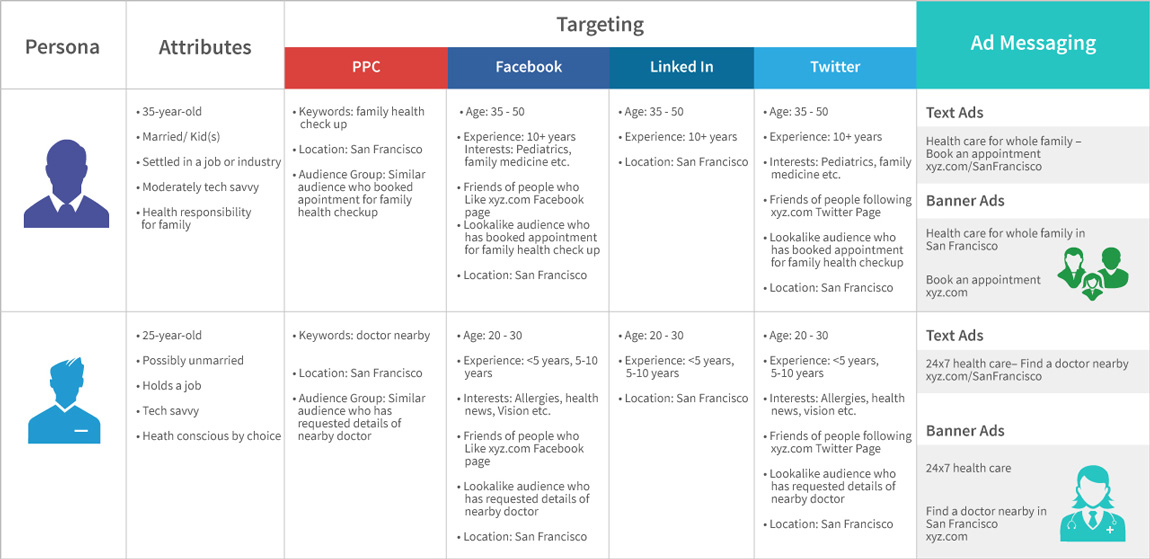
    An Example of Persona Targeting and Messaging Matrix

    Persona features matrix for an online medical care scheduling service provider

    Persona Targeting and Messaging Matrix

    Sample Results:

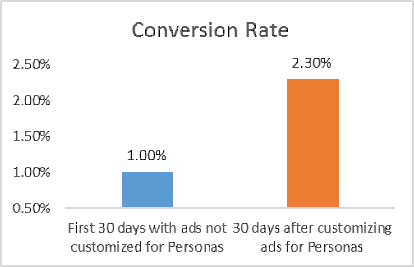
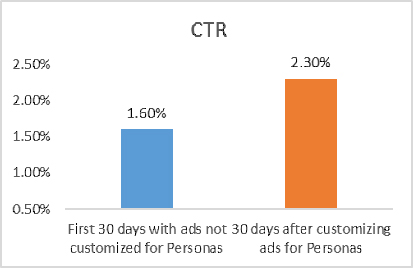
    Results for one of the accounts where we have identified personas and changed the messaging accordingly – observed lift in both CTR & Conversion Rate.

    Date range Impressions Clicks CTR CPC Cost Conversions Conversion
    rate
    Cost/
    Conversion
    First 30 days with ads not customized for personas 26,014 418 1.6% $2.8 $1,174 4 1.0% $294
    30 days after customizing ads for personas 29,478 688 2.3% $2.2 $1,541 16 2.3% $96

    Conclusion:

    Personalized and customized messaging built on personas yields 2X the average sales pipeline1.

    All you need to do as a marketer is to equip yourself with a strategic toolkit to identify personas & address their needs with a relevant messaging, and monitor the impact.

    Source1: www.siriusdecisions.com

  • Smart Money is in Digital Ads, Where is Yours?

    When consumers embark on their journey, we know that they use multiple channels to get information. Of all the touch points in a typical journey, display ads are a major contributor to conversion. As spend increases, and customers’ behavior changes, we’re seeing digital ads pushing better and better results.

    The real magic here is that digital ads boost results across the board. As an example, take a look at the BrandScience and Microsoft econometrics study. They wanted to figure out how online advertising influences behavior. The study found that digital ads perform very well when taken as a sole channel. Combined with other media spend, they can lift ROI by up to 70 per cent.

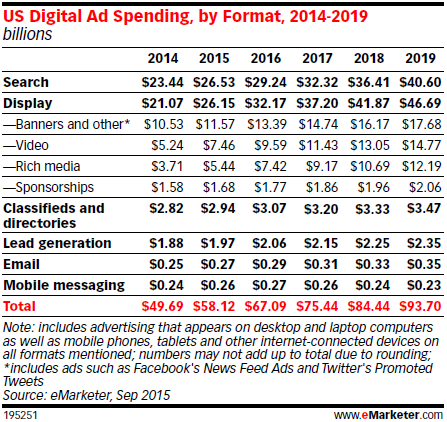
    US digital ad spend

    Image Source

    Now is the Time

    In 2016, US digital ad spend will surpass spend on search advertising. This is a big deal for marketers, because it’s the first time that digital ads will come out on top, with the estimated spend being more than $32 billion total. This huge figure is set to increase to over $46 billion by 2019.

    We already know that paid media and digital ads are a major factor in the buyer’s journey. They support brand discovery, encourage repeat visitors from partner websites, and reinforce the brand message you’re cultivating. Now that we also know that digital ads boost results holistically, we can look more closely at the proof.

    Digital Advertising: Facts and Figures

    Display advertising is a very effective way to drive traffic. Display ads across all formats result in an average 0.6 per cent CTRGlobally, we’re going to see increasing shifts towards campaigns that focus on digital. Multinational companies like Procter & Gamble invest huge amounts of money in this space. Investment of 30-40 per cent of a marketing budget is fairly typical, and reflects the overall interest of bigger brands in boosting overall results in a campaign.

    In fact, 57 per cent of CMOs expect budgets to increase over the next two to three years.

    Looking specifically at mobile, spend on mobile search is expected to increase from $13.6 billion in 2015 to $18.5 billion in 2016. And if we look at US spend on banners, rich media, sponsorships and other display formats, a massive 77.5 per cent – $17.5 billion – will target individuals on mobiles and tablets.

    The proof is there, and it’s compelling. But there’s one more piece in this puzzle.

    Honing Digital Ads

    When it comes to digital ads, the amount you invest is going to dictate your results. But focus is just as important, and 2016 is the year we’re going to see an uplift in ROI via more targeted advertising strategies.

    Coming up with effective ad strategies is not easy, and there’s an ongoing question mark around ad blockers and other tools that can disrupt planned trajectory. Brands are struggling to leverage the market on their own. But with the right support from a capable agency, any business can navigate this complex terrain.

    Position2 is well placed to deliver the strategy you need to make the most of your digital ad spend. We have our finger on the pulse, and we know which metrics to measure. We know how, and when, to target your audience.

    Seeking an integrated digital media strategy? You found your perfect partner. Contact us for advice today, and subscribe to our blog for more updates.