Category: Content Creation

  • Copy Writer vs. Content Writer: Which One is Right For You?

    Content creation is the lifeblood of digital marketing.

    It’s a given that customers aren’t just going to stumble on your business while browsing the internet unless your content compels them to. Content is the soul of digital marketing and any successful digital marketing campaigns, from search engine optimization (SEO), pay-per-click (PPC) advertising, and social media marketing (SMM) – all rely on top-notch content.

    Every sentence and every paragraph of content represents your business – setting up a new opportunity for your business to connect with prospective customers. There’s a catch here – content types vary. There’s content writing, and there’s copywriting – the difference is night and day. While both are used in digital marketing strategy, campaigns, and on your website, they have different purposes.

    It’s a common misconception among businesses that content writing and copywriting are interchangeable. If you hire a copywriter instead of a content writer (or vice versa), the result is not going to meet your expectations. A copywriter or a content writer’s ultimate goal is to influence their business’s bottom line, but that’s where the similarities end – if you use digital marketing for promotional purposes – we recommend you read on.

    Table of Contents

    • What is Copywriting?
    • Examples of copywriting
    • Top Features of Copywriting
    • What Is Content Writing?
    • Content Writing Examples
    • Top Features of Content Writing
    • Difference Between Copywriter and Content Writer
    • Content Writer vs Copywriter Statistics
    • Conclusion

    What is Copywriting and What is The Role of a Copywriter?

    It involves the creation of content to persuade readers to engage with your business’s sales process. Put simply, copywriting is writing advertising copy. So, what’s effective copywriting? It’s content that immediately grabs the reader’s attention, and clearly promotes a product or idea – prompting the reader to take action (clicking a link or making a purchase).

    Copywriters write persuasive short-form copies such as headlines, taglines, scripts for commercials, sales letters, product descriptions, and other types of advertising copy.

    Copywriters work closely with marketers, creative directors, and designers to develop content that resonates with their target audience.

    Examples of copywriting:

    • PPC landing pages
    • PPC ads
    • Cost-per-mille (CPM) ads
    • Social media ads
    • Product pages or brochures
    • Website sales copy or Website funnels
    • Sales emails or Direct emails
    • Short Message Service (SMS) ads
    • Conventional forms of advertising
    • Taglines

    Top Copywriting Skills

    A good copywriter possesses the combination of skills and qualities for writing a compelling content that captures and engages the target audience. Here are some important features of a good copywriter:

    1. Persuasion Skills

    A good copywriter is persuasive and can influence the target audience to take a desired action, whether it’s making a purchase, signing up for a service, or subscribing to a newsletter.

    2. Excellent Writing Skills

    A good copywriter must have excellent writing skills along with grammar, syntax, spelling, and punctuation.

    3. Understanding of the Target Audience

    A good copywriter understands the target audience, their motivations, and their pain points. This will help in generating a copy that resonates with the target audience.

    4. Research skills

    A good copywriter is adept at researching and gathering information on the topic they are writing about. This helps them create accurate, informative, and persuasive content.

    5. Creativity

    A good copywriter is creative and can develop unique ideas and perspectives that make their content stand out.

    The sole purpose of copywriting is to persuade. They use emotion to compel the reader to action. You’ll want to hire a copywriter if you’re hoping to sell something on your website through ads, email, or direct response materials.

    The primary objective is to understand sales psychology and human behavior. Copywriters use this understanding to craft copy highlighting a product’s features to create a unique selling proposition that addresses consumer demands and needs. Copywriters thrive on brevity and use emotion-based, short-form text that grabs attention and directs consumer behavior. According to research conducted by Harvard University professor Gerald Zaltman, over 9 in 10, consumer purchases are driven by emotion.1

    Marketing copy should be concise, using a limited number of words to convey the point and convince the consumer to take the desired action, whether to click a link or make a phone call.

    What Is Content Writing and What is The Role of The Content Writer?

    Content writing involves the creation of content to inform, educate or entertain readers. It drives sales, but that’s not its only purpose. With content writing, you create high-quality content to engage and entice the reader to learn more and empower the readers to make more informed purchasing decisions.

    Content writers are specialized in creating high-quality and engaging content that appeals to the target audience, drives traffic, and achieves marketing goals.

    Content writers may collaborate with other professionals such as designers, marketers, and editors to develop and optimize content for maximum impact.

    Content Writing Examples

    For example, a computer company may have datasheets or whitepapers on their current line-up of laptops that they intend to sell – those documents are providing useful and actionable information for consumers or a channel partner. Sales are the end goal, but content writing drives sales through exposure, and building consumer trust.

    • Advertorials
    • Blogs
    • Website articles/news articles
    • Evergreen articles
    • E-books
    • Social media posts generate leads and are aimed at a targeted audience
    • Tutorials
    • Emailer newsletters
    • Case studies

    Top Content Writing Skills

    To become a good content writer you should possess some excellent writing skills, creativity, and the ability to write in a tone that resonates with the target audience.

    1. Excellent Writing Skills

    A good content writer should have excellent writing skills and should be able to write clear, precise, and engaging content. They should be proficient in grammar, punctuation, and spelling.

    2. Creativity

    A good content writer should be creative and should be able to come up with new content ideas and fresh perspectives. They should be able to present the information in a way that is interesting and engaging to the readers.

    3. Research Abilities

    Content writers should be able to conduct thorough research on the blog topic and gather relevant information to write a valuable article.

    4. SEO Knowledge

    A good content writer should have knowledge of Search Engine Optimization (SEO) which would help them in optimizing their content to improve visibility and ranking in search engines.

    5. Adaptability

    Good content writers should be adaptable and able to write for various types of content, such as blog posts, social media posts, whitepapers, and product descriptions.

    The sole purpose of content writing is to engage, inform or entertain. A content writer uses education to connect with the reader and to build trust.

    About 6 in 10 consumers2 feel more optimistic about a company/brand after reading custom content on its site. If your goal is brand awareness, establishing thought leadership, demonstrating industry expertise, or creating educational materials for your customers – you’ll need to hire a content writer.

    Content writers craft long-form content (between 500 – 2,500 words) that is optimized for search. They are usually skilled researchers and excellent writers. The best content writers are storytellers, weaving words into compelling and relatable content designed to connect on some level with the reader.

    Differences Between Copywriters and Content Writers

    Here are some key differences between copywriting and content writing:

    Copywriter Content Writer
    Purpose – To sell the target audience to the brand Purpose – Build trust and educate the users about the brand
    Goal – Persuasion is their main goal Goal – To educate readers about the brand by writing a long descriptive content
    Audience – They target the specific audience who are interested in buying the product/service Audience – They target the broader audience who may or may not be familiar with the topic
    SEO – They mainly focus on the keywords and phrases which are designed to rank well in search engines SEO – Along with keywords they focus on creating high-quality content which will be valuable for the reader

    Breakdown of Differences Between Copywriter and Content Writer

    1. Purpose

    The purpose of writing content for both copywriter and content writer is different from each other. Copywriter writes short-form catchy content which can persuade users to take action on the page.
    While a content writer writes detailed long-form content to educate and inform the user about the brand. This will help in building trust and recognition of the brand among the users.

    2. Main goals

    Both the copywriter and content writer aim to improve the bottom line of the business. The only difference is that the path chosen by both professionals is different.
    The copywriter writes the content focusing on short-term commitment. Their topmost priority is to persuade their users to take action. In other words, we can say that copywriter is majorly focused on increasing sales.
    Content writing is a long-term commitment. It takes some time to build trust and recognition of the brand among the users. For this to achieve businesses need to post regularly to entertain and educate their target audience.

    3. Audience

    The target audience for both copywriting and content writing differs. Copywriting is designed in such a way that it will target only the specific audience who are interested in buying the product or service. The language and tone of the content would be more persuasive so that the target audience would take some action.
    While for content writing the target audience would be broader as a content writer writes long-form content to inform and educate the readers who may or may not be familiar with the topic at hand. The language and tone of the content would be more informative.

    4. SEO

    Search Engine Optimization (SEO) is an important consideration for both copywriters and content writers. However, the approach to SEO is different for each.
    The copywriter often focuses on specific keywords and phrases that are designed to rank well in search engines. The goal here is to make that copy appears on the top of the results when users search for those keywords.
    The content writer also focuses on keywords along with the main focus would be on creating high-quality content that is valuable to the readers. By creating informative and engaging content the hope here will be that content will attract links and shares naturally, which will help in improving the search engine rankings.

    Content Writer vs Copywriter Statistics

    When it comes to the world of writing, there are two main types: content writers and copywriters.

    Here are some statistics that highlight the differences between the two:

    – Content writers focus on creating informative and educational content for websites, blogs, and social media. They typically earn an average salary of $50,000 per year.

    – Copywriters, on the other hand, specialize in writing persuasive and promotional content for advertisements, sales pages, and marketing campaigns. They typically earn an average salary of $61,000 per year.

    – The demand for content writers is expected to grow by 9% from 2019 to 2029, while the demand for copywriters is expected to grow by 3% during the same period.

    – Content writing jobs are more prevalent in industries such as healthcare, finance, and technology while copywriting jobs are more common in advertising agencies and marketing firms.

    – While both roles require strong writing skills, copywriters must also have a deep understanding of consumer psychology and marketing strategy.

    Overall, whether you choose to pursue a career as a content writer or a copywriter will depend on your interests and strengths as a writer.

    Dabbling in copy and content?

    Can a content writer also craft compelling copy, and can a copywriter create useful content? Absolutely. A good writer can do both – the ability to juggle content and copy expand the writer’s options for future assignments.

    Conclusion

    Content brings an audience to the website – copy converts that audience into consumers.

    In conclusion, the choice between a copywriter and a content writer ultimately depends on your specific needs. If you’re looking for persuasive writing that drives action and sales, a copywriter is your best bet. However, if you’re more interested in engaging your audience with informative and educational content, then a content writer is the way to go. Ultimately, both roles are important for any successful marketing strategy, and it’s important to find the right balance between them based on your goals and objectives.

    FAQs on Copywriter vs Content writer

    What industries hire copywriters and content writers?

    The travel industry, the Healthcare industry, Nursing homes & assisted living facilities, Education, and Staffing & Recruiting.

    How do copywriters create effective advertising messages?

    Here are some guidelines for creating memorable advertising that really sells:

    • Make sure your ads are “on strategy” with your business positioning.
    • Go to where your customers are.
    • Communicate a simple, single message.
    • Stick with a likable style.
    • Be credible.

    How do copywriters work with designers and other creatives?

    Copywriters and designers are natural collaborators. Both share a common mindset: to create beautiful, effective things that engage people and achieve results. In other words, to build stuff you believe in.

    What is the role of a content writer in SEO?

    An SEO content writer understands search engine optimization and knows how to write content that’s informative, compelling, and relevant. However, they aren’t always effective when it comes to writing content intended to drive conversions.

    How do content writers create engaging and informative content?

    • Address something your audience cares about
    • Think about the user need you’re going to fulfill
    • Make sure the headline indicates what you’re actually going to write about
    • Get your timing right
    • Understand which format fits at what time
  • Why Live Video Streaming – The Next Big Thing In Marketing

    Digital marketing has spent much of the past decade looking to social media for the latest trends in cool content. So, it should come as no surprise that the popularity of live video streaming has grabbed the attention and imagination of marketers worldwide.Live video streaming or livestreaming involves broadcasting video content on the internet in real time. The idea of streaming video on the web for promotional purposes is not entirely new; businesses have been using webcasting to share key events with wider audiences online for a number of years.

    Reaching Millions

    But the game changer has been the recent explosion in dedicated live streaming app such as Facebook Live, Youtube Live, Periscope, Meerkat, Younow, Twitch and many more are giving millions of users worldwide opportunity to broadcast live to the world at the touch of a button. And millions are watching.

    It is this level of popularity which has grabbed the attention of the marketing industry, speeding up the on-going shift in advertising spend away from television towards digital video. A recent poll of US marketers found 41% are keen to trial live video streaming as a content platform. One-fifth of US media decision-makers have already allocated budget to advertise around livestream content in the next 6 months.

    So why the buzz?

    Livestreaming is proving a hit on social media because it is immediate, it is personal and it feels authentic. In a world where people expect much video content to be heavily staged and layered with CGI effects, livestreaming feels stripped back and more real. The popularity can be compared to the viewing figure peaks seen for a big live sporting event or a major live news broadcast. People love watching live content.

    That buzz has created a rush of demand to advertise around livestream content, hiking prices way up above comparable online display rates. On the other side of the coin, the close association with livestream has helped social media overtake dedicated video services as the preferred platform for digital video campaigns – according to Trusted Media Brands, 65% of US marketers would rather use Facebook and Twitter than Youtube. With that kind of pulling power, you cannot afford not to be in on livestream.

    Brand Benefits

    The power of livestream is not just about the size of the audience. According to research from Brandlive, a specialist livestream SaaS consultancy, 79% of US-based retail executives feel that live video streaming helps to create more authentic interactions than other forms of digital media, adding a ‘human’ element. Not only does the sense of immediacy and authenticity attract large audiences, it helps to establish trust in a brand and positive interaction.

    In the same survey, just under a third of respondents cited the fact that livestream offers real-time feedback from customers. The ‘live’ aspect creates the conditions for a genuine conversation with an audience of thousands, as everyone can log their thoughts and reactions there and then. And while the ‘live’ element carries much of the power of the format, and content produced can of course be recorded to be reused again, helping to drive traffic to websites where archives are hosted.

    If you are looking to keep up with the latest trends with your digital marketing campaigns, Position2 has the expertise and industry insights to provide the support you need!

  • Creative Guidelines For Marketing


    You know your target audience. You know the response you want to stimulate. And you know the kinds of metrics you hope to see as a result. These best practices will help you get there:

    Copy

    • Keep the message simple and strong. Use an active voice.
    • Keep your target market in mind while writing the copy
    • Use short and punchy headlines

    short and punchy headline

    • Don’t overuse exclamation marks, uppercase, bold letters and emoticons. Have a specific reason for using them

    use of punctuation

    • Make your message scanable. Don’t overwhelm readers with long paragraphs and lots of copy

    content

    • Body font should be 12 point or higher (and if you’re using a Sans Serif font, increase leading)
    • Use a punchy call to action

    punchy call to action - CTA

    Graphics

    Images and visuals are a critical part of marketing your product or service.

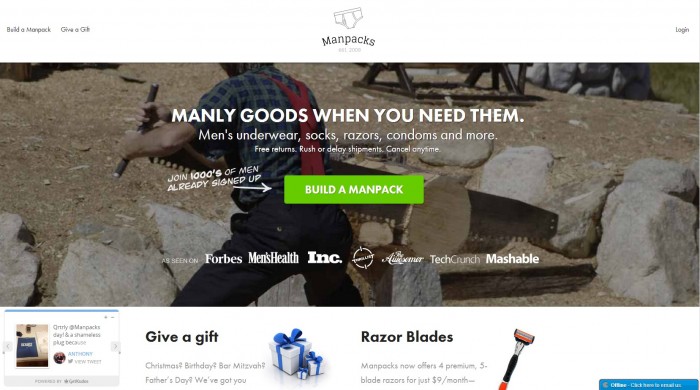
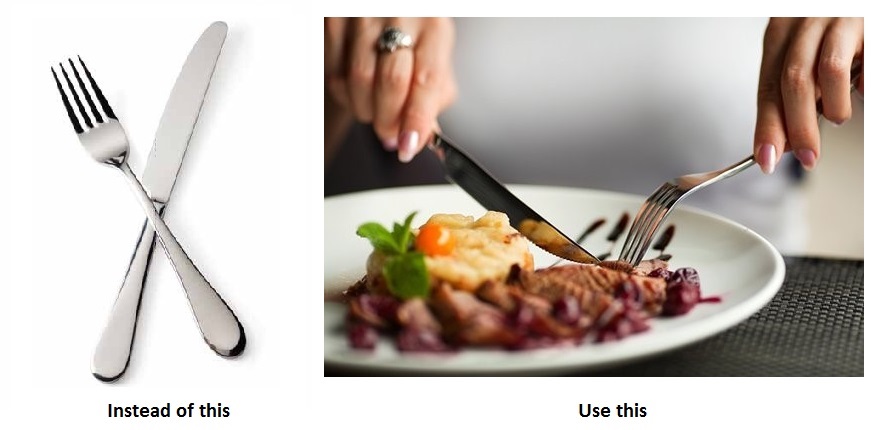
    • Always use shots of people using the product/service instead of product shots alone. It makes an emotional connection with the target audience

    standalone product images vs user images

    • The larger the illustration, the better. They get more “sight time”

    larger illustration

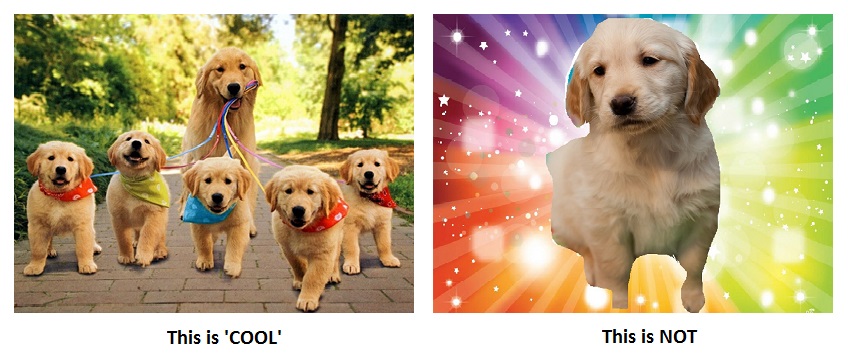
    • Warm colors (yellow, red, orange, pink) pull more views than cool colors (green, blue, gray, beige)
    • Use colors with care. Subtlety is your friend

    color usage

    Layout

    Layout is critical. It can make or break direct marketing content.

    • For magazine ads and postcard type mailings, the eye goes from right upper, to left middle, and ends at right lower. Design your piece with this flow in mind.

    layout

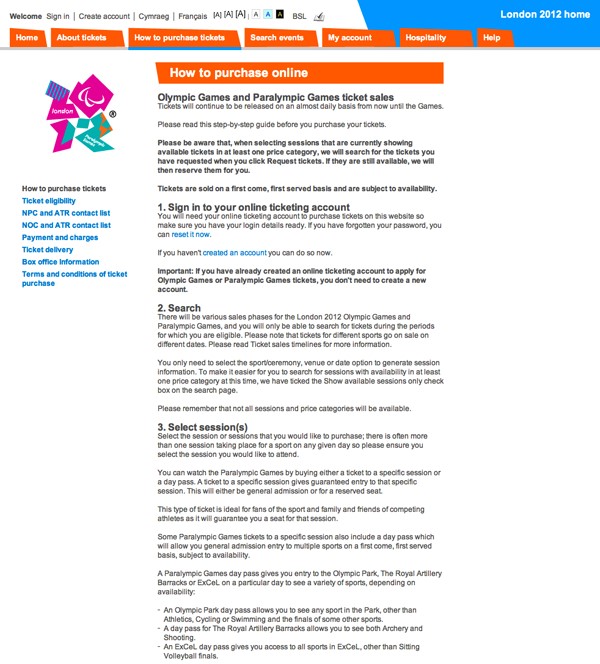
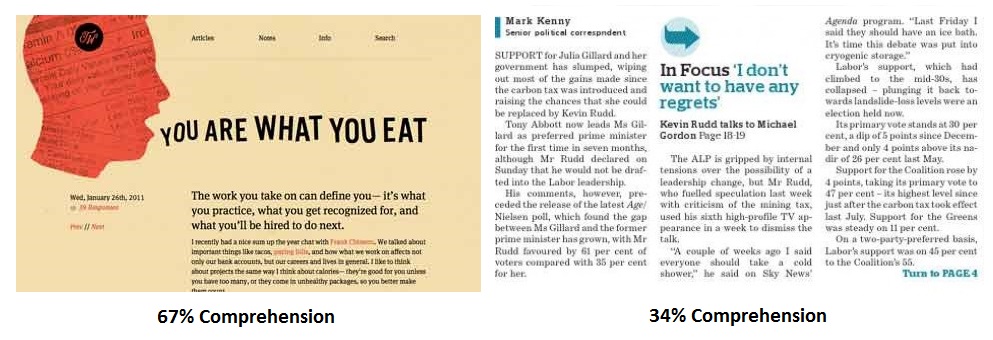
    • It is best to follow a Picture, Headline, Body Text format (67% comprehension) over placing the Headline and/or Picture under or alongside the Body Copy (34% comprehension)

    page design and layout

    • For letters the eye starts upper left and zigzags to end at lower left. This is why a P.S. in a letter is so important

    ps

    The devil is in the details. But details lead to marketing success.

    Share your comments and experiences in the box below!

  • Creatives in Today’s World

    We all know that visuals are an attractive aspect of digital marketing collateral. But within the world of creative development, what are the skills required and trends observed to succeed? Where is the world of creative development heading?

    Recent research indicates that app development and 3D modeling are must-have skills. This is partially true. However, creative development is such a diverse area that each sub-domain under creative development requires different, in-depth specialized skills.

    Rajesh Muthyalu, Creative Director at Position2 sheds more light on the current scenario in creative development. Here’s what he had to say:

    Team Position2: Creative professionals thrive in a rapidly changing world…how do you keep up to date with all that’s happening?

    RM: It is our job to know what is happening and so we consciously spend time to stay updated about the latest developments. We subscribe to select newsletters and follow trends on leading websites. We ensure that everyone in the company has access to this information.

    We strongly believe in knowledge sharing and update everyone in the team with new trends. Importantly, we look at new trends through the filter of usability. We are also active on relevant LinkedIn groups through which we gather updates about important webinars on design trends. The team attends these webinars to stay updated.

    Team Position2: What is your take on mobile specific designs and usage of responsive technology?

    RM: At Position2, we use responsive design technique. It is better than mobile specific designing because there are a variety of screen sizes in the market. We incorporate new aspects like long scrolling, which have come into being due to smaller screens that necessitate more scrolling. Also, for mobile based Landing Pages (LPs), we follow best practices like shorter forms, less images and so on to facilitate better user experience and faster loading speeds.

    Team Position2: How do you believe the B2B industry is keeping up with the change in creative development?

    RM: B2B industry does embrace new trends in creative development like scrolling and single page website. But the adoption is slower and not to the extent of B2C because of the difference in the nature of the target audience. B2B targets industry professionals who are short of time and expect information to be readily available in one place. B2B designs need to follow specific wireframes where all the important information has to be seen on the home page in the form of top menu bars and such. We can and do implement new trends in the B2B industry also but the focus is on doing what’s best for a client.

    Team Position2: When we think of creative teams, we imagine a bunch of creative professionals brainstorming and writing on a piece of paper or a whiteboard. How does the Creative team at Position2 work?

    RM: We first get an initial brief about the client, which includes details about their target audience. Next step is to have a Q&A session with the client. We then have a strategy meeting where team member comes up with creative ideas separately. We always encourage input from everyone, because anyone can come up with a great idea. We then discuss each person’s ideas, vote and pick the most appealing ones.

    Before beginning the creation process, we create a single reference document with approved final ideas. The ideation process involves developing multiple wireframes, copy and obtaining client approval for the design and copy. Once we get the approval, we plunge into the creation process, post which we employ a stringent QC process that includes multiple rounds of internal and client QC. The final design includes inputs from all the relevant people without compromising on creativity or usability.

    However, our creative process can be customized based on asset and client requirement.

    Team Position2: Have you adopted the use of smart devices to help you do great creative work?

    RM: Depending on the requirements, we use latest devices during the creative development process. Testing for all scenarios is done using different updated devices and technology.

    Team Position2: How do you take decisions? Do you trust your intuition or would you prefer to rely on research? Do you like to break away from rules and create new trends or do you stick to existing trends?

    RM: We check designs with industry trends and see how they compare. We always give first priority to usability, because, as designers we can adapt quicker to new trends than users. It is important that we don’t leave users behind because we have evolved faster than them.

    Team Position2: How has the creative field evolved over a period of time?

    RM: Not much change has happened in the last 2 years, and in the B2B industry, change is relatively slower than in B2C. In B2C, technology and trends change much faster. Lately, more changes have happened in B2C than in B2B.

    Team Position2: What new skills are in demand in the creative field?

    RM: For videos, skill in using Adobe After Effects, Adobe Premier Pro, Adobe Flash and Cinema 4D is necessary. We use technologies based on the time available to deliver. Sometimes, we use all the above technologies to create a video.

    For infographics, static banners, ads and LP designs, we use: Adobe Photoshop and Adobe Illustrator. Animated banners and ads require expertise with Adobe Flash.

    And every designer needs to understand basic HTML to design web pages. He/she also has to have knowledge of HTML 5 and basic design guidelines.

    Team Position2: “Traditional media restricts you because of guidelines (TV – time, print – space)…but social is where creativity thrives because you have more freedom. According to recent research, social media/ mobile friendly designs inspire to create. Is this true or do they restrict creativity? What are the main sources of inspiration for you?

    RM: Social media gives immense freedom and flexibility to create wonderful campaigns and helps you get to a whole new level.

    But there are certain social media platform design specifications that have to be followed. We subscribe to these updates from all the major social media sites and stay updated. Also from the viewpoint of development, in digital media, you can change content anytime, even if it is live.

    Testing results on digital will help optimize collateral better. However, one drawback is that you will lose out on visibility and engagement if you make changes in videos and upload new ones.

    Team Position2: How important do you think 3D modeling is as a trend? How are companies/ clients going to benefit from that?

    RM: Rather than a common trend, 3D modeling is used based on the industry the company is from and what their requirement is. 3D modeling more suited for certain industries than others. For example, 3D modeling is a great technique for the automobile industry.

    Team Position2: How do you keep your team updated in terms of knowledge and skill sets?

    RM: Always, emphasis is placed on the team having basic understanding of all creative technologies. Depending on the sub-domain the person is working in, he/she needs to go deeper into their respective field. The team attends relevant webinars and training sessions based on the skills required. But, as said earlier, usability and creativity are most important.

    Team Position2: Do app development and 3D modeling enhance the appeal of creatives?

    RM: We develop a lot of apps for our clients. In any medium, creative appeal is the combined function of technology, powerful visuals and copy. Based on the medium and platform used, you need to pick visuals, animation or copy to be highlighted to enhance appeal.

    Team Position2: What role do mobile devices play in creation and inspiration?

    RM: Mobile device aspects like Flat UI, no bevel, embossing and iOS have inspired creation and changed design trends. Since we need to consider load time and usability on mobile devices, it changes the design. Responsiveness that has come into play because of changing mobile device screen sizes has also impacted design.

    Before I sign off, I would like to say that, “We have seen simple, sleek and flat designs. Now, it’s time to design using responsive framework since users are spending most of their time on mobile/tablet devices. Flat designs and long scroll approach with parallax scrolling will become even more popular. We need to focus more on UI/UX than latest trends keeping best practices in mind especially in the B2B space.”

    That was really informative Rajesh. Thank you!

    Marketers, what is your opinion about the field of creative development today?