Author: Tristian Lacroix

  • Content Mapping – Why is it Important?

    When developing marketing content – how do you start the conversation and where do you engage with your prospects and clients?

    For the consumer, your solution can easily get lost in a sea of SEO keywords, landing pages that all look alike and social channels with sporadic episodes of content. You need to position your solution in the right context for your business. Most companies know the prerequisite marketing for your website, product brief, and contact form-fill pages but not many go beyond that to tailor the bespoke experience for your audience. The extra step of content mapping your collateral can deliver a full-funnel experience for easy access to information and enough due diligence for next steps.
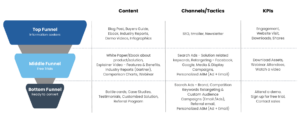
    Content Mapping Featured Image

    First, for top-of-funnel content, make sure you are building your narrative and positioning your value prop in a clear and concise way. Begin your content by telling the audience what question you’re going to answer, what problem you’re going to solve, and how you’re going to help them achieve a specific goal. This will save time and keep the audience engaged.

    For the rollout of content, make sure there is an up-to-date blog post, topical podcast, and or youtube video showcasing your solution for the audience. Awareness content can have a huge impact on the customer who is screening multiple solution providers for base-level domain expertise. If your content is topical, posted on a regular schedule, and provides enough of a comprehensive approach to the subject matter then it is perceived as authoritative and trustworthy. SEO best practices would also entail making sure that backlinks, such as PR/news, are up to date and optimized.

    During the middle of the funnel, stakeholders are comparing and shopping solutions. In this phase the highest impact content is video. Explainer videos, customer success story videos, and recorded webinars bring to life the solution, product, or service your organization focuses on. In this phase of the discovery process, the audience wants to see color both literally and metaphorically. The solution benefits and story should be on full display to highlight why your value prop is the leader in your industry. Clear, defined features and success outcomes should put even the most jaded stakeholder at ease with wanting to learn more and or make contact.

    For example, if your product or service has made a significant impact on a client – make sure to showcase this by getting customer testimonials, quotes, and perhaps even a video interview from the satisfied customer. There is nothing that compares in the consideration phase more than real examples of your solution shining.

    Finally, at the bottom of the funnel, make sure your content is summarizing your solution benefits with actionable next steps. The CTA should feel like the logical continuation of the conversation to move the needle forward. For instance, the next step of contacting your company should be an easy one. Both simple form-fill pages and additional gated content like case studies could serve two objectives. The first, getting the contact information of the now very interested prospect, and secondly, giving one last example of a success story that your solution achieved. Here, contact is not only expected by the prospective customer but welcomed.

    At this stage, your solution is probably one of two or three, and FAQs are top of mind. Internally, make sure all your representatives have battle cards and energized talking points to devour the competition with your solution facts! If your solution has a proprietary algorithm and or uses AI to solve complex business challenges – make sure you are speaking to that differentiator.

    Likewise, just as it’s important to map the right content according to the buyers’ journey; it’s equally noteworthy to have an overarching multi-touch approach to content distribution. Mapping the right collateral to SEO, the company website, and social channels are commonplace. In fact, an argument can be made that if you are not continuing the conversation on more than one device and channel then you’re leaving an opportunity on the table. My favorite platform for granular targeting in the conversion phase is Linkedin in general. The preferred medium is video.

    As your audience finds value in your content, they should be encouraged to be a part of your community. Advocacy and evangelism are sometimes left as an afterthought for content. Instead, plan for community-building opportunities to consistently engage with your loyal audience. Ultimately, it is vital to guide both new and returning leads through the journey while employing the right plan, channel mix, and commitment at every step.

  • Qualitative Strategic Content Audit Guidelines

    When was the last time your team did a content audit on your marketing assets ?

    A qualitative assessment of your content is a best practice – it’ll help identify messaging that’s out of date, improve relevancy for new audiences as well as overall organization for your content.

    What qualifies as content?

    Everything from your website (and landing pages), blogs, social media channels/pages, posts, and third-party content/event is a good start for a content audit. Don’t stop there, there’s value in extending the audit to product briefs, whitepapers, use cases, customer success stories, ebooks, webinars, videos, and recorded live streams.

    Do you know how your content measures up against your business goals? And why is that important? If you’ve never done a content audit, it can be overwhelming to get it started, try focusing and prioritizing on what content needs action, then start identifying low-quality content to clean up or remove.

    Quick questions to ask when you’re considering an audit:

    Does your content meet your audience’s needs?

    Is your content findable?

    Is your content easy to digest?

    Is your content actionable?

    Strategic Content Assessment Factors

    Time to get started evaluating content quality and value:

    Is the content relevant? Yes or No

    What’s the purpose of the content? Is it Informative or Actionable? Does the content educate or influence the audience? Or is the content meant to move the reader to take action (fill out a form)?

    What is the value of the content? Is it critical to the goals and strategy of the business and or does it support your brand?

    How valuable is your content to your audience? In order to identify the value, you have to measure audience engagement (web visits, time on page, clicks). If you don’t measure engagement, you’re just speculating.

    What’s the tone of your content? Does it support the brand voice, persona(s), and buyer’s journey? Does it represent the voice of the company or the product team?

    How accurate is your content? Does it represent the current view of messaging or product information?

    Expertise, Authority and Trust (EAT)

    One of the more important aspects of content/content marketing that you’ll have to address is EAT. It’ll be difficult to measure in your organization but it’s important to Google – since they represent a large part of US search – it’s also critical for your business.

    Expertise in content is demonstrating that you (or your company) have the domain expertise. Being an Authority is the natural progression of that expertise. Trust, howsoever, is built over time – think of your favorite ‘trusted’ brands, they took years to build.

    There’s no quick way to build up EAT, if you haven’t started – there’s no time like now to start.

    Content Marketing checklist

    Use this list as an audit checklist and a foundation of a scoring system.

    Audience: Identify the relevant audience and match it to the right content asset. Your audiences will include customers, prospects, internal, press/media etc.

    Industry: If your content is developed for a particular industry – be sure to identify it by industry. Some of your content will have broad appeal – list it as general or multi.

    Service / Product: Your company could offer services, a product(s), or both – identify your content accordingly.

    Key topic: When reviewing content that is editorial in nature (blogs, case studies, eBooks, etc) identify each asset for its key topic for easier categorization and access

    Funnel: Is your sales and marketing content applicable to the stages of your prospect/customer journey? You’ll want to identify and categorize the content asset by TOFU, MOFU, and BOFU (top, middle, bottom of the funnel).

    Objective: What’s this content purpose/objective? Brand awareness, sales, lead generation, etc.

    Map Your Content

    Map your content to your audience persona’s buyers’ journeys. (TOFU, MOFU, BOFU)
    (use a comprehensive multi-touch attribution approach i.e. website, social, third-party)

    1. What is the current audience mindset?
    2. What do we want them to think and feel regarding our offering?
    3. What are our key message(s) and messaging frameworks?
    4. What are the appropriate content types(video, short-form, long-form?)
    5. What content is available and low effort/high effort?
    6. Determine the appropriate KPIs?
    7. Find your gaps? What is missing?
    8. Make appropriate content recommendations for net new.

    Results

    Once the audit is completed you’ll have the confidence that your content is positioned to perform, on-brand, current, and valuable to your audience.

    • Outdated content is refreshed and updated
    • The digital experience for customers and prospects is improved
    • Your brand message is clear and concise
    • Content is more relevant to the audiences it was developed for
    • Traffic and site stickiness improves
    • Redundant or outdated messaging is removed
    • You’ve de-cluttered the CMS
    • The client has actionable insights and next steps