Author: Sajjan Kanukolanu

  • Future-Ready Agencies Must Embrace AI and Human Collaboration

    Change is the only constant in business, and technology has always been a change driver. The impact of generative AI-led tech will be unlike anything we have experienced. AI tools have the potential to revolutionize how digital marketing agencies price their services, organize their teams, operate, and continue to be profitable.

    If your agency or marketing team still needs to adopt the Gen AI capabilities, you may already be missing out. Why? Because your competition is not waiting, nor is the AI tech advancement.

    It can be overwhelming, instead of focusing on every new tool or application – focus on a few marketing areas where generative AI significantly impacts your business or your industry. Explore potential applications and strategic implications for marketers. Learn how humans and machines can work collaboratively and how human involvement will remain indispensable.

    As businesses strive to create engaging and personalized customer experiences, generative AI presents a transformative opportunity for marketing agencies to achieve unparalleled creativity, efficiency, and customer engagement.

    Here are some of the applications and implications of this technology:

    Transforming Creativity

    Today’s AI platforms produce original and innovative content and design, challenging traditional notions of creativity. Digital marketing agencies can use these algorithms to generate compelling visuals, ad copy, and immersive storytelling experiences.

    Platforms such as Dall-E, for example, allow us to combine human creativity with the limitless possibilities of AI. Agencies can unlock new realms of imagination and deliver truly unique and captivating campaigns.

    While AI can provide inspiration and streamline certain creative tasks, it cannot replicate the true depth of human creativity. The human touch adds emotion, intuition, and an understanding of brand and cultural nuances, enabling marketers to craft unique and compelling works of art.

    Automated Multichannel Campaigns

    AI can automatically adapt and optimize marketing materials for various channels, including social media, email, websites, and mobile apps. Sophisticated algorithms ensure consistent messaging and design across multiple platforms, reaching customers at the right time and through the most effective channels.

    Chat GPT can help with basic content that prompts can generate. The more detailed your prompts, the more accurate the output. Jasper can help with SEO and email content. Generate extensive prompts that help with email and other short and long-form content in seconds. Copy.ai can help with social posts and more in seconds.

    This level of automation frees up agency resources, allowing everyone to focus on strategic planning and creative imagination. Marketers can conduct detailed and deep research on the target markets, geographies, and personas. This can feed into the AI platforms that will then offer insights, content, and ideas that can speed up campaign launches and go-to-market.

    Dynamic Optimization

    With generative AI, digital marketing agencies can optimize real-time content based on audience response and feedback. The algorithms can dynamically analyze user engagement metrics, sentiment analysis, and conversion rates to adjust and optimize campaigns.

    LLM-based platforms create AI applications rapidly to create custom data optimization models that can be used for SMBs and Enterprises alike.

    This enables agencies to fine-tune content, ROI targets, budget allocations, and ad elements such as headlines, visuals, and calls to action. Ensuring that marketing messages resonate with target audiences and maximize desired outcomes.

    Streamlined Customer Journey Mapping

    Generative AI can revolutionize how to map and optimize customer journeys. By analyzing vast amounts of customer data, AI platforms, such as Upshot.ai, can identify key touchpoints, pain points, and opportunities for engagement.

    This knowledge allows agencies to create seamless, personalized customer journeys that guide individuals from initial awareness to conversion. AI-powered customer journey mapping ensures that marketing efforts are aligned with customer needs and preferences, leading to improved customer satisfaction and higher conversion rates.

    However, it is crucial to remember that AI is a tool that augments human decision-making rather than replacing it. Marketers must interpret the insights generated by AI systems, apply their strategic thinking, and make informed decisions based on their deep industry knowledge and expertise.

    Hyper-Personalization at scale

    Generative AI enables digital marketers to achieve hyper-personalization at an unprecedented scale. These algorithms can analyze individual preferences, behaviors, and interactions by leveraging vast customer data to create highly personalized marketing materials.

    From tailored product recommendations to customized email content, generative AI empowers agencies to connect with customers on a deeply individual level, fostering long-term loyalty and increasing customer lifetime value.

    Opportunities for agencies

    The Evolution of Roles and Skillsets

    The advent of Generative AI is not a threat to human jobs in the digital marketing industry. On the contrary, it allows marketers to evolve and embrace new skill sets. AI should be a technology that takes over repetitive and time-consuming tasks. Marketers can focus on activities that demand creativity, strategy, and critical thinking.

    Professionals in the field must adapt and upskill, gaining proficiency in AI implementation, data analysis, and decision-making. Human intuition, empathy, and understanding of complex consumer behavior remain invaluable assets that AI cannot replace.

    Ethical Considerations and Human Oversight

    As digital marketing agencies embrace generative AI, ethical considerations continue to emerge. Agencies need to ensure transparency, fairness, and responsible use of AI.

    Human oversight becomes crucial to guarantee that AI-generated content aligns with brand values, trademark regulations, legal guidelines, and ethical standards.

    A balance between automation and human judgment is required to maintain unbiased output and mitigate potential risks associated with AI-generated content.

    In conclusion, generative AI applications are here to stay and will continue to influence marketing and design for the foreseeable future. The future of digital marketing agencies lies in harnessing the power of generative AI to deliver unparalleled creativity, personalization, and efficiency.

    Balance must be maintained between AI-driven automation and human oversight, ensuring ethical use and preserving brand authenticity. The true potential of Generative AI lies not in fearing it or in keeping it at bay but in collaboration where humans and machines work hand in hand to bring ideas to life.

  • It’s Time for Marketing to Own the Customer Experience (CX)

    The role of marketing has changed dramatically in recent years. Marketers’ scope of work has expanded from just running ads and generating leads. In my recent posts, I discussed how CMOs and their marketing teams own organizational growth and are expected to manage customer churn. The marketing tech stack is now owned and run by marketers and not the IT team. These are just a few ways in which marketing’s avatar is evolving.

    The lines are blurred…

    The line between Customer Experience (CX) and marketing is already blurring. CX is no longer a siloed function. For companies to grow, their CX strategy needs to be deeply intertwined with everything the organization plans and executes across functional areas, including marketing. But of all the departments, CX has a special place in marketing.

    Historically, marketers have always cared about customer behavior for their campaigns. But now more than ever, the marketing function is in the process of understanding, influencing, and changing the customer perceptions, which traditionally was seen as a CX responsibility.

    So, what’s changing?

    The difference now is that CMOs and their teams’ scope has expanded from lead generation to delivering a consistent and seamless experience, from acquisition to conversion to growth to advocacy. Marketers are beginning to support customer journeys, similar to what CX used to do. This new reality shift means that marketers need to have the right message ready for customers, no matter the channel and no matter the time. And, customer needs are changing fast too. This means that marketing needs to capture, analyze and deliver against these new expectations.

    How Can Marketing Own CX?

    It’s crucial for marketers to be mindful of the customer experience, and be active in helping improve it. Here’s what marketing can do to optimize the CX.

    1. Start with the Customer: The Persona and The Journey

      The first step in owning CX is to start with a deep understanding of the customer profile.

      This has two key parts:

      • Start by understanding who your ideal customer persona is and what their needs are. When organizations understand their target persona they can leverage the needs of these personas to drive best-in-class messaging, content, and campaigns.
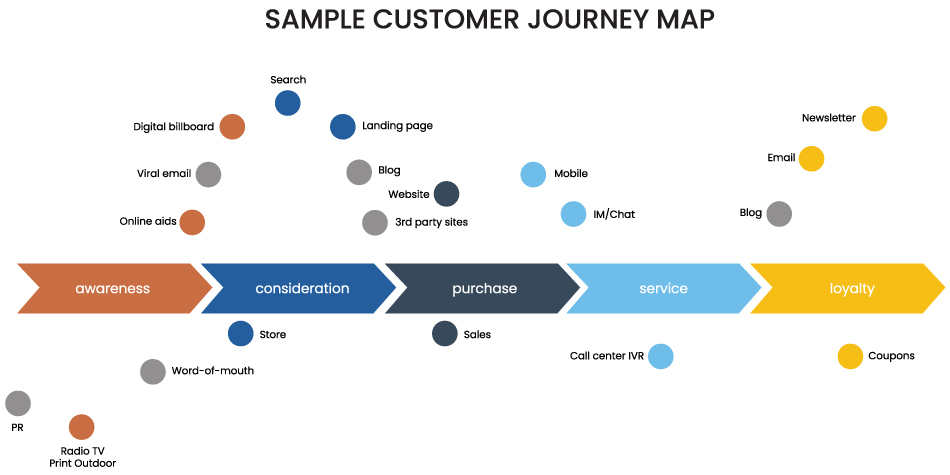
      • Once marketing understands these personas in-depth, the next step is to identify all the touch-points customers have with your brand. This is the journey a customer, prospect, or ex-customer takes with your service, brand, or product. Imagine these touch points as a visual storyline of every engagement with the brand. For example, a journey map may include how the customer first heard of you through social media or brand advertising, interactions with the product in a store, their behavior on the website, sales interactions, after-sales support over a period of time, and so on.

      Outlining your current steps, touchpoints or processes helps to visualize what the customer is experiencing in real-time and may unveil common pain points that need to be addressed. The ability to establish empathy for your customers and identify how they’re feeling at every turn is what makes customer journey mapping powerful.

      Through this exercise, you’ll also be able to connect with new buyers, existing customers, and past ones. Marketers can engage with all of them at every stage with the relevant messaging to reduce friction and provide relevant and personalized content. This not only improves customer experience, but it also helps move more customers or prospects down the funnel to sales, repeat sales, and advocacy.

    2. Build Trust with a Robust Content Strategy

      Once the journey is mapped, marketers need to build a thorough and deliberate content strategy that addresses all the good and bad points across the journey. This strategy should be persona and touch point specific, not a one size fits all.

      Start with a content strategy that is grounded in the very purpose of content marketing – creating and adding value to customers. Don’t hard sell. Rather provide a solution to a problem or offer value in the form of information. If you put out the most relevant content for your new, current and past customers depending on the persona and the touch points, it builds relevance and trust. This trust then creates repeat visits, be it in-store or online. This triggers repeat purchases and loyalty.

    3. Double Down on Your Biggest Asset: Social Media

      Social Media is an interesting channel that functions as a marketing platform and a customer service medium. But, social media accounts are owned by marketing in most companies. So why cannot CX become part of marketing’s ownership?

      When marketers own CX on social media, they can enhance the customer experience by responding quickly to questions and starting the conversation. They can use it promote content, communicate service enhancements, new products or product features, and loyalty rewards to eligible users. When done right your customers become defacto promotors who rave about your brand. This success then gets noticed by your prospects and is likely to increase your overall customer base.

      Marketers can also run integrated campaigns between email, search, and social. These can be designed in such a way that markets layout a series of personalized connects with each persona and their specific journey touch points. Using this approach marketers can share the right content and engage with the right prospects on the right channel at the right time. This strategy is a great way to move prospects and customers down the funnel to closure.

    Wrapping up

    When marketers own the CX, they have an opportunity to create a new customer base, increase stickiness with current customers – moving them towards loyalty and advocacy.

    With the connected digital ecosystem, there’s no better time than now for CMOs and their marketing teams to own customer experience. This is the golden era where marketing can own the end-to-end customer journey, from acquisition to repeat customer to a loyal advocate.

  • Marketers Can Manage Churn to Show Growth

    This article is a continuation of the one I wrote on how CMOs and their marketing team can drive organizational growth.

    As Marketing takes charge of growth, an important aspect of the business to understand and manage is your client churn.

    A common question here is: why should marketers care about churn, isn’t it customer service or leadership’s responsibility? – Wrong!

    Don’t Keep Filling a Leaky Bucket

    Lost customers impact business sustainability, and result in multifold cost incurred to get new ones. While this increases marketing budget, just covering the gap is not growth.

    Thus, it is only fair that when Marketing is tasked with bringing in new customers, they should have a say in retention too. At the very least, Marketing should influence retention along with other groups such as customer-facing teams and Sales.

    Types of Churn

    Generally, churn can be of two types- customer churn and revenue churn.

    Assume you have two customers: Customer A generates $1,000/mo. revenue and Customer B produces $5,000/mo. Your total revenue is $6,000/mo. Assume you lose Customer A. Your customer churn is high at 50%. But if you look at the dollar/revenue churn, you are at 17%, a fairly small number. You still have $5k MRR (monthly recurring revenue) from Customer B. Congratulations!

    Now, if you lose Customer B, your customer churn is still 50%, but the dollar churn is 83%. This number is big enough to give you sleepless nights.

    Imagine if you did lose Customer A (at $1k/mo. revenue), but you grew Customer B by $2,000/mo. – the total revenue now is $7k/mo. In this scenario, the revenue churn is actually negative. This is good news.

    Negative Churn Formula

    Negative churn is a powerful metric to measure your success despite the loss. A negative churn is a positive thing, and for this to happen, your additional revenue from any existing customer should be greater than the revenue lost from churn.

    Expansion

    Marketing can Control Churn

    Marketing has a lot of control over churn reduction and on expanding revenue from current customers. In fact, Marketing can help the customer-facing team and the leadership reduces churn. What is required is a deliberate strategy.

    Appropriate short and long-term nurture strategies such as content marketing and ABM (Account-Based Marketing) can help reduce churn. Marketing teams can plan and implement custom programs to the key accounts and promote the benefits of the products/services they signed up for – in a way influence why they should stay with you. Marketing can promote product features and how the product is different from competition to attract new customers. Assets such as case studies, white papers, product videos, testimonials from current customers, and other thought leadership content can help build a positive image with your current and future customers. Who does not want to be associated with a company that is making other firms in their industry successful, right?

    Other strategic initiatives could include webinars, social media, Q&As, blogs, meet-the-expert events, etc. In the post-pandemic business world, all these can be executed virtually with lower costs than large scale off-line events. You can now spending your marketing budget on customer retention and revenue growth effectively.

    Conclusion

    Your customers want to know that they have made the right decision in hiring you to help them grow. Marketing as the growth driver and one with customer insights have all the ammunition to manage churn. Thus, marketing should contribute towards and run churn management programs in conjunction with other teams such as Customer Care, Sales, and Account Management. The collective customer insights from all these teams are priceless and can help build a robust churn management strategy.

  • Chief Marketing Officers, You Own Organizational Growth

    According to Mckinsey, 83% of Global CEOs say that marketing can be a significant growth driver in their organization. This is great news for the Chief Marketing Officers (CMOs).

    But don’t pop the champagne bottle just yet! Only 23% of CEOs feel that marketing is delivering on that plan. Ouch!

    Like it or not, the responsibility to fix this is squarely on us marketers.

    So how do marketers drive growth?

    It starts by (1) recognizing that the role of marketing has indeed changed and (2) taking on accountability for the entire customer journey.

    Let’s deep dive into these two areas.

    Consumers Have Redefined Marketers’ Role

    During the pandemic, offline interactions and transactions moved to digital touchpoints at a shocking pace. And there are no signs of this abating.

    As a result, we are in the midst of a new era of consumer expectations. To cater to this demand, large and small companies have already moved, or are fast-moving, to digital experiences for their customers.

    This change is forced upon us by consumer behavior. Given marketing’s close proximity to the consumer, the impact on it is also most widely felt. As a result, the role of Chief Marketing Officers (CMOs) and their teams is changing fast.

    80% of respondents to the 2021 CMO Spend Survey by Gartner indicated that they are solely responsible or play a leading role in their company’s digital business transformation strategy. According to another report from Capgemini Research Institute, CMOs’ responsibilities are shifting. Approximately 76% are now responsible for contributing to business growth and 74% for data and technology.

    These new-age demands of a CMO and her team are a far cry from the traditional roles. A CMO needs to get into the driver’s seat and orchestrate the change, many times with the risk of ruffling feathers of other C-suite leaders.

    Additionally, to deliver to the consumer expectations in an always-connected world, marketers need to own the end-to-end consumer journey, from the first touch to loyalty and advocacy. Thus, CMO and her teams’ concerns need to shift from just marketing to the challenges of orchestrating customer-centric complex journeys.

    This brings me to my second point about what marketing needs to own and is accountable for.

    Accountability: Kill “Lead-Gratification”

    To be successful, CMOs need to go to the heart of the organization to expand the role marketing plays. To do so, they need to free the organization and the marketing department of what I call the “lead-gratification” culture.

    In this culture, marketing thrives on the lead volume from in-bound and out-bound tactics. Marketing hits its lead targets based on some qualifying criteria like industry type, title, or some other parameters. From here on out sales chases these leads. The CRM systems get updated regularly with the lead or contact status.

    On the surface, the performance looks great. But a look under the hood will show that despite the hefty marketing spends and the volume of leads, there isn’t enough revenue coming in to keep the business afloat in the long run, i.e. the lead-to-customer rates are not optimal.

    Unfortunately, this culture not only plagues the marketing and sales teams, but also the leadership. When the growth conversations about revenue, profits, customer satisfaction, and retention are missing in the leadership meetings or in the boardroom, it is an organizational issue. This culture has to change.

    Why Should CMO’s be Accountable for this Cultural Change?

    In the digital ecosystem that consumers now buy-in, marketing has become less about empowering sales with leads and some collateral to chase these leads. Marketing, now more than ever, is about working together with sales, product, finance, customer success, and offline teams to define the consumer journey touchpoints and tackle real customer pain points. Marketing can now own and demonstrate success to help educate, guide, and navigate the consumer through the entire buying process.

    To be the growth drivers, the CMO and her team need to go beyond just marketing-related metrics such as branding, engagement and leads. Marketing needs to own business metrics that offer insights into the company’s performance and marketing’s impact on the overall business. All KPIs—such as customer experience, churn, customer lifetime value, recurring revenue, and customer retention—need to be the metrics that marketing owns. This is the only way marketers can meet the demands of the CEO and become the growth drivers.

    Conclusion:

    The pandemic-driven behaviors changed customers’ engagement with brands. This forced firms to relook at how each function added value to the customer and the organization. Marketing was no exception.

    To adapt to the new reality and be agile, CEOs and the rest of the C-suite need to accept that the scope of marketing has already expanded. Marketing can no longer be a cost center but needs to be treated as a growth driver.

    These times offer great opportunities to CMOs and marketers to grab the reins and drive organizational growth. This is not going to be easy as it starts with changing the core culture within the firm and the marketing teams. It is incumbent upon marketers to ensure that the growth conversations keep happening in the leadership meetings and the boardroom and it is marketing that leads from the front.

    1. https://www.mckinsey.com/business-functions/marketing-and-sales/our-insights/marketings-moment-is-now-the-c-suite-partnership-to-deliver-on-growth

    2. https://marketingtechnews.net/news/2021/oct/12/three-quarters-of-cmos-are-contributing-to-business-growth/

  • Marketing 2021: Three Trends That Will Define The Year

    Marketers, are you ready for marketing’s new normal?

    COVID-19 has had an unprecedented impact on marketing globally. As businesses rebound, marketers are required to know the pulse of their consumers. Marketers will need to think differently from the past to respond to the new demands of the consumer.

    What follows are the three macro trends that will impact marketing worldwide. Marketing Tips provided can be a great starting point to tackle these challenges. Geographic, economic, and cultural micro trends may evolve, and influence marketing as the world comes out of COVID. But the trends discussed here will continue to be some of the main influencers. Thus, their implications for marketers warrant careful consideration and thoughtful action.

    Trend #1: Digital Adoption

    COVID-19 fast tracked digital adoption across the world and across industries. People in unprecedented proportions shifted to digital channels.

    Digital Adoption

    Overnight, the traditional model of in-office work went online. Face-to-face meetings became Google Meet or Zoom meetings. Kids were catapulted from in-class learning to online. Traditionally off-line events and conferences, from SMX to MarTech to Adobe to Forrester, went virtual. Shoppers chose online ordering to an in-shop experience.

    As consumers went online in record proportions, companies and industries responded. Many firms leveraged digital platforms and tools to efficiently manage their business and internal processes. Slack and Microsoft Teams saw a significant jump in usage. At Position2, our internal communication and campaign management platform Arena helped with mass communication, project management and digital campaign performance management. Arena bridged the gap between our global clients and teams.

    Many companies created digital and digitally-enabled offerings in 2020 to support their service and product portfolio. According to one Mckinsey report, globally there is an average of a seven- to 10-year jump in the rate at which companies were developing these products and services.

    The ease of use of digital platforms, the efficiencies driven, and the collaboration enabled will only evolve. As a result, digital adoption will only increase in the future. Therefore, it is fair to say that the digital or digitally driven ecosystem of interconnected technologies is here to stay. Companies and their leaders need to adapt to this phenomenon to stay ahead and thrive.

    Marketing 2021 Tip

    As marketers, you will need to identify platforms and technologies that will help you build digitally-enabled client experiences and workplace ecosystems. You will need to start moving some, if not all, of your offline experiences online.

    The questions to answer are: How can I engage my customers, partners, and vendors digitally for the next six to nine months as the world slowly limps back to normal? Think about all the touchpoints that can go digital. Which touchpoints are impactful and easy to implement digitally? What are the measurable and scalable digital initiatives I can conquer quickly? Your answers to these questions will pave the way to a digitally enabled experience that supports your organization and your goals.

    Trend #2: Shifting Consumer Behavior

    The pandemic has disrupted old consumer behaviors. Loyalty towards brands was quickly replaced with the economics of shopping and ease of access. Essentials and value are now driving consumer buying. Consumption on digital devices offered a fast and safe alternative buying that could be accessed from the comfort of homes. These new shopping behaviors are here to stay. Similarly, the adoption of video chat and messaging apps, and Social Media has gone up. A study by PWC shows that greater than 75% of those surveyed said that they would continue with these behaviors in the future.

    Shifting Consumer Behavior

    Thanks to the ubiquitousness of mobile phones, wifi, and mobile data, post-COVID consumers dictate the what, how, and when of purchases or interactions. Micro-events and in-the-moment interface with a brand will help increase affiliation and loyalty. But brands are no longer in the driver’s seat.

    The rise of apps, the ease of ordering online, and the simplicity of digital content interaction will make online consumption the norm. To cater to this behavioral shift, companies will need to increase their presence online and offer a much better experience.

    In the technology driven hyper connected consumer world, the desire to buy from you is directly proportional to positive reviews and influencers’ recommendations.

    The desire to buy from you is directly proportional to positive reviews and influencers recommendations

    Brands that can connect their product or service to a consumer’s need will win. If consumers have had a bad experience with your brand, the news will spread like wildfire, impacting a large chunk of your sales.

    Marketing 2021 Tip

    To ensure consumer centricity, brands will need to personalize the experience or product. Experiential and personalized marketing will be very powerful in 2021. This type of marketing can be delivered via your website, social channels, or even through an app. It can also leverage AR. For example, you can offer the consumer a product experience without even having them to step into the store. This is what L’Oréal and Timberland did with their make-up and accessories respectively. You can also use AR or VR in B2B to train your sales or clients with interactive products. This technology can help conduct virtual immersive events.

    Personalized experiences can also be delivered via email. By combining first-party and third-party data you can build an ideal customer profile (ICP) with detailed behaviors, interests, and in-market needs. You then build an online engagement strategy with a series of emails, custom content or targeted ads relevant to them. You can also deliver a highly personal, 1 on 1 experience to consumers via online chat.

    The bottom line: personalized experience is a prerequisite. Organizations need to shift from brand centricity (self-obsessed) to customer centricity.

    Trend #3: Marketing Technology

    No surprise that technology is playing a huge role in marketing today. The rise of marketing technology is going to be exponentially greater in the future.

    Marketing Technology

    With cloud and computing power becoming easily accessible and cost-effective by the day, technology will be an efficient and effective way to run marketing, be it online or offline. The fact that there are over 8,000 marketing solutions available is a testament to that.

    With technology, companies can now accelerate and optimize every consumer touch point. These range from e-commerce purchases to online-brand interactions to simple content consumption. Furthermore, complex multi-channel and multi-dimensional customer relationships are becoming easier to manage.

    Marketing 2021 Tip

    As you look at the many ways to add to your marketing technologies, your tech stack can become complex and difficult to manage. But the manageability of the stack is what will help marketers thrive. By focusing on tech stack governance, you will increase interconnectedness and decrease redundancy-driven wastage.

    Along with the tech stack governance, marketers need to think of accurate data integration and insights. Connecting various data pipes can be daunting. But accomplishing this enables you to run synchronized activities across channels. This can propel the brand and consumer loyalty forward. Strong interactive data visuals enable you to dig right into the problem. Thus, integration and solid data science that can feed intelligence into this data are critical for a marketing manager or a CMO to win.

    In Conclusion

    2021 will be the year of transformation. For marketers, the changes to consumer behavior have already been set in motion with large-scale digital adoption. Thus, it is safe to say that consumers are already on the fast track towards a digital-led lifestyle.

    The resulting changes in consumer behaviors will only evolve and are here to stay. The trends discussed here will continue to shape the next normal and will impact marketing for years. With foresight, innovation, and consumer centricity, brands and marketers can find enduring success.

  • R.E.M. – Why Mobile is Essential

    The first and second blog in this series discussed the importance of relevance and engagement when it comes to your paid acquisition landing page. The third key to success is mobile experience. An increasingly large audience use Mobile devices to search, access their Facebook feed, read content, interact with businesses, and make purchases. However, many companies haven’t optimized their sites for mobile yet. As a result, they suffer from slow load times, which in turn increases user abandonment and impacts SEO and Adwords ranking.

    Here are a few critical elements to keep in mind:

    1. As a marketer, you need to make sure your landing page loads quickly once a user clicks on your ad.
      A mobile friendly site is essential for making sure your site’s visitors complete their objective. Therefore, the mobile site has to be optimized, keeping in mind the ‘Mobile Customers’ and their interactions on the site.
    2. With restricted real estate, mobile and the on-the-go consumer mind-set, you want to make sure your prospects or customers quickly find what they need. So prioritize the content and keep the most important one above the fold.
    3. It is perfectly fine if you have a long scroll page, but make sure your offer has enticing information as users scroll up and down. Keep the most important information up top, evaluate how your form fits in the small space on mobile, and do not force fit your form. Use a sticky CTA – i.e. one that scrolls up and down with the user. This way your CTA is always in front of the user.

    In the digital marketing world, the user is in control. So give them the information they seek, and let them make a decision. Forcing your objectives on to users will result not only in page abandonment, but also in potential brand abandonment.

  • R.E.M. – Keeping Your Audience Engaged

    In yesterday’s blog, R.E.M – The 3 Must Haves for Paid Acquisition Landing Pages, I mentioned the three core requirements for any paid acquisition landing page – Relevance, Engagement, and Mobile (R.E.M.). Here are some great tips on “E” – keeping your audience engaged with your brand and increasing brand recall:

    1. Conventional wisdom of Paid Ads tells us that we should have dedicated landing pages. This has worked for many years and for many marketers. We support this approach and recommend it to our clients. With that said, there are still valid benefits to sending users to site pages too. For example, if you are an e-commerce player, site pages can offer a depth of product information that dedicated landing pages cannot, especially if the search term is generic like ‘digital cameras’. If you are B2B or a business looking to capture leads, and you need to share a lot of information to assist decision making, you have two main options:
      1. You can build a dedicated page with all the information you want to share. You can also create a single or multi-tab page. Users landing on this page will either do what you want them to do, or will leave because dedicated pages do not typically have links to the main site.
      2. You can also send them to a relevant site page. If they like what they see, they will do what you want them do (fill a form etc.), or they will navigate to other parts of the site. This strategy increases time spent and pages visited — it increases the engagement with your brand and can lead to better brand recall in the future.

      The decision to go with a dedicated page or a site page is very important. It has to be planned well with thorough data analysis and should be driven by objectives. Pick your final strategy after doing statistically significant A/B testing. Our recommendations for which landing pages our clients use typically depend on the client goals, data, and larger Demand Acceleration objectives.

    2. When users are about to leave the landing page, engage them one last time by offering them content similar to what they were consuming. You can also try and collect an e-mail to nurture them in the future.
    3. Often times marketers forget the all too critical component of marketing- “build trust and entice customers to take an action.” How do you do this? Share a video testimonial from your customers or show them a series of text testimonials on the site or share case studies. The more you have others vouch for you the better. No better way to win additional business than from referrals.

    The final blog in this series will be posted next week and focuses on the last component of successful paid acquisition Landing Pages, “M” – optimizing your site for mobile.

  • R.E.M – The 3 Must Haves for Paid Acquisition Landing Pages

    R.E.M stands for Relevance, Engagement, and Mobile – the 3 core requirements for any landing page experience and an important concept for every marketer to know. This blog will discuss the “R” – the importance of relevancy in your landing pages.

    Relevance:

    As a seasoned marketer, you’ve probably heard that landing page relevance is critical for digital marketing success. But what does that really mean? Here are some ways to ensure your landing page remains relevant:

    1. For starters, make sure that the landing page is centered around the keyword or the ad your prospect clicked on. For example, if the keyword was about the “iPhone 8”, the landing page should be about the iPhone 8 and not the iPhoneX.

    This might seem like a no-brainer, so why even talk about it? At Position², we see such mistakes often. We highly recommend that you double and triple check your landing pages, especially if you have a large inventory of pages.

    2. If the searcher is looking for generic products, DO NOT send them to a product specific page. For example, if the user is searching for “digital cameras”, don’t send them to a “Canon Digital Camera” page.

    At first, the user is mainly interested in learning more about all the products you have to offer. After exploring the products and offerings, they might want to pick the best camera for themselves. Instead of focusing on a specific brand, use this opportunity to tell the user more about your business and the general products you offer.

    So, what is the best way to do this? First, tell them about the different types of digital cameras – give information about DSLRs, Point and Shoot Cameras, etc. Then, tell the users why your site is unique and what cameras you offer. Finally, entice them to buy from you through offers, discounts, and sales.

    If you are B2B company, you can offer your audience a relevant Whitepaper, E-book or video about your products. The key is to give the user all the information needed to make a decision and buy from you.

    3. Create transparency by giving your business details, phone number, and address. Explain what your business does.

    If you are in the financial, medical, or a related industry, you might need to explain your products and services. Include information about your approvals, accreditations, and ratings. If you ask for user information through a form fill, tell them why you need their information and what you will do with it.

    Check back tomorrow as we delve into the details of “E” – how to keep your audience engaged.

  • Critical SEO Factors for 2017: Key Elements from The Periodic Table of SEO

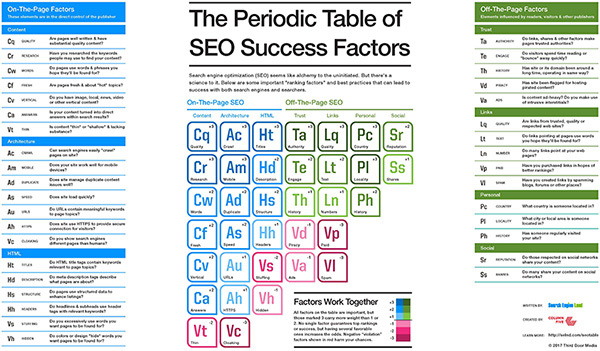
    The 2017 edition of the periodic table of SEO success factors is interesting not because new elements were added, but because it holds a few surprises on what are not that important any more.

    AdWords Optimization

    For advanced and amature SEO’s, this blog can serve as a quick reference for what to defocus from and what to focus on. I have kept the exhaustive details out, but, if you need those details and are curious about how the scores are derived, feel free to read the original article.

    The 2017 edition is the 4th installment of the Periodic Table. Notable changes from the 2015 version are:

    • Mobile, Direct Answers & Site Speed have gained greater value
    • Search history has decreased its importance
    • Site Identity and Social Sharing have been dropped

    Factors with increased value:

    Mobile – Mobile is more important than ever. It’s score increased to +3 from +2 in 2015. With 50% of Google searches on mobile devices, there is undoubtedly a need for mobile-friendly content. Plus, by the end of 2018, Google will use a “Mobile First Index” even for the desktop users.

    Speed – Google continues to push for faster sites, thus emphasizing “speed” as an important ranking factor. Implementing the AMP (Accelerated Mobile Pages) is widely backed by Google. The value of speed has increased from +1 to +2 in 2015.

    We expect speed to continue to play an important role in the long term as more and more people move to mobile and the number of consumers craving for speed increases.

    Direct Answers – This factor was added in 2015 with +1 value but now has gained a higher value of +2. With Google and Bing increasingly showing direct answers culled from webpages above regular listings (featured snippets in Google), it is a critical component for ranking.

    Given these results are directly proportional to searcher’s intent and fits right in Google’s mantra of “relevent content,” we expect this to continue to gain more importance in the future. Therefore, companies should start looking at their sites as content publishing platforms that cater to the needs of the target audience.

    Factors with drop in value:

    Site History – The value of site history dropped to + 1 (from +2 in 2015 edition), as Google seems to have downplayed the importance of a site’s age or history.

    Personal Search History – This dropped to + 2 as compared to +3 in the 2015 edition. This is an interesting twist, and it will only benefit the consumer who keeps looking for new and relevant sites that cater to their needs.

    Factors dropped:

    Identity – This factor dropped from the table as Google has blocked authorship entirely in June 2016 (a way to link content you create with a Google+ profile).

    Social – Google+’s impact on Google search has decreased. Therefore, this factor was dropped from the table.

    In Conclusion:

    The Periodic Table is an interesting way to view citical SEO parameters. I have personally used it for training and it sits really well with aspiring SEO geeks.

    The periodic table by no means should be the sole guiding force for your SEO efforts. It should be a guidance for information on factors that are most or least important.

    Do not forget, your main objective with SEO is to continue to focus on the searcher and personas you want to target. So developing quality and relevant content is most important, followed by the right site architechure. Ranking and traffic will follow as long as you do not spam or use black hat techniques.

    Leave your comments below or write to us. Feel free to give us your details and we will get in touch with you if you need SEO help.

  • AdTech, MarTech, Demand Acceleration, Anonymous Visitors and More. Learnings from SiriusDecisions Summit 2017

    Position2 was again a Platinum sponsor at the SiriusDecisions Summit 2017 in Las Vegas this May. Wow!! What a show it was! SiriusDecisions unveiled a new Demand Waterfall, and that was just the beginning.

    We met with many amazing marketers and discussed real world advanced challenges about marketing technologies, demand acceleration, AI and anonymous visitors. Our team did two presentations on diverse and very relevant topics for today’s marketers. Niraj Swarup, Sr. VP of Products and Services, talked about the demand waterfall and I spoke about AdTech and MarTech integration.

    Over the last month, I’ve had the opportunity to digest the learnings from the summit. I aligned these learnings with the challenges our clients and prospects face in their day-to-day digital marketing efforts. Optimizing the demand waterfall and tech stack continue to throw up major challenges not just for SMBs, but also for billion dollar enterprises.

    In this article, I have compiled the key points from our presentations and SiriusDecisions’ sessions. My aim is to offer you direction to solve some of your digital marketing challenges. In doing so I have laid out high-level pointers to help you build a robust and scalable digital marketing model. If you require additional information or would like to just chat with us about your challenges, please write to us.

    My session was titled ‘Crossing the Chasm from AdTech to MarTech’. Primary objective was to explain – (1) how to build the right technology and marketing infrastructure to track digital campaigns, (2) the need to track digital marketing efforts granularly – and benefit from – cross-channel media mix optimization, and (3) the right team for success.

    Here are a few strategic and tactical tips to get you going:

    1) Marketers have too many technologies or platforms on their hands that make the job of integrating AdTech and MarTech difficult. I recommend you re-evaluate your entire tech stack. Identify and keep the most critical technologies or platforms. Get rid of stuff that you do not need.

    Yes, this is a slow and painful process, but it is something you will need to go through to succeed. In fact, a common theme at all the conferences we attended over the year was that successful large enterprises and smaller firms went through this exercise. Once done, these organizations had an ideal stack that best suited their needs.

    2) For greater digital media efficiencies, marketers need to look for ways to capture source to close data using “Deep Funnel Metrics”. Many marketers fail to do this because they either have limited or excess technologies. Another impeding factor is an unfriendly team structure.

    3) Marketers should strive to use cross-channel insights to optimize the media budget effectively. This is the best way to make sure that you and your teams will be able to migrate one channel’s successes to another. Often this effort falls flat for marketers because their teams work in silos.

    4) Lean teams can be a challenge. Therefore, marketers should not shy away from hiring the right resources with diverse skills to manage AdTech and MarTech stacks. Once you have the resources on board you need to make sure that all members of your team are working together.

    Niraj’s topic was ‘Add Yellowstone’s Upper and Lower Falls to Your Demand Waterfall’. Niraj drew inspiration from Yellowstone’s famous waterfalls and spoke about an augmented marketing framework that Position2 uses for clients.

    Below are a few high-level pointers from his presentation:

    1) It is important to identify and optimize the combination of touches that actually convert suspects into a known lead.

    2) We recommend that SiriusDecisions model be implemented so that you can track and optimize prospects as they convert to customers and as they flow through the waterfall, now the demand unit waterfall.

    3) Typically revenue from existing customers accounts for a very significant portion of overall revenue. Therefore, loyalty, renewal, customer advocacy, and retention programs are the critical challenges to solve.

    Along similar lines, another interesting topic that emerged this year was about tackling anonymous visitors hitting your website. Here are some insights:

    1) Web personalization is one-way marketers are trying to solve this problem.

    2) Marketers are playing around with AI and ABM to target these audiences.

    3) One can connect platforms like analytics and automation tools to build your ideal profile and target anonymous visitors’ through look-alike visitors.

    Of course, this is a new and emerging trend, so watch out for interesting directions to surface frequently.

    I hope this article has given you a few tips to solve the challenges of scaling digital marketing Demand Acceleration. We are happy to talk with you about your current MarTech, AdTech or Demand Acceleration challenges. Just contact us and we will reach out to you soon.