| This week’s hot news, events and videos from the online marketing and social media world. | ||||
 |
||||
 |
||||
|
||||
|
||||
| If you are reading this blog post via a RSS reader, please click here to subscribe. |
Author: Team Position Squared
-
Real time update in SERP’s, 9 signs that you are marketing automation ready and much more…| Best of the Week
-
Search is Changing – Real-time Updates in SERPs
 The world around us is moving at a swift pace today, so much so that often information absorption has to be literally (read, virtually) instantaneous. Web platforms have made it so easy to share information that people use these channels to announce important events and updates rather than wait for the slow dissemination of information by traditional media.
Speed of Information Diffusion
According to the now obsolete Hypodermic Needle Model theory, traditional media has an “immediate” effect on the masses. The theory stated that people were passive receivers of information and that they were immediately influenced by it.
This theory was developed in the days when only traditional media existed and its meaning of the word ‘immediate’ is vastly different from today’s adrenaline driven, turbo charged world of social media and online communities.
Immediate today means ‘immediate’!
Earlier, it took at least a few hours for news to be updated through traditional media (as it does sometimes even today). But today, by that time, crucial updates would have already broken out on forums and social channels.
In today’s highly interconnected world, it’s very important today to know about key events as soon as possible. This necessity invariably prompts people to look towards information sources that are more real-time oriented.
For instance, the ongoing crisis in Syria captured headlines world over, especially on the web. People took to online communities and social sites like Twitter and Instagram to protest and express their anguish. A brand crisis like defective brakes in a new car model too can prompt widespread searches. Tyson’s chicken scare recently triggered a few frantic searches.
Real-time Updates in Search Engines
 Search engines are mostly regarded as a treasure trove of data by netizens. Innumerable people gravitate towards search engines when they are looking to learn about the latest events. However, a developing trend is where web users are turning to online forums and social sites like Twitter, Pinterest, Instagram and the like for real-time updates.
Let’s do a quick inspection of the most popular multi-lingual search engines and understand their current position in terms of availability of real-time updates:
Google
Arguably the most popular search engine, Google has not missed this trick. They have been covering Twitter and FriendFeed updates to which they added Google+ updates also recently.
Bing
Microsoft’s search engine is also up-to-date offering Twitter and Facebook updates on its SERPs.
Yahoo!
They entered the game a little late after both Google and Bing but Yahoo! also started offering real time information on the search categories available at search.yahoo.com.
There are also unmistakable signs of search engines opening up to search result components of different natures when compared to results that appeared on SERPs traditionally. For example, Google has begun integrating Google+ updates and it recently allowed more in-depth articles in its search results. According to Google, many users’ requests for information were for broader topics, to cater to which, the search giant incorporated more detailed posts in SERPs.
YouTube videos have also been included in search results from a long time.
Effect on Businesses
All of this asks the question, ‘Can brands take advantage of people’s interest in real-time information?’ One way of doing this is in the manner mentioned above; of quickly reaching out to consumers at a time of a product crisis.
Another way to positively leverage this opportunity is by aligning promotions with significant events. Tweeting congratulations to Golden Globe winners as the awards are announced or building a quick info newsbyte around significant events will help the brand get featured in the search results.
How else can brands leverage people’s search for real-time information? Tell us!
Image Sources: Bizness Quest, Real Traffic Productions
-
Social Media User Engagement – Facebook is Still King [Study]
Many social networks were launched in the last few years and attained a respectable amount of popularity. They’ve found their place in brands’ social strategies.But, it looks like Facebook is not relinquishing its hold on the market anytime soon…
A recent study by Pew Research Center found that Facebook is the dominant network for user engagement followed by LinkedIn and Pinterest. 71% adults had Facebook accounts in 2013 as opposed to 22% and 21% on LinkedIn and Pinterest respectively.
What Facebook is also succeeding in is drawing users to login multiple times in a day. While 63% of Facebook users check the site at least once a day, 40% login multiple times.
According to the study, 36% adults use only one social network. A whopping 84% of those who use only one major social network said that Facebook is the chosen site.
How does this affect B2B marketers in specific?
Facebook is an indispensable part of most marketers’ social strategy. B2B marketers are also using Facebook organically and through paid ads for various purposes ranging from building a strong audience base to selling their products.
The principles of using Facebook for marketing don’t change too much whether it is B2B customers or B2C customers. Brands still have to build a fan base, target them with relevant content, engage them and try to convert them.
It’s important to remember that most people visit Facebook for personal and not professional reasons. So it’s best for marketers to engage with the personal side of the prospect and target him when he is ‘off guard’. GE does this brilliantly with various subtle messages, contests, and trivia such as, the picture of a particular mobile power plant displayed on their Facebook page that weighs 2300 tonne!
The B2B buying process is different from the B2C process and wherein buyers are likely to require more engagement and information before they take a decision. Subtle, but interesting engagement can help build predisposition towards the brand. Visual content can engage the eyes, ears and mind and communicate information powerfully. This can influence the buyer’s decision, which can be critical when it comes to choosing between companies that don’t have significant differentiation.
Facebook, like other social sites, is all about content and an added advantage is that it has a wider base of visitors than others who visit it more often. This is a compelling combination and probably the reason why so many B2B brands like CISCO, Dell, Fluke and GE use it to promote their brands.
If you think Facebook is all about consumer marketing and LinkedIn is only about business, think again! Facebook can be a powerful tool for B2B marketers too if used well. Do you know of any B2B brands that are doing a great job on Facebook? Let us know.
Image Source: Outsourced Communications
-
LinkedIn or Facebook: Where should you advertise?
 Let’s face a fact.
Both Facebook and LinkedIn are possibly the best advertising platforms digitally, not only socially. Want to target the mass, Facebook’s CPM rates are a boon for you and looking to target the CEOs and CIOs of the world, head to LinkedIn. This is basically how the world loves to classify social media advertising, which may not entirely be wrong.
With minimum spending caps being ridiculously low as compared to traditional websites (news sites being the favorite), Facebook and LinkedIn have heralded a new dawn of reaching people. We’re not letting in Twitter in this discussion as the price points, reach capability and available audience type are very different as compared to the two in focus here.
So as a digital marketer, where should you be heading to? What’s the best that you can tap in your available budget, objective and time frame? Let’s see which platform fits the bills in these three criterions:
- Budget
At the very outset, let’s spill the beans that Facebook is far more affordable than LinkedIn. This can be safely said at least in the CPC and CPM factors. LinkedIn is still a couple of times more expensive than Facebook. There is a very critical reason here; LinkedIn is still a smaller and more focused community. Facebook is huge and really diverse, which gets the luxury advertising concept, that focus is expensive and mass is cheaper always. Want to target a niche segment or audience similar to your current customers? Spend more and go for LinkedIn. Want to build a huge brand affordably and by huge we mean, in terms of eyes only? Go for Facebook. - Objective
Brand building has traditionally been Facebook’s forte owing to its CPM capability and affordable rates. Brand reach and customer positioning is LinkedIn biggest win, thanks to designations and place of work data availability and correctness. - Time-frame
This is where Facebook wins hands down. There is a famous digital saying that you can become a Facebook hero in a few hours, overnight is passé. Basically, get a thousand dollars, divide it 80:20 to CPM and CPC respectively, set a time frame of two weeks and you might just be called to the next industry summit, all thanks to Facebook. LinkedIn, on the other hand, takes it slow but does the job really well. You need to hit the CEOs and stay exclusive, LinkedIn will do it so perfectly that there’s a possibility that no one below B-level would ever know of your brand.
Plan your advertising platform smartly. It’s not always what messaging you put across; it needs to be on the right platform as well.
Image Source: Screaming Lunatic Design Agency
- Budget
-
Personalized Marketing, 5 ways B2B companies can evaluate their on-site SEO program in 2014 and much more…| Best of the Week
This week’s hot news, events and videos from the online marketing and social media world. 
Best of the Week Video
IBM’s innovation is not just restricted to Watson. Check out IBM’s videos on youtube for some innovative ideas to create B2B videos.White Paper: Increase Visibility for Your Content by 4x Today’s traditional SEO is inadequate: Ignite your search results by accelerating visibility in more places than ever before.Download this White Paper and learn: - SEO, why the way we know it is not enough
- Introducing and implementing Enterprise Visibility Accelerator (EVA)
- Using multi-channel tracking tools for effective monitoring
- How EVA benefits businesses.

If you are reading this blog post via a RSS reader, please click here to subscribe. -
Facebook and Twitter Updates for the Week
Facebook
News Reader Service
According to a Re/Code update, Facebook is going to launch a news reading service, ‘Paper’, by the end of this month.
‘Paper’ will reportedly be a Flipboard look-alike in the way it works where it will choose social updates along with news stories from publications that are of interest to a user. As per Re/Code’s update, ‘Paper’ will include Facebook posts.
During the launch of the new look for the News Feed in March 2013, CEO Mark Zuckerberg had expressed a desire to bring out a ‘personalized newspaper’ and ‘Paper’ seems to be another result of that desire.
Facebook has declined to comment on this. So, we do not know if ‘Paper’ is going to be a standalone app or if it will be in any other format.
Keep an eye on this space! We will bring you an update on this once Facebook confirms the news.
Acquisition of ‘Branch’
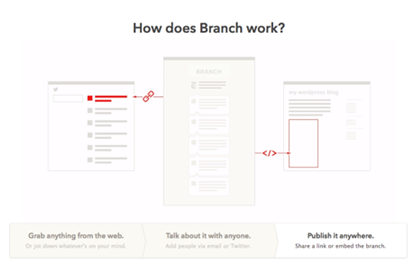 New York based start-up ‘Branch’, is the latest addition to Facebook’s arsenal. ‘Branch’, which is into social discussion tools, will form Facebook’s Conversations group and aims to help users connect with other like-minded people. Facebook also gained ‘Potluck’, built by ‘Branch’ in this deal. ‘Potluck’ focuses on content sharing and discussion rather than signs of engagement such as likes.
The acquisition news was announced through a Facebook post by Branch co-founder Josh Miller. Branch’s capabilities will help in building rich, consistent conversations.
This looks to be another effort by Facebook to improve the content offered to users.
Twitter
 Tailored Audiences Expanded
Twitter is partnering with Epsilon to offer marketers new ways of targeting ads through its Tailored Audiences feature.
Using the SecureConnect technology, marketers can delve into their own audience and zero in on focused segments based on data provided by Epsilon.
New Web Interface
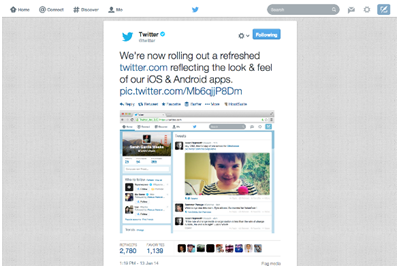
Twitter announced the launch of its new web interface through a tweet recently.
Twitter’s website was behind its iOS and Android sites. With this launch, Twitter is trying to reduce that distance.
-
Personalized Marketing – How Personal Should You Get?

Personalized marketing.
Though the name is pretty much self-explanatory, we would still like to define it because it is a significant aspect of modern marketing and deserves a definition. Simply put, personalized marketing is the breaking down of the mass marketing process to directly address the needs and interests of individual prospects.
Why is personalized marketing so important?
In the past, it was probably acceptable to a certain extent for marketers to send out generic communications. You would remember that personalized messages weren’t as common some years ago, as they are today. Generic communication to the entire audience suited everyone whether customers or marketing departments for no one knew or even could do any better.
As consumers and technology changed, there was a need for marketing to become a lot more focused and cost-effective. Consumers began asking for their individual needs to be addressed and marketers had to measure up to the changing expectations.
Increase in the amount of content
This situation escalated with the onslaught of online content. The internet is an ocean of content and an average person receives more content today and from more sources than compared to a few years ago.
Sifting through the entire content one receives, looking for information that is relevant, is not something that anyone looks forward to. In the midst of all this generic (and mostly irrelevant) content, people are on the lookout for communications that talks to them directly and offers to address their needs.
Marketing is getting more personal
According to research conducted in 2013, 74% of online customers said that they get frustrated when they encounter content irrelevant to their interests on websites.
This goes to show that after being literally (or, should we say virtually) bombarded with generic content, consumers don’t want to be bundled with a crowd. They want personalized brand messages that are in line with their interests.
But if you think that this mindset is restricted to brand messages, you’re wrong. Consumers want the entire marketing process to be personalized, sometimes including personalized products too. And while this is tough, marketers are figuring how to do this because it stands to deliver greater loyalty and higher sales.
Benefits of Personalized Marketing
Personalized marketing is also helpful in nurturing leads and retargeting campaigns. Talking to a lead about something that interests them about your brand will naturally capture their attention and result in better lead nurturing.
With retargeting campaigns, targeting prospects with products/services they have already shown an interest in buying may prod them into actually making the purchase.
But, but, but…how personal can you get? Doesn’t this personalization need to stop?
Introducing personalization as early as possible and increasing it as far as possible is a great way to improve loyalty and effectiveness.
What’s important, however, is that it should be done right.
Do it right.
Adopting an overly familiar tone with prospects just because you know their name or presuming that you know their requirements too early in the relationship can put them off. You definitely don’t want to get off the wrong foot like this. Nobody likes a smug presumptuous associate!
However, as you gain more knowledge about the prospect, using this well to personalize your information, suggestion of products, etc. will help further the relationship. You can even use a marketing automation system to manage this if the volume of prospects is high. Mass personalized marketing as a concept is here to stay.
We would love to know what your opinion is about personalized marketing. Drop your comments in the box below…
-
Deconstructing the Value of LinkedIn Sponsored Updates
LinkedIn is arguably the most popular networking site, in the social world, for professionals.
The site has a really attractive ad products’ suite to which it added Sponsored Updates in July last year.
So what is it all about?
Sponsored Updates are very much like regular LinkedIn updates, the only distinction being that they are marked as ‘Sponsored’. LinkedIn users can like, comment, share and follow sponsored updates posted by brands.
Sponsored updates can be viewed on desktops, smartphones and tablets.
With every increase in the amount of content generated on the web, the chances of your content getting missed in the virtual ocean of content are higher than before. At the same time, marketers can’t do too much to make their content stand out because readers don’t appreciate content presentation that is at odds with the rest of the page that they are reading.
Effectively, brands need to do some amount of tight rope walking to get noticed by customers without alienating them.
The future of Sponsored Updates and how it’s helping B2B marketers
Sponsored Updates cater to two important requisites in digital marketing today: native advertising and targeted marketing.
Sponsored Updates is a good example of native advertising where the ad takes the form of regular content.
Using Sponsored Updates, B2B brands can target the right people with the right content. LinkedIn’s competence in targeting combined with the subtle nature of Sponsored Updates makes it a powerful tool in the hands of canny marketers.
One of the common problems these days is the quality of leads that marketers get but this may soon be a thing of the past.
The combination of the right audience, subtle and well-targeted content is resulting in Sponsored Updates delivering high quality leads. It is expected that as more marketers start using these updates and best practices evolve, Sponsored Updates will become a large source of high quality leads for B2B businesses on LinkedIn.
Another aspect that will be observed in the coming days is that as marketers develop greater familiarity with this tool, more of them will use images and different content types including rich media. This will increase the types of brand messages that marketers can communicate using Sponsored Updates.
For example, Sponsored Updates can be used to not only make company announcements and gain new customers, but also to deliver communication to their current customers about upgrades to products/ services they are using.
Success Story – Adobe
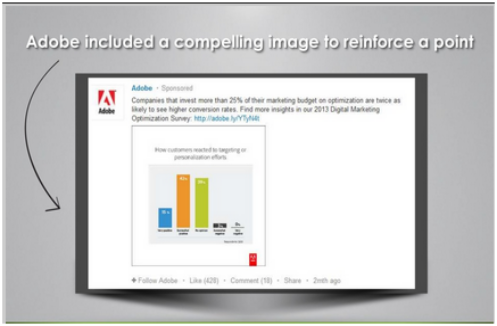 Adobe, a top B2B brand on LinkedIn, was a part of LinkedIn’s Sponsored Updates testing phase. The brand has continued using Sponsored Updates with impressive results after testing. Research indicated that after Adobe used Sponsored Updates, targeted decision makers were:
- 50% more likely to agree that Adobe is shaping the future of digital marketing
- 2.5x more likely to agree that Adobe’s Sponsored Updates captured their attention
- 79% more likely to agree that Adobe can help them optimize their media spend
Have LinkedIn Sponsored Updates been useful for your B2B brand in any other way? Tell us in your comments!
Image Source: Tech Marketing Buffalo
-
Turning Google+ posts into display ads, Four very useful iPad stats and much more…| Best of the Week
This week’s hot news, events and videos from the online marketing and social media world. 
From the Position2 Blog This Week: Turning Google+ posts into Display Ads
Google+ Post Ads give a brands’ online content a power boost by turning their Google+ posts into display ads that will run across the web through Google Display Network. To know more on how brands can go beyond normal, static advertising, read our blog.
Best of the Week Video
Accenture gets it! Whether it is offline advertising or going viral, they have it all figured. Check out this week’s “awesome b2b company video” channel on You Tube and get inspired!White Paper: Increase Visibility for Your Content by 4x Today’s traditional SEO is inadequate: Ignite your search results by accelerating visibility in more places than ever before.Download this White Paper and learn: - SEO, why the way we know it is not enough
- Introducing and implementing Enterprise Visibility Accelerator (EVA)
- Using multi-channel tracking tools for effective monitoring
- How EVA benefits businesses.
If you are reading this blog post via a RSS reader, please click here to subscribe. -
Adapting to Changing Digital and Social Media Rules
After a great run in 2013, digital and social media seem ready for a strong performance in 2014.
So, why are we placing special emphasis on the changing digital and social media rules?
Consider this:
Digital and social media are the fastest growing branches of digital marketing in 2014. 100% business executives use social networks for work purposes. Social media has taken on increased importance in the B2B industry.
In any digital strategy B2B brands need to consider both their Target Group (executives) and their digital/social media budget.
But, there is another crucial aspect that brands should consider while working on their digital and social media strategy. Now, what’s that?
We are referring to the frequently changing ground rules of digital and social media websites.
Brands often focus so much on budget allocation, demographic specifics and the content to be used, that they run the risk of missing the opportunities and threats presented due to the changing ground rules of social networks. As you will agree not knowing the rules of the game will lead to a sub-optimal brand strategy.
Relevant Changes in the Social and Digital Realm
Here are a few examples of changes in the social and digital world that made a significant difference to the way these sites functioned and in turn impacted brand strategies:
- Google HummingbirdThis was one update from the search engine that made digital marketers sit up and take a second look at search efforts, analytics setup, content used and general website health. Though marketers were already focusing on all these, the Hummingbird update prompted them into making changes to:
- Keyword complexity levels
- Level of importance of user behavior in analytics
- Quality of content developed
- Strategy for an error-free website
- Facebook’s News Feed Algorithm UpdateFacebook’s changes to its News Feed algorithm in early December last year gave a shock to marketers. With this update, organic reach reduced. According to Facebook’s director of communications Brandon McCormick, this was the site’s goal from a long time. Facebook wanted to clean up the clutter of Liked Pages that users would have accumulated over the years. If a user has liked your brand’s Page years back and hasn’t visited you since then, post this update, its less likely that your brand’s content will appear in that user’s News Feed.Brands need to focus on improving their Facebook page user experience so that their users keep visiting it and the brand page stays in the user’s News Feed.
- Instagram AdsInstagram kicked off its advertising plan last year. Given its popularity as a ‘visual site’, this update opened the doors for digital marketers to explore online visual marketing. However, this introduction also meant that marketers had to shuffle around their media plan within the same social and digital marketing budget to accommodate one more online portal. It’s probably money well spent given the powerful impact of visuals in marketing.Social sites keep introducing new capabilities in their race to stay ahead of each other. While it may be tough to follow these constant changes, these actually provide marketers with the opportunity to fine tune their media plans to achieve their various marketing objectives better. Discerning marketers will pick and choose sites to make their campaigns more synergistic and impactful.
- Google+ Post AdsGoogle+ launched the ability to turn Google+ posts into ads recently. A really attractive feature of this update is the ads’ ability to offer consumer interaction with the brand directly through the ad along with exposure to Google Display Network’s 2 million sites. This change is important enough to make marketers who hadn’t given Google+ much thought, pause and re-think their strategy. If a brand decides to start using these ads, it does mean tweaking its budget allocation again.
Impact on Marketing Strategies
Often these changes are designed to improve user and/or marketer experience with the site. In doing so, they mostly offer new benefits to marketers and help them connect better with their audience. Even the changes like the Facebook News Feed algorithm can serve as good warnings for brands to improve their engagement with their audience.
Keeping an eye open for changes in sites’ ground rules:
- Helps in judicious and beneficial online marketing media planning and budget allocation
- Helps understand user behavior better.
- Helps avoid the negative impact that ignoring these can have on their brands.
Can you think of any other updates that have significantly affected the digital/social world recently? In what other ways do you think such changes impact brand strategies?
- Google HummingbirdThis was one update from the search engine that made digital marketers sit up and take a second look at search efforts, analytics setup, content used and general website health. Though marketers were already focusing on all these, the Hummingbird update prompted them into making changes to: