| This week’s hot news, events and videos from the online marketing and social media world. | ||||||||
 |
||||||||
 |
||||||||
|
||||||||
|
||||||||
| If you are reading this blog post via a RSS reader, please click here to subscribe. |
Author: Team Position Squared
-
Add E-commerce Analytics for Better Business and much more…| Best of the Week
-
Google Introduces New Sitelinks Search Box
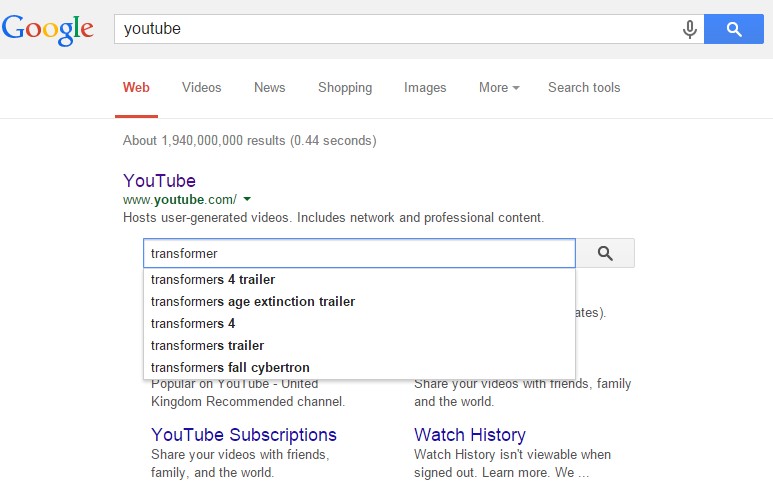
Google introduced a new Sitelink search box feature that gives webmasters the ability to control searching within their site. Websites seen in the SERP (Search Engine Results Page) now display a site search box above the Sitelinks. The new search box has been designed to simplify a user’s query for specific content on your website, working directly through your own website search pages.
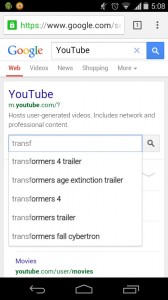
The Sitelinks Search Box is displayed in a prominent position and the new functionality eliminates a step in a user’s content search process. The auto-complete feature is also used to great advantage when a user types search terms into the search box. The new search box is available for both desktop and mobile searches.
Desktop version:
Mobile version:
The new Sitelink Search Box sends the user directly to your website’s search pages. You need to markup your pages correctly to enable this feature. Websites must have a working search engine function to implement this feature, and webmasters should use Schema.org markup on the home page.
Best practices for schema markup (from the Sitelink Search Box implementation guidelines) include:
- Put the markup on the homepage of your site. (It is not necessary for the markup to be repeated on other pages.)
- Use JSON-LD. (Alternatively, you can use microdata.)
- Specify only one URL search pattern for the target. (Google is experimenting with multiple pattern support, so if you have feedback or use cases for multiple target support, let us know in our Webmaster Central Help Forum.)
Some Google best practices on site-wide configurations include:
- Set a preferred canonical URL for your domain’s homepage using the rel=”canonical” link element on all variants of the homepage. (This helps Google Search choose the correct URL for your markup.)
- Prevent crawling of your site’s search results pages with robots.txt. (See more in our Webmaster Guidelines.)
- Make sure your server supports UTF-8 character encoding.
This feature gives webmasters the ability to drive traffic to specific pages that a user might be searching for, while eliminating a step along the way that gets them there. It’s sure to become popular.
Feature to disable the Sitelinks Search Box
Google also added a new feature to disable the Sitelinks Search Box and prevent it from showing up completely. To disable the Sitelinks Search feature use the new meta tag, nositelinkssearchbox:
<meta name=”google” content=” nositelinkssearchbox”>
Adding this tag to a site tells Google not to show a Sitelinks Search Box when the site appears in search results. The Sitelinks Search Box will be disabled as part of the normal Googlebot crawling and processing of the page. This can take a few weeks depending on the site and other factors.
Contact us now to make your website user-friendly!
-
Add E-commerce Analytics for Better Business
The Future of e-commerce
The future of e-commerce is mobile. It lives in tablets and smartphones. There shouldn’t be a retailer out there who doesn’t know this to be true. But a new study by the mobile services provider Zmags (Mobile and Tablet Ecommerce: Is Anyone Really Ready?) found that only one-third of the top U.S. online retailers are even optimally ready for mobile e-commerce. Two-thirds of top U.S. retailers currently overlook this market opportunity. Neither are they ready for today’s shoppers using tablets and smart phones, nor can they identify new, incremental sources of traffic and conversions.
Welcome to e-commerce Tracking
If you want to effectively analyze online business performance you need transaction data. It’s vital. Measuring metrics like conversion rates is all well and good, but measuring revenue truly captures a business owner’s attention. To make the analysis simple, include e-commerce data in your web analytics application.
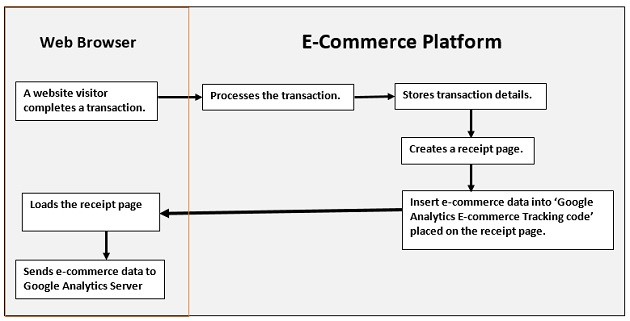
How e-commerce Tracking Works?
- A website visitor completes a transaction.
- Your e-commerce platform:
- processes the transaction (verify credit card details etc)
- stores transaction details
- creates a receipt page (generally ‘thank you’ page)
- inserts e-commerce data into ‘Google Analytics e-commerce tracking code
- sends receipt page to the visitor’s web browser
- As soon as the page is loaded into the visitor’s browser, the Google Analytics e-commerce tracking code is executed and sends the e-commerce data to the Google Analytics server.
How to Set up e-commerce Tracking in Google Analytics
Step 1: To activate e-commerce tracking
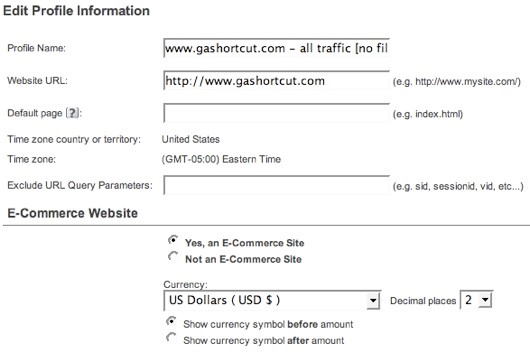
You must first enable e-commerce reports. Log into GA and edit the profile settings. To activate the e-commerce reports, specify that your site is an e-commerce site.
Unless you have an international site, you won’t find much use for the other e-commerce settings. For example, you can specify one of 25 different currencies and the number of decimal places you want displayed. Even if you use USD you can specify 3 decimal places. By Default, e-commerce tracking is set to “off”. In order to track a transaction on GA activate e-commerce tracking at a profile level.
Step 2: Tag your receipt page
Make sure you add the GA tracking code on your receipt page. The e-commerce tracking code is stored in the ga.js and if this file is not included on the receipt page you can’t track transactions.
Step 3: Install the code
Code construction: the hard part. GA uses a JavaScript collection technique to track e-commerce transactions. Your server code must inject transaction information into the GA JavaScript before sending the receipt page back to the browser. When the receipt page renders in the visitor’s browser the JavaScript executes and sends the transaction info to GA.
Here’s the code:
< script type=”text/javascript” >
pageTracker._addTrans(
“order-id”, // required
“affiliate or store name”,
“total”,
“tax”,
“shipping”,
“city”,
“state”,
“country”
);
pageTracker._addItem(
“order-id”, // required
“SKU”,
“product name”,
“product category”,
“unit price”, // required
“quantity” //required
);
pageTracker._trackTrans();
< /script >There are three distinct parts to the JavaScript, and each is a different method. The first section, identified by the _addTrans() method, creates the transaction and stores all the information about the transaction. The second section, identified by the _addItem() method, is used to add an item to the transaction. You need to create an_addItem() section for each separate item, or SKU, in the transaction. The order ID in the _addItem() method must be the same order ID used in the _addTrans() method. That’s how GA ties an item to a transaction. The final section, the _trackTrans() method, sends the data to GA by requesting the __utm.gif file once for the transaction and once for each item in the transaction. So if you have 3 different SKUs in a transaction there will be 4 requests for the __utm.gif.
The JavaScript shown above can appear anywhere on your receipt page. But make sure that it appears after the main GA page tag because the e-commerce code is part of the pageTracker object. Just to reiterate a point: you must create server side code that outputs the transaction data in the above format. If you do not have access to your shopping cart code, and if your cart provider does not provide e-commerce tracking, you may be out of luck.
Once the code has been installed you should begin to see e-commerce data in your GA.
What Data can be Tracked?
Google Analytics collects two types of e-commerce data: transaction data and item data. Transaction data describes the overall transaction (transaction ID, total sales, tax, shipping, etc.) while item data describes the items purchased in the transaction (sku, description, category, etc.). All of this data eventually ends up in GA reports.
The complete list of data includes:
Transaction Data
- Transaction ID: your internal transaction ID [required]
- Affiliate or store name
- Total
- Tax
- Shipping
- City
- State or region
- Country
Item Data
- Transaction ID: same as in transaction data [required]
- SKU
- Product name
- Product category or product variation
- Unit price [required]
- Quantity [required]
A few notes about the data:
- Geo-location data is no longer used by Google Analytics. The new version of GA identifies where the buyer is located using an IP address lookup.
- You should avoid using any non-alpha numeric characters in the data, especially in the numeric fields.
- Do not add a currency identifiers (i.e. dollar sign) in the total, tax or shipping fields. This can cause problems with the data.
Contact us to learn more about how analytics can improve your business.
-
“No CAPTCHA reCAPTCHA” from Google
Research experts at Google have come up with a solution to make CAPTCHAs more effective and it is called ‘no CAPTCHA reCAPTCHA’. This is not only perspicuous to the human users but is also effective in stopping malicious bots. CAPTCHAs are so commonplace these days that humanity as a whole is ‘wasting’ a lot of time on it without any utilitarian value added, whatsoever. The driving force behind the whole research was that if this effort could be properly channelized, humanity as a whole would benefit and thus was born reCAPTCHA.
There is lot of indecipherable text in ancient literature tomes, old newspapers, satellite imagery, Google Street View, et al as far as machines are concerned. So if such texts could be given to the humans in the process of typing CAPTCHAs, a huge problem would be solved with no extra strain on resources!
Google has rolled out a new API that directly asks users whether they are robots. Human users then can just check the box mentioning ‘I’m not a robot’, and gain access without actually solving any CAPTCHA. There’s more to this API than meets the eye. Google will scrutinize a user’s entire engagement with the CAPTCHA using Advanced Risk Analysis before determining whether the user is a robot or a human.
If you are a mobile user you will have an image based reCAPTCHA. You might be shown an image of an animal and given a few image options that may or may not match with the animal in question. You have to select only those options that are relevant. Humans can easily do this whereas machines cannot. This makes the tool very useful to discern a human user from a robot.
Your Digital Marketing Dollars Saved
You can use the Google reCAPTCHA for free. You need not download anything from Google and thus your computing resources can be utilized elsewhere. Everything is done via the Google servers. You can now have a fool-proof method of keeping those lurking bots at bay. The best part is that if Google finds out using logs that some of their reCAPTCHAs can be deciphered by machines then it will automatically up the ante without you having to do anything.
Imagine your website is under relentless attack by unscrupulous bots. Your resources might be at stake or your site’s security itself could be under threat. There are ample instances of bots writing tens of hundreds of reviews to unprotected sites around the world and in the process trying to advertise some product or service without the webmasters’ permission. Now you can close the doors on all such malicious bots thanks to Google reCATPCHA.
If Google finds out that an entity consistently solves your reCAPTCHAs then the ensuing reCAPTCHAs will become harder to solve thus giving you an additional shield against these nasty bots. Thus the main aim of this tool is to see to it that humans are allowed access and bots are stopped in their tracks. reCAPTCHA does a fine balancing act as far as security and usability is concerned at all times, in order to give a seamless experience to the human users.
Let us know what you think about reCAPTCHA.
Contact us to have a spam-free experience on the Net now!
-
Ten Ways to Optimize Website Speed and much more…| Best of the Week
-
Pin a Post on Your Google+ Page/Profile
Google has added a new feature wherein you now have the option to Pin your favorite Post on your Profile or Page, as the case may be. This is of considerable significance since you can now display your most important Post to all your viewers. This Pinned Post will be available at the top of your content. This post could be your recent activity or an event that you are hosting that needs to be highlighted constantly.
This Google+ feature mandates you to Pin only those Posts that are Public. This can be useful to businesses as they can now highlight their most important product launch or any new services rendered at the top of their Page.
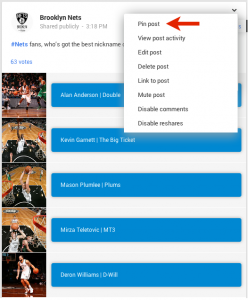
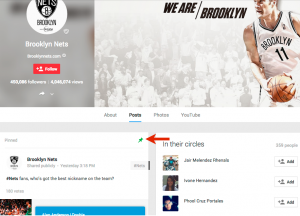
To Pin your Post to your Page just click on the downward facing arrow on the top-right of your Post and you can Pin only one Post at a time and it will be marked with the picture of a Pin on the top-right corner for easy identification as shown below:
Do let us know what you think of this new additional feature on Google+.Contact us now for all round visibility for your campaigns across the digital spectrum!
-
Google Penguin 3.0 – Diagnosis & Recovery Steps
It has been over a year since Google announced Penguin 2.0 update and we had shared our thoughts on it. Since Penguin 3.0 update was announced by Google on Oct 17, 2014 – it was estimated to affect less than 1% of English queries as Moz pointed out. John Mueller from Google had said that this update could roll out over the next few weeks.
This update is intended at reducing “web-spam” at a much higher and sophisticated level than Penguin 2.0 update. Let us now try to understand how this update actually works. First & foremost, Penguin 3.0 update is pretty much similar to the preceding updates with the main intention being reducing web-spam by demoting sites with bad link profiles (removing websites from Google Index which have acquired “paid links” over the years). Google experts say this is a refresh. This essentially means the algorithm was re-run to release sites that fixed their issues and to demote sites that had issues that weren’t picked earlier. Site owners & SEO experts may have to be ready to witness fluctuation in traffic and rankings.
Diagnosis & Recovery Steps for Google Penguin 3.0
If your website has seen drastic changes in organic traffic and/or keyword ranks over the last few weeks here are a few steps to consider immediately:
-
Check for sources of links to the site
Bad or paid links may also be a factor if you are affected by this update. Check for links from paid directories, irrelevant forums and non-industry specific sites
-
Use Diagnosis tools effectively
Google Webmaster tools and other tools like Moz come in handy. Conduct detailed tests using these tools and update your website profile. If your site is linked with some shady sites, then usage of Disavow tool can be an added advantage. Disavow tool on Google Webmaster lets you start disassociating from such poor/bad-links.
-
Disassociate from bad reputation sites
If your website is associated with sites of bad reputation including paid ones identified by the above mentioned steps, this is the right time to disengage yourself from these associations.
Having said all of the above, be aware of with whom you are linking to in the future. Share your feedback and comments in the comment section below.
Contact us to learn more. Have a happy spam free experience on the Net!
-
-
Ten Ways to Optimize Website Speed
After quality content, page speed is the most important website feature. But all too often people think that optimizing website speed at the time they create a website or blog is wasted effort. They couldn’t be any more wrong. As the popularity of your website expands, testing for page speed becomes absolutely imperative.
WHY WEBSITE SPEED?
In a word, search engine rankings.While optimized website speed is important from a user’s perspective, search engines reward it with higher rankings because speed is critical for robots scanning a website. If a competitor’s website loads faster than yours it will take a better position ahead of you on the search engine results page. The performance of a website is important, but so too is increasing website load time speed. Regularly monitor your website load time and take necessary measures to increase the site speed.

BEST SEO TIPS TO OPTIMIZE THE WEBSITE SPEED
- Minimize HTTP Requests
According to Yahoo, 85% of web page load time is spent downloading the different components of the page (e.g. images, style sheets, and scripts). An HTTP request is multiplied when there are duplicate scripts in the code. Identify and remove these duplicate scripts.
The quickest way to improve site speed is to simplify your design.
- Use CSS scripts to combine multiple images
- Combine background images into a single image
- Combine multiple style sheets into one
- Use Script tag on your HTML page
- Reduce scripts
- Optimize Image Size
Images often contain additional comments and use unnecessary colors. Make images as small as possible so that the browser does not have to resize them.
Use image editing tools to:
- Crop your images to the correct size
- Save in JPEG format
- Reduce color depth to the lowest acceptable level
- Remove image comments
- Specify image dimensions
- Minify Resources
Minification, the process of removing all unnecessary characters from source code without changing its functionality, helps to reduce its size and improve load time.
Eliminate extra spaces, line breaks, and indentation in your code to keep your pages as lean as possible.
Minification tools available online include:
- To minify HTML, PageSpeed Insights Chrome Extension (generates an optimized version of your HTML code)
- To minify CSS, YUI Compressor
- To minify JavaScript, JSMin , YUI Compressor
- Add CSS at the top and JS at the bottom
Your pages load faster with style sheet references added to the head of your HTML document because it allows the pages to gradually render the styles. Style sheets also improve page load time.
Browsers can only download two components per hostname at any given time. Adding your scripts towards the top blocks everything below during the initial page load, and gives the impression of the page loading slower.
To avoid this situation, place your style sheet at the beginning or <Head>of the HTML document and scripts references at the end, right before closing the <Body> tag.
- Caching your web pages
When you visit a web page for the first time, your browser requests all the web page image files, CSS Scripts and Java files to load from the website’s server, taking up precious page load time. Caching your website saves these file resources to the browser, and the files can be retrieved from the cached files rather than downloading them again from the network.
- Install a cache plugin
Caching plugins permit you to publish static rather than dynamic HTML files, reducing the time a page takes to load. Additional caching features include minification, caching of feeds, Gzipping, and Content Delivery Network (CDN) support.
- Compress and optimize your content
Compressing your website content will have a huge impact on reducing load times. Large pages with recurring high-quality content are slow to download. The best way to speed up the load time is to zip the pages, called compression. This saves bandwidth as well as the download time it takes to view your website. It’s biggest impact is on web page load time. Be sure to configure the server to return zipped content.
You can also compress and optimize your CSS and JavaScript files by combining them and minifying the source code.
- Reduce 301 redirects
Avoiding redirects increases serving speed. Every time a 301 redirect is used, it forces the browser to a new URL which increases page-loading time. The solution? Check for broken links and fix them immediately.
- Reduce the number of unnecessary plugins
A site that needs plugins may slow your web page loading speed. Too many plugins create safety issues, and often cause crashes.
Try to measure server performance after disabling the plugins. This way you can identify any plugins that hamper your site speed.
Web page speed is a metric that should not be ignored if you are concerned about providing the best user experience. You can examine and check website speed through free services like Google Site Speed Test and Pingdom.
- Avoid text graphics
Some sites may need formal text to make the web page look attractive. However, text in the form of an image takes up a lot of the web page size and is of no SEO benefit. Don’t use text styles in CSS and keep everything in text format in its place.
Take Away
Optimizing your website loading speed is an essential task because search engines reward fast loading websites. Hopefully, these best practices will be of some help. What has or hasn’t worked for you? We would love to know. Contact us now to optimize your website!
-
E-tailers hit Hard by Changing Facebook News Feed Policy
It’s the sign of the changing times. The digital domain is a dynamic and evolving world where nothing can be taken for granted. We had recently talked about the issue of changing Facebook News Feed Policy under the title – Facebook Starts Monitoring Promotional Pages. Now it looks like the Indian e-tailers who had until now extensively used the Facebook News Feed for promotional purposes are getting the short end of the stick.
Though India is a developing country, the digital penetration in this part of the world is worth mentioning. Check for the latest Indian Internet users figure here which has already crossed the 250 million mark! Facebook alone has crossed the 100 million users mark in India! This burgeoning digital demographics here has given rise to sundry ecommerce players that are mushrooming by the day. For companies that did not have access to deep pockets or cutting-edge expertise in digital marketing, the Facebook News Feed was a fertile ground to sow their advertising seeds. But not anymore!
Come January and the social networking giant will start monitoring overly promotional posts and desist brands from using it as a purely advertising tool. This has got the Indian ecommerce players quite chagrined. They will now have to shell out more money in order to advertise on the Facebook ad platform. But if you look at it closely, it’s not all gloom and doom!
Your Efficiency is Your Edge
This move from Facebook will surely separate the men from the boys of the digital marketing world. Going forward you will have to provide compelling content if you want people to like your brand or company. This will no doubt put a strain on your creative and design teams. But still it is worth the effort. If you can add value to your users on Facebook then definitely you don’t have to worry about this latest development from Facebook. It will be business as usual for you or maybe even better, since going forward Facebook will be looking to separate the contenders from the pretenders. Hence you need to equip yourself with the right set of skills in this digital war zone for more user clicks, impressions and leads.
If you want to implement Integrated Digital Marketing, look no further and contact us now.
-
Black Friday Holiday Season and much more…| Best of the Week
This week’s hot news, events and videos from the online marketing and social media world. 
From the Position² Blog This Week: Black Friday Holiday Shopping Season
The biggest shopping carnival of the year is here. Today online is rightly the biggest stomping ground for deal seekers and bargain hunters. Read this incisive blog to find out how you can benefit from all this bonhomie, as a digital marketer.
Best of the Week Video
Watch this video by Rand Fishkin where he talks about how to measure the value of top of the funnel demand generation channels.sWhite Paper: Increase Visibility for Your Content by 4x Today’s traditional SEO is inadequate: Ignite your search results by accelerating visibility in more places than ever before.Download this White Paper and learn: - SEO, why the way we know it is not enough
- Introducing and implementing Enterprise Visibility Accelerator (EVA)
- Using multi-channel tracking tools for effective monitoring
- How EVA benefits businesses.

If you are reading this blog post via a RSS reader, please click here to subscribe.