Author: Anandan N

  • Content Marketing Best Practices

    What Is Content Marketing

    Content marketing is a strategy focused on creating and distributing valuable, consistent content designed to attract and retain your target audience. This content can take various forms – blog posts, videos, infographics, e-books, etc. The key to success lies in delivering high-quality content that caters to your audience’s needs while aligning with your business objectives. Doing so can build credibility, generate leads, and raise brand awareness.

    The Value of Content Marketing

    Content marketing has become a pivotal part of contemporary business strategy and for good reasons. Here are some key advantages of content marketing:

    It helps build brand awareness

    Creating and distributing valuable content can increase your brand’s visibility and reach a wider audience.

    It establishes trust and credibility

    Creating and disseminating valuable content can increase your brand’s visibility and reach a broader audience.

    It generates leads

    By offering valuable content in exchange for contact information, you can capture leads and nurture them into paying customers over time.

    It drives traffic to your website

    Sharing your content on social media or other channels can drive traffic back to your website, increasing the likelihood of conversions.

    Overall, content marketing offers a cost-effective way to attract and retain customers while building a solid brand reputation.

    Content Marketing Statistics

    • Demand Metric reports that 91% of B2B marketers employ content marketing to reach customers, while 72% of marketers confirm that content marketing boosts engagement and leads.
    • According to HubSpot, companies that publish 16 or more blog posts monthly receive almost 3.5 times more traffic than those publishing four or fewer posts.
    • Demand Metric notes that content marketing costs 62% less than traditional marketing but generates about three times as many leads.

    Top 12 Content Marketing Strategies for 2023

    Content marketing is an ever-evolving field, and staying on top of the latest trends is crucial for success in 2023 and beyond. Here are some tips to help you stay ahead of the curve

    Your goal with content marketing is to create content that showcases your subject matter expertise and helps your prospects and customers see what makes you unique. How do you do that?

    Here are 12 best practices that will make a big difference in helping prospects and customers move through the buying cycle.

    1. Know your audience

    If you’re an email marketing company and operate under the assumption that every single company is a potential customer because every company uses email, you’re missing the boat. You’re talking so highly that nobody can relate to you. You need to define your persona(s) much more precisely. Perhaps one of your targets is chain restaurants that need to promote their brand and their individual locations.

    2. Focus on key messages

    Know precisely what you want your reader to take away from your piece. Is this a new product story? Are you addressing a customer pain point? A competitive comparison? Have you chosen a good keyword?

    3. Determine the next steps

    What do you want your reader to do next? Have a clear plan and put it clearly and enticingly in your call to action (CTA).

    4. Remember that a picture is worth a thousand words

    The primitive brain plays a huge role in customer engagement, particularly during the early stages of the sales funnel. Pictures are essential, as are relatable stories.
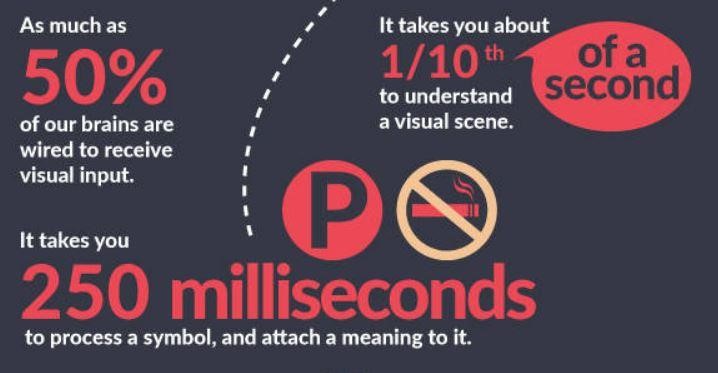
    Remember that a picture is worth a thousand words

    5. Pay attention to readability

    After you’ve written your piece, read it as if you’re the audience and ask yourself, “Would I read through to the end? Would this engage me?” Assuming it’s a topic that would interest the audience if you answered no to these questions, it’s time to look at the piece’s readability. Do you sound a bit standoffish, or do you speak in an inviting tone? Do you break the piece into titled sections and include some bullets to make it more readable? Do you include some personal information to help people get to know and trust you? Is your piece boring? Can you figure out how to take more risks and make the piece juicier?

    6. Create A Measurable Goal

    When it comes to content marketing, creating measurable goals is essential for success. A specific and measurable goal could be to increase website traffic by 20% within the next six months through targeted content creation and promotion. To achieve this, regular blog posts, social media updates, and email newsletters can be implemented.

    Regular tracking and analysis of website traffic using tools like Google Analytics will help determine if the goal is being met and allow adjustments to be made if necessary. Businesses can achieve their content marketing objectives and drive growth by setting a clear, measurable goal and implementing an effective strategy.

    7. Understand Your Buyer’s Journey.

    Understanding your buyer’s journey is crucial for successful content marketing. It involves identifying the different stages a potential customer goes through before making a purchase and tailoring your content to address their needs at each stage.

    By creating targeted content that speaks directly to your audience’s pain points and interests, you can build trust and establish your brand as a thought leader in your industry. This, in turn, can lead to increased conversions, higher customer retention rates, and ultimately, more significant ROI for your content marketing efforts.

    8. Pillar Cluster Content Model

    The Pillar Cluster Content Model is a best practice in content marketing. It involves creating a pillar or main piece of content, such as an in-depth article or video, and then creating multiple smaller pieces of supporting content around it.

    This approach helps to establish authority and thought leadership on a particular topic and can also improve search engine rankings by providing a comprehensive resource for users. By organizing content this way, brands can create a cohesive and effective content strategy that resonates with their target audience.

    9. Track Content Marketing Performance

    To track content marketing performance, it is essential to establish clear goals and KPIs before launching any campaigns. This will help you measure the success of your efforts and identify areas for improvement. Regularly reviewing and analyzing your metrics can provide valuable insights into audience engagement, content effectiveness, and overall ROI.

    Key metrics include website traffic, social media engagement, email open rates, and lead generation. By implementing these best practices, you can ensure that your content marketing efforts deliver measurable results and drive business growth.

    10. Provide Content For Present And Future Actions

    Content marketing best practices involve creating content that speaks to your audience and provides value and relevance. It’s essential to align your content with your business objectives and use data to inform your strategy.

    Additionally, you should focus on creating evergreen content that can be updated and repurposed for future use.

    11. Strengthen Stats Skills

    Strengthening your stats skills can significantly enhance your ability to make data-driven decisions and improve your overall job performance. Whether you work in marketing, finance, or any other field that requires data analysis, having a solid foundation in statistics is essential.

    By taking courses, attending workshops, or even just practicing with real-world data sets, you can sharpen your stats skills and become more confident in interpreting and communicating complex data. This not only benefits you and your career but also helps to drive better outcomes for your organization.

    12. Keep importance to writing styles

    In content marketing, the writing style is of utmost importance. It plays a critical role in engaging and retaining the audience’s attention while effectively conveying the intended message.

    A consistent and coherent writing style can help build brand recognition, establish credibility, and strengthen brand identity. Therefore, investing time and resources is essential to develop a clear and distinctive writing style that aligns with the brand’s values and target audience.

    Before and After Applying the Best Practices

    Before

    At Acme Manufacturing, we make the best refrigeration systems in the world. Our systems feature forced air circulation for uniform temperature at all shelf levels, heat-free defrost for maximum uniformity, and solid doors.

    After

    As a food warehouse manager, you are focused on storing and preserving your food safely, with the fewest interruptions. At Acme Manufacturing, we are committed to providing safe storage with minimal interruptions.

    Content Marketing Trends for 2023

    To improve your content marketing efforts in 2023, consider implementing these content marketing tips: creating high-quality and relevant content, leveraging new technologies such as AI and AR, prioritizing customer experience, utilizing social media platforms, and measuring the ROI of your content marketing efforts.

    1. Short-Form Video Content

    Short-form video content has become an essential part of content marketing best practices. With attention spans decreasing, short-form videos provide a quick and engaging way to communicate your message to your audience. They are easily shareable on social media platforms and can help increase brand awareness and engagement.

    2. AI and Automation

    AI and automation are revolutionizing businesses’ operations, from streamlining processes to enhancing customer experiences. By leveraging the power of AI and automation, companies can increase efficiency, reduce costs, and gain a competitive edge in today’s fast-paced digital landscape.

    To stay ahead of the curve, businesses must understand how these technologies can benefit their operations and implement them effectively.

    3. Content Consistency Is Key

    Content consistency is a fundamental aspect of successful content marketing. It helps to establish brand identity, build trust with your audience, and improve SEO rankings. A consistent content strategy ensures that your messaging is clear and on-brand across all channels and platforms, leading to greater engagement and increased conversions.

    4. User experience

    User experience (UX) is critical in content marketing best practices, as it determines how users interact with and perceive your brand. Creating a seamless and enjoyable user experience can increase engagement, build brand loyalty, and ultimately drive conversions.

    5. Human-Centered Content

    Human-centered content is a crucial aspect of content marketing best practices. By focusing on the needs and preferences of your target audience, you can create content that resonates with them on a deeper level. This means taking the time to understand their pain points, interests, and motivations and using this information to inform your content strategy.

    Whether you’re creating blog posts, social media content, or video content, the key is to put your audience first and create content that speaks directly to them. Doing so can build stronger relationships with your customers and drive tremendous success for your business.

    6. Rely On original content

    As the digital landscape becomes increasingly crowded with content, relying on original content to stand out is more important than ever. Creating original content sets you apart from others in your industry and helps you establish your brand identity and build trust with your audience.

    Original content can take many forms, including blog posts, videos, infographics, and social media posts. By consistently producing high-quality original content that resonates with your target audience, you can position yourself as a thought leader and attract new customers or clients.

    So if you want to stay ahead of the game and make a lasting impact in today’s fast-paced digital world, prioritize original content in your marketing strategy.

    Types of Content Marketing Strategy

    Content marketing best practices for businesses include using various strategies to reach their audience. Blog content establishes a brand’s expertise, videos create engaging content, social media connects on a personal level, email marketing provides direct communication with subscribers, and infographics convey complex information quickly. The choice of strategy will depend on the business’s goals and target audience.

    Infographics

    Content marketing is a vital part of any successful digital marketing strategy. One popular approach is to use infographics, visual representations of data or information that are easy to digest and share on social media. Infographics can attract attention to your brand and increase engagement with your audience.

    Blog content

    Another effective content marketing strategy is blog content. By creating high-quality blog posts that address the needs and interests of your target audience, you can establish yourself as an authority in your industry while also driving traffic to your website.

    Podcasts

    Podcasts have also become a popular way to reach audiences in recent years. By creating engaging audio content that listeners can tune into anytime, anywhere, you can build a loyal following and position yourself as a thought leader in your field.

    Videos

    Videos are another effective way to engage with your audience. Whether through product demos, educational tutorials, or entertaining content, videos can help humanize your brand and build trust with your target audience.

    Social media

    Finally, social media has become essential to any content marketing strategy. By sharing relevant content on platforms like Twitter, Facebook, and LinkedIn, you can increase your brand’s visibility while building relationships with customers and prospects. Regardless of your chosen approach, a strong content marketing strategy can help grow your business and achieve long-term success.

    Wrap Up

    Effective content marketing is crucial for businesses looking to boost their online presence and engage with their target audience. By following best practices such as creating high-quality content, leveraging social media, and measuring performance, businesses can achieve their content marketing goals and drive success. At Position2, we specialize in helping businesses develop and execute effective content marketing strategies. If you’re interested in learning more about how our expert team can help your business succeed, please don’t hesitate to reach out. We look forward to partnering with you to achieve your content marketing goals.

    FAQs on Content Marketing

    How do I identify my target audience for content marketing?

    Identify your target audience for content marketing by researching their demographics, interests, behaviors, and pain points.

    How do I measure the success of my content marketing efforts?

    Measure the success of your content marketing efforts by tracking key performance indicators such as website traffic, engagement, leads, conversions, and ROI.

    What are some common mistakes to avoid in content marketing?

    Common mistakes to avoid in content marketing include ignoring your audience’s needs, being too promotional, producing low-quality content, and not measuring the results.

    How do I distribute my content for maximum impact?

    Distribute your content for maximum impact by using a multi-channel approach, leveraging social media, email, influencers, SEO, paid advertising, and other tactics that fit your audience and goals.

  • Why UI and UX are crucial for SEO?

    UI (User Interface) and UX (User Experience) play crucial roles in SEO (Search Engine Optimization) because they directly impact user engagement, website performance, and overall user satisfaction. A website with a well-designed UI is visually appealing, easy to navigate, and provides a seamless browsing experience. This encourages visitors to stay longer on the site, explore its content, and engage with it, which signals to search engines that the website is valuable and relevant.

    Beyond Content & Links

    Search Marketers are right when they say content is ‘King’ regarding Search Engine Optimization (SEO). While we are busy generating quality content for our target audience, there is another aspect that we tend to overlook completely.

    You must have guessed it by now. It is the aspect of how content is presented to the readers. We are referring to UI/UX (User Interface/User Experience), an integral aspect of promoting content on the web.

    With the inclusion of recent updates like Hummingbird, Panda, Penguin, Pigeon, and hundreds of other Google algorithms that are being tweaked regularly, it becomes critical to know how users react to the website User Interface. The experience that the visitors go through definitely counts regarding how we perform on Search Engines, with special emphasis on Google!

    As a webmaster/marketer, it is essential to understand how users react to your website. Are visitors spending ample time on the website? Are they finding relevant information with minimal clicks? Are they taking desirable actions? Why are they bouncing off the website? Can the website drive visitors to the right content/sections and encourage them to take action after that? – While there are many questions to ponder, the simplicity behind having a great website is to have helpful content and enhanced UX with a well-laid-out UI.

    SEO

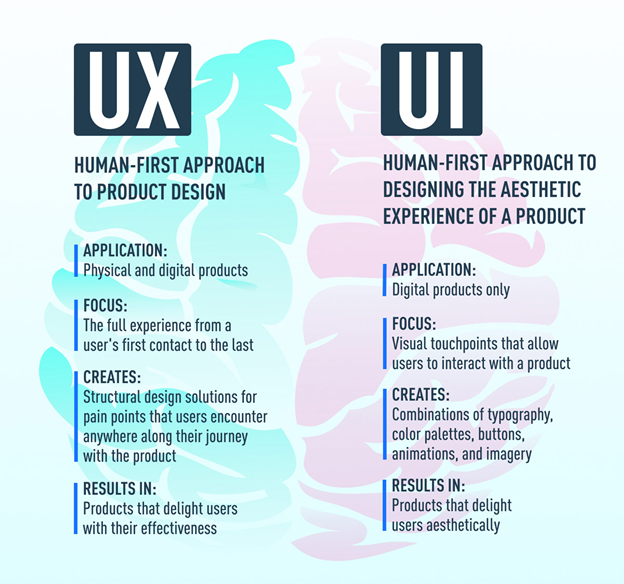
    What are UI and UX

    What are UI and UX

    User Interface (UI)

    UI refers to a website’s visual and interactive elements, including buttons, menus, and other graphical elements that users interact with. The UI creates an intuitive and user-friendly interface that allows users to navigate and interact with a website easily.

    User Experience (UX)

    UX, on the other hand, refers to a user’s overall experience when interacting with a website. This includes factors such as site speed, ease of navigation, and the quality and relevance of the content. A good UX design aims to create a positive and engaging user experience, which can lead to longer session durations, lower bounce rates, and higher conversion rates.

    In short, UI and UX are important aspects of web design that create a positive user experience.

    Impact of UI UX on SEO

    Impact of UI UX on SEO

    UI UX both have a significant impact on SEO. A website with good UI and UX design can increase SEO rankings, traffic, and user engagement.

    A good UI design can improve a website’s SEO by making it more user-friendly and easy to navigate. This can lead to longer session durations, lower bounce rates, and higher click-through rates, all important factors that search engines consider when determining rankings.

    Similarly, a good UX design can improve a website’s SEO by creating a positive and engaging user experience. This can lead to more social shares, backlinks, and other signals that search engines use to determine the relevance and authority of a website.

    1. Teamwork: SEO + UI/UX

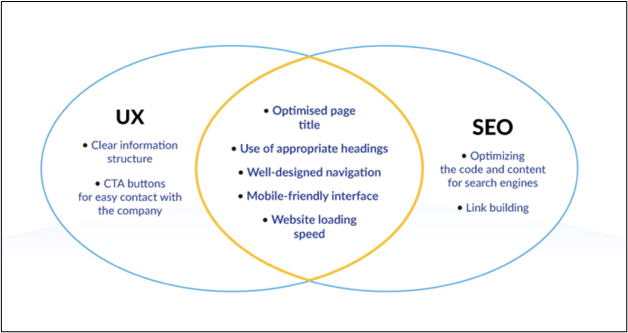
    SEO is the medium to drive traffic, while UX/UI creates the first impression. Both work in tandem to ultimately serve the user’s intent and hence conversions on the website. It is that bit of Creative effort which aids in boosting conversions.

    matts cutts

    “…If you don’t have search engine optimization, it’s harder to be found. If you don’t have end-user optimization, you don’t get conversions… you need to have both…Try to see them in tandem (i.e., Search Engines and End Users) …Your users’ interests and the search engine’s interests are always aligned….Hence you need to view them as one unit. .”

    SEO and UI/UX play a significant role in where the path (SEO) leads to the destination (UI/UX). What happens on the web page is our real goal or concern (conversions).

    We should know that SEO exists due to dynamic Search Engine algorithms, and hence fundamentally, it plays the role of a latent follower when optimizing a website for search.

    Google Hummingbird, Panda, and Penguin updates are now meticulously weeding out sites that don’t meet the basic content standards, design (UI/UX), utility, relevance, and speed.

    SEO and UI/UX are more like unified partners that marketers/businesses must respect since one cannot work without the other.

    2. Graphics makes your website more Attractive

    While most marketers are concerned with the content that drives traffic to the website, the other aspect that we miss is the aesthetics part. This concerns how the content is more impressive and informative to visitors.

    The image and graphics support and content make visitors interact more on the website and react positively to the information provided.

    Using the right mix of graphics, images, and text is a simple and effective idea. Using image alt tags, Meta information, and SEO-friendly URLs further helps to attain more SEO benefits.

    3. Visibility: Above and below the fold

    Don’t make your website a newspaper. The above-the-fold actions came from newspapers and were later adopted as a norm for websites. You need to evaluate the website’s objective to serve the target audience.

    With the changes in user behavior and assimilation of information available on the websites, visitors have learned to scan and scroll the webpages below the fold too. The folding concept remains important, but the judgment of how to attract visitors with content, images, and graphics that make visitors look for more cannot be ignored.

    4. Responsive Website: Facilitate improved User Experience

    As more people choose to use mobiles, smartphones, and tablets, having a responsive website that allows users to search for required information on any device becomes all the more imperative.

    In 2014, 4.22 billion people worldwide are expected to use smartphones. 49% of mobile users will go online via mobile browsers or apps. By 2015, the global mobile phone Internet audience is anticipated to cross well over the 50% mark. Hence, the importance of focusing on the responsiveness of a website that provides users with what they want, i.e., uninterrupted and high-quality User Experience (UX) on any device used for search. Read more on the importance of mobile SEO optimization.

    Responsive Website

    5. Call-to-Actions on your website pages

    The call-to-action (CTA) emphasizes what a user is expected or anticipated to do. Additionally, the Call to Action helps visitors find what they need. CTAs open the website and assist users in consuming the content they are searching for by making it easy to access, increasing engagement, and improving the probability of conversions.

    call to action

    6. Blog post-level Social Sharing

    While social signals are not a direct ranking factor, they can indirectly impact a website’s search ranking in several ways. For example, if a website’s content is widely shared on social media, it can lead to more backlinks to the site, which is a direct ranking factor. In addition, social signals can also increase the visibility and reach of a website’s content, which can lead to more organic traffic and engagement on the site. This can lead to longer session durations, lower bounce rates, and higher click-through rates, all of which are important factors that search engines consider when determining search rankings.

    Social sharing

    Furthermore, areas where UI and UX impact SEO

    1. Site Speed

    Site speed (page speed) is important for SEO. Search engines like Google prioritize providing users with the best possible search results; a fast-loading website is key. Websites that load quickly are more likely to rank higher in search results

    In addition, site speed is also important for mobile SEO. With more and more users accessing the internet on mobile devices, search engines like Google prioritize mobile-friendly websites.

    2. Bounce Rate

    Bounce rate refers to the percentage of users who visit a website and leave without interacting with the site beyond the first page they land on. A high bounce rate can indicate to search engines that the website does not provide a good user experience, which can negatively impact search rankings.

    3. Linkability

    It refers to how easily other websites can link to a website. Having a high number of high-quality external links pointing to a website is a key factor in improving its search ranking.

    Example of UI and UX elements that impact SEO

    • Instagram has become extremely popular. Users can easily move through the never-ending stream of visual content for lengthy periods of time without feeling overburdened because of its layout. There is something genuinely great about Instagram’s visual harmony and order, even though most users couldn’t quite put their finger on it.
    • Uber is a prime example of a product with a nearly evenly split UX design.
    • Disney+ has generated a lot of buzz since it first entered the streaming media. The user experience has been enhanced even if the UX design had a rocky beginning.
    • Telegram is less well-known than Whatsapp, its main competitor. Its UX design does, however, offer a thoughtful, attention-to-detail experience, which is a feature of a strong UX design example.
    • Nike’s website recognizes that proximity and visual cues significantly impact the user experience. This is a lesson that every design team should remember: proximity and hierarchy can promote sales. Nike’s various product pages are excellent examples of effective UX design.
    • Without mentioning Pinterest’s recognizable user interface, what kind of blog post about UI design inspiration would it be? As true innovators in card design, Pinterest combines card design with a waterfall flow to provide users with an extremely seamless and user-friendly interface.

    Conclusion

    User intent should be measured as a probable treasure trove for content marketers. Great content, amplified attention to SEO aspects of your website, and equal prominence to the User interface (including Call-to-Actions) are all critical for making a website add value to your business.

    UI and UX is a critical part of the online purchase cycle of a product or service, and having an optimal balance of all the aspects puts you ahead of the competition.

    Frequently Asked Questions

    How can I measure the impact of UI/UX on SEO?

    You can measure the impact of UI/UX on SEO by tracking metrics such as bounce rate, session duration, and click-through rate using tools like Google Analytics. Additionally, conducting user surveys and analyzing user behavior can provide insights into how UI/UX impacts search rankings.

    Is UX/UI part of SEO?

    UX (User Experience) and UI (User Interface) are not directly part of SEO (Search Engine Optimization). However, they can indirectly impact SEO by affecting user behavior on a website. A website with a good UX/UI design is likelier to have lower bounce rates, longer session durations, and higher click-through rates, all factors that Google considers when determining search engine rankings.

    Why is user experience the most important factor for SEO in 2023?

    User experience (UX) is one of the most important factors for SEO (Search Engine Optimization) because it directly affects user behavior on a website. Search engines like Google prioritize providing their users with the best search results; a positive user experience is key. Websites that provide a good user experience, with fast loading times, mobile experience, easy navigation, and engaging content, are more likely to rank higher in search engine results.

    How do poor UI and UX affect a website’s SEO?

    A poor UI (User Interface) and UX (User Experience) can have negative impacts on a website’s SEO (Search Engine Optimization). A website’s poor UI/UX design can lead to high bounce rates, low session durations, and low click-through rates. These factors can signal to search engines that the website is not providing a good user experience, resulting in lower search rankings.

    How is SEO connected to UI and UX?

    SEO (Search Engine Optimization) and UI/UX (User Interface/User Experience) are connected because a good UI/UX design can positively impact a website’s SEO. Search engines like Google prioritize providing their users with the best search results; a positive user experience is key.

  • ChatGPT for SEO: Maximize Your SEO Strategy

    Microsoft has added an additional $10 billion in funding (added to the initial $1BN investment) for OpenAI. That investment, in the words of Satya Nadella (Chairman and CEO, Microsoft) was because of a shared ambition to responsibly advance cutting-edge AI research – while democratizing AI as a new technology platform. AI-powered ChatGPT can improve SEO by generating high-quality, relevant content, keyword strategy, and analyzing user intent.

    Our team is experimenting with some of the ChatGPT chrome extensions, here’s what we found.

    How To Use ChatGPT For SEO

    By now, many of you have tried ChatGPT or you’re familiar with how it work. OpenAI has released several updates to serve improved results for user queries. Notable releases include daily limit, general performance (speed of returns), conversation history, etc.

    Let’s dive deeper, and review the use cases of ChatGPT in real time.

    There are several ways you can use ChatGPT for digital marketing. Utilizing ChatGPT For SEO can save time and effort… and SEO automation. The chatbot plays a vital role in repetitive digital marketing activities. SEO and AI are quickly becoming unseparable, and are laying the path for future SEO success.

    “According to Neil Patel, AI is transforming the search industry. Machine learning and natural language processing will improve relevance and deliver personalized results. In the future, searches will become even more personalized.”

    How to use ChatGPT for maximum impact in your SEO efforts

    ChatGPT is only available only on the desktop version, and many of the applications available on the Play store are not legitimate. Integrate ChatGPT in your digital marketing by tying it to conversational interfaces for improved customer engagement and personalized experiences.

    Improving ChatGPT responses with examples

    You get the most from ChatGPT in real time with prebuilt SEO prompts – these prompts help to ensure the accuracy of results. It’s not a guarantee that it generates entirely original results. As you know, these AI-generated results based on learning models, you’ll need to review and edit those results to get the most of out of them.

    Let’s discuss two of the Chrome extensions for ChatGPT.

    They are AIPRM for SEO and WebChatGPT – let’s dive in and look at a couple of examples:

    AIPRM ChatGPT for SEO

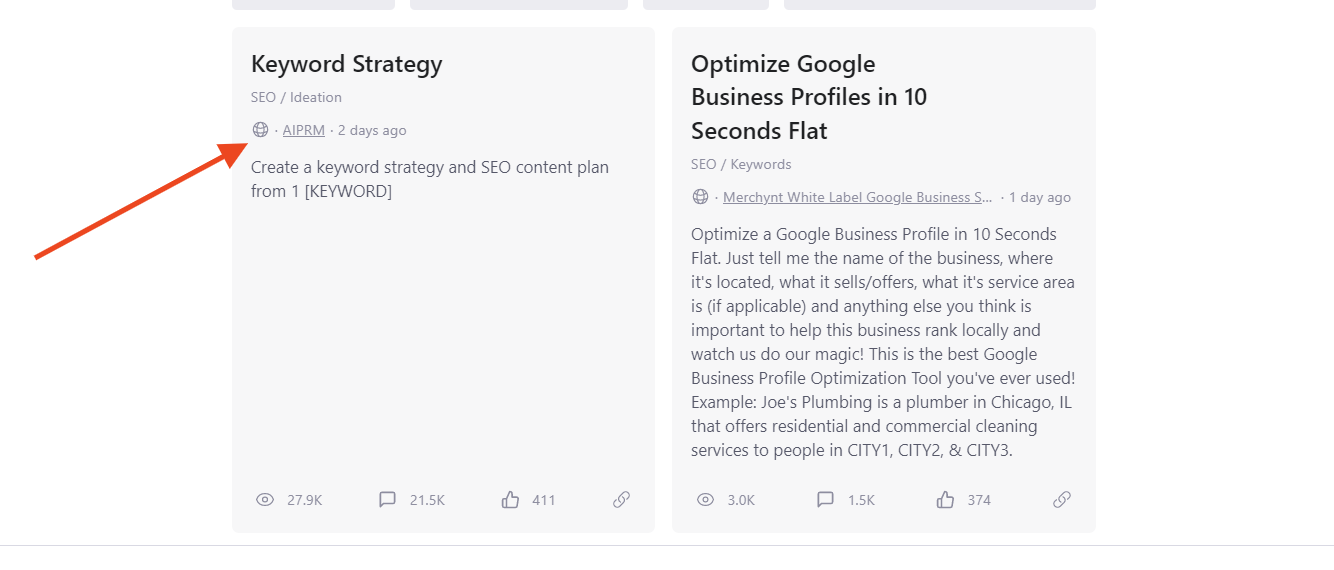
    AIPRM ChatGPT Chrome extension (multi-community version) has a list of curated prompt templates for SEO, SaaS, and more. If you’re looking to increase your organic traffic and attain a higher Google ranking through ChatGPT, this is the extension for you.

    Let’s start with keyword research. This is one of the most powerful features in AIPRM.

    Public Prompts is basically a list of predefined SEO prompts with categories like ideation, marketing, and writing. If you need something different, choose Own prompts to create your own template for recurring tasks based on your needs and requirements.

    The expectation for the Public prompt

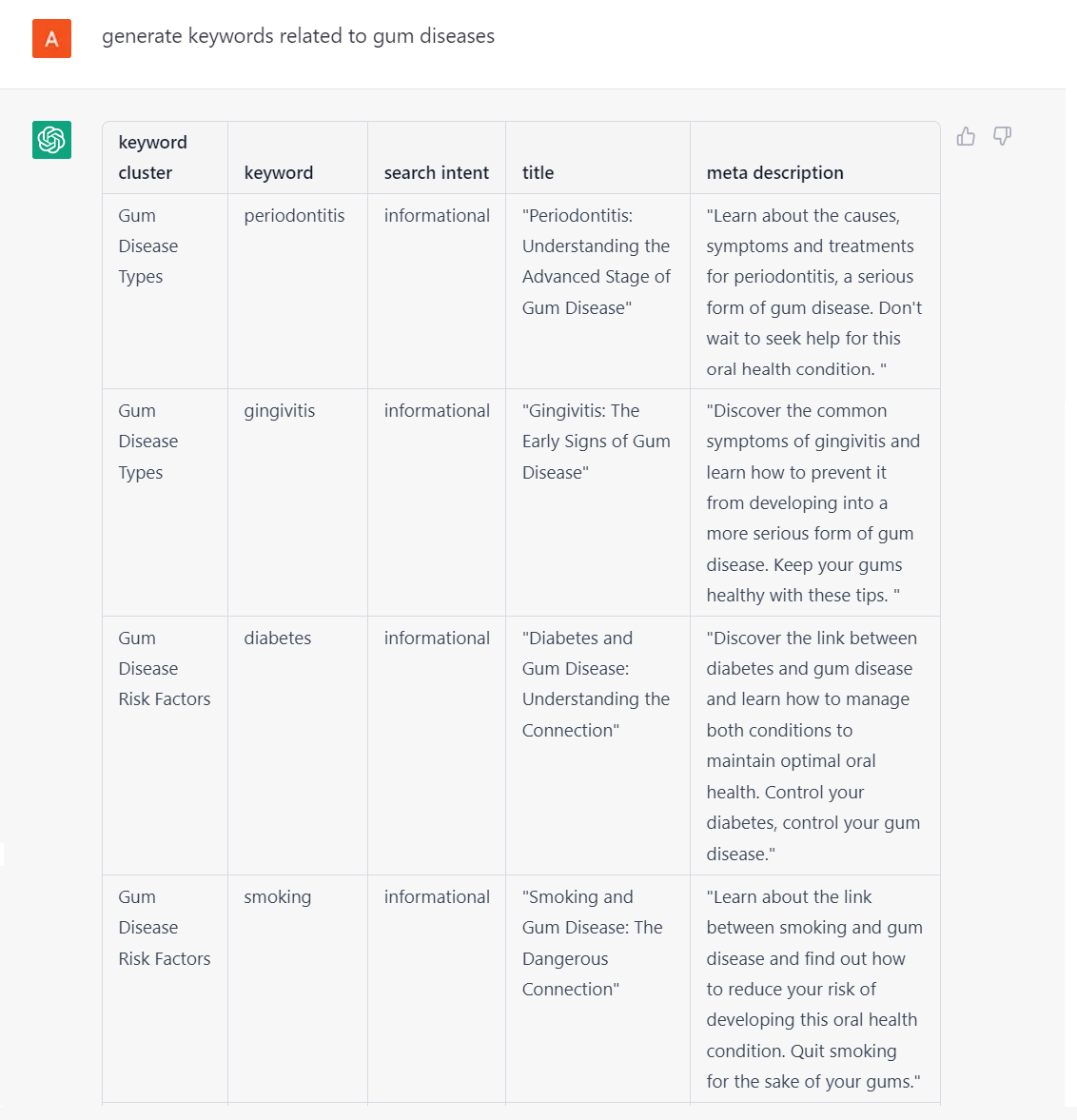
    Let’s prepare a content strategy for one of the client businesses in the healthcare industry. Start with the keyword strategy to generate the right strategy for the blog post.

    Pro Tip:

    You can expect the desired results if you choose the SEO prompt from AIPRM. Check out the screenshot for reference.

    Keyword strategy

    Your Input: Generate keywords related to gum diseases. You can find numerous results including keyword clusters, keywords, search intent, titles, and meta descriptions. Keyword research is made easier with the assistance of this SEO tool.

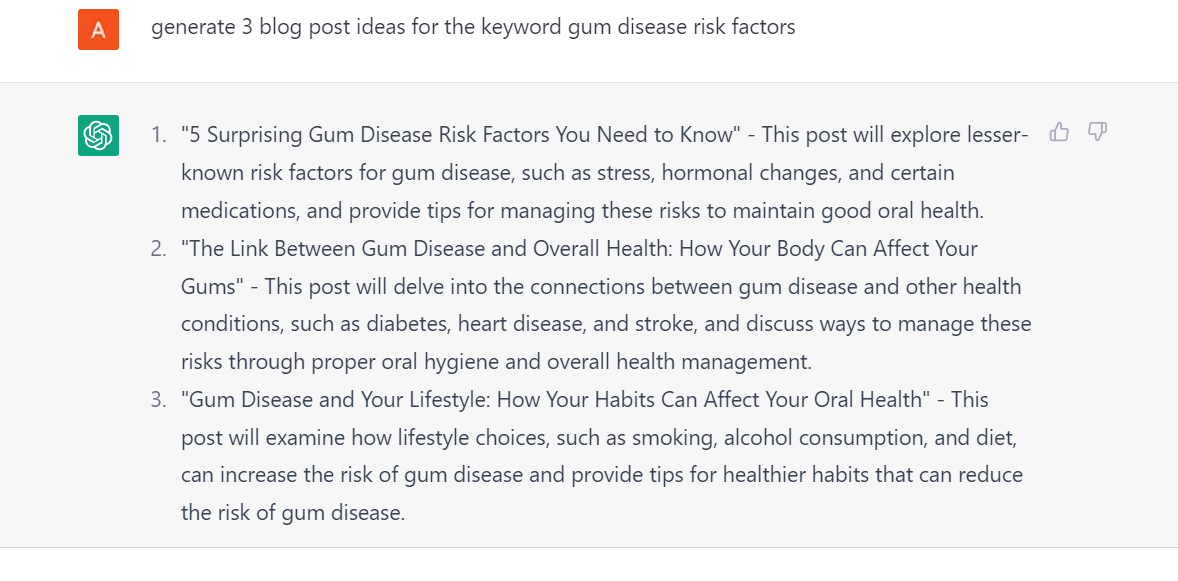
    Next step, pick one keyword from the list of suggested keywords and will ask to generate blog post ideas for the same keywords.

    Blog Post Ideas

    Your Input: Generate 3 blog post ideas for the keyword ‘gum disease risk factors’ (example below).

    Title and Meta Description

    Your Input: Generate a page title (maximum 70 characters) and meta description (maximum 160 characters) for the blog post: “The link between gum disease and overall health”, (example below).

    … in conclusion

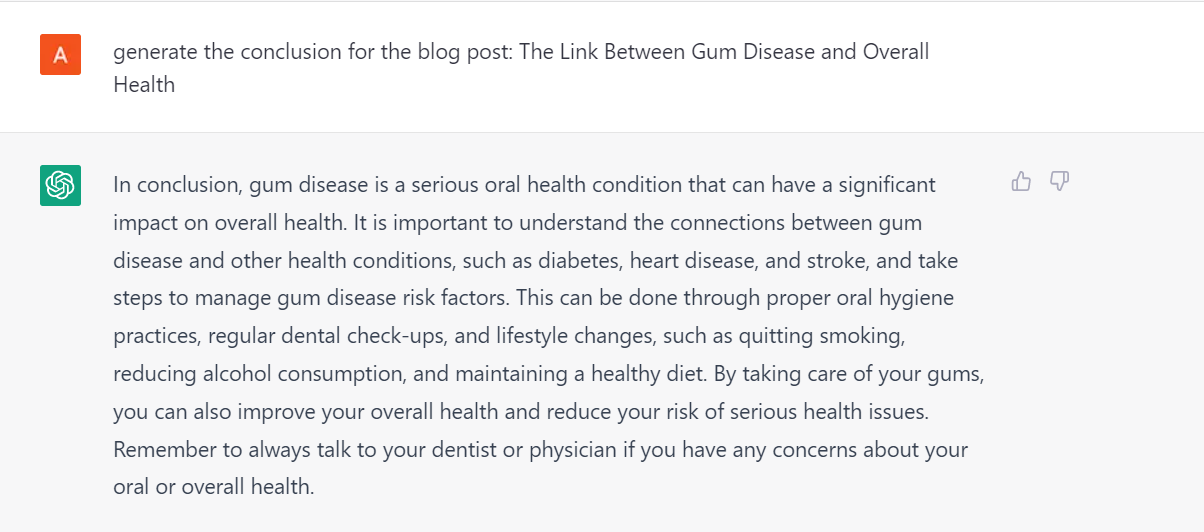
    Your Input: Generate the conclusion for the blog post: The link between gum disease and overall health. This SEO prompt can assist you in finding content ideas. AI-generated content may not be 100% accurate, so we recommend proofreading the output, (example below).

    Generate FAQs Related to Content

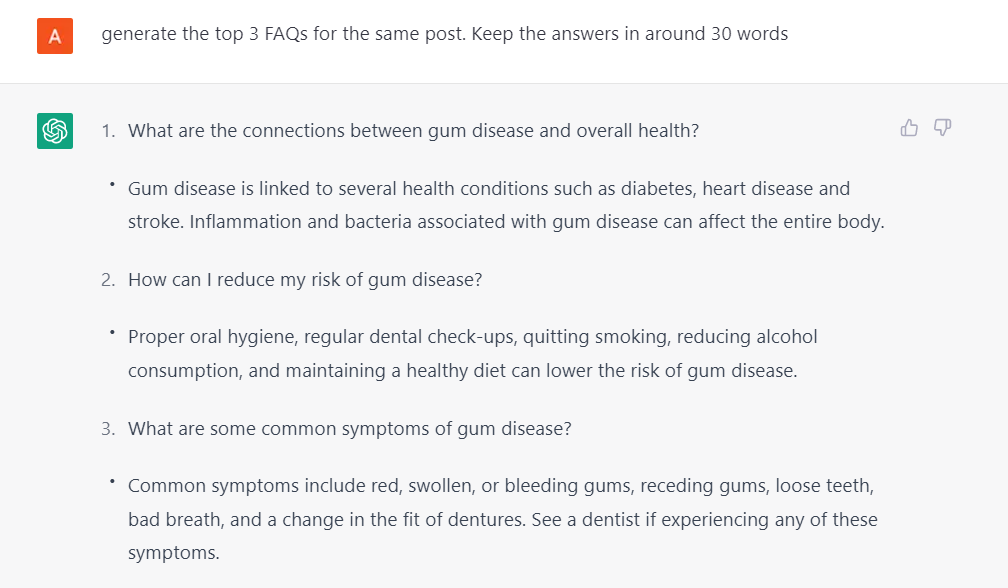
    Your Input: Generate the top 3 FAQs for the same post, keeping the answers in around 30 words, (example below).

    Generate FAQ Schema Markup

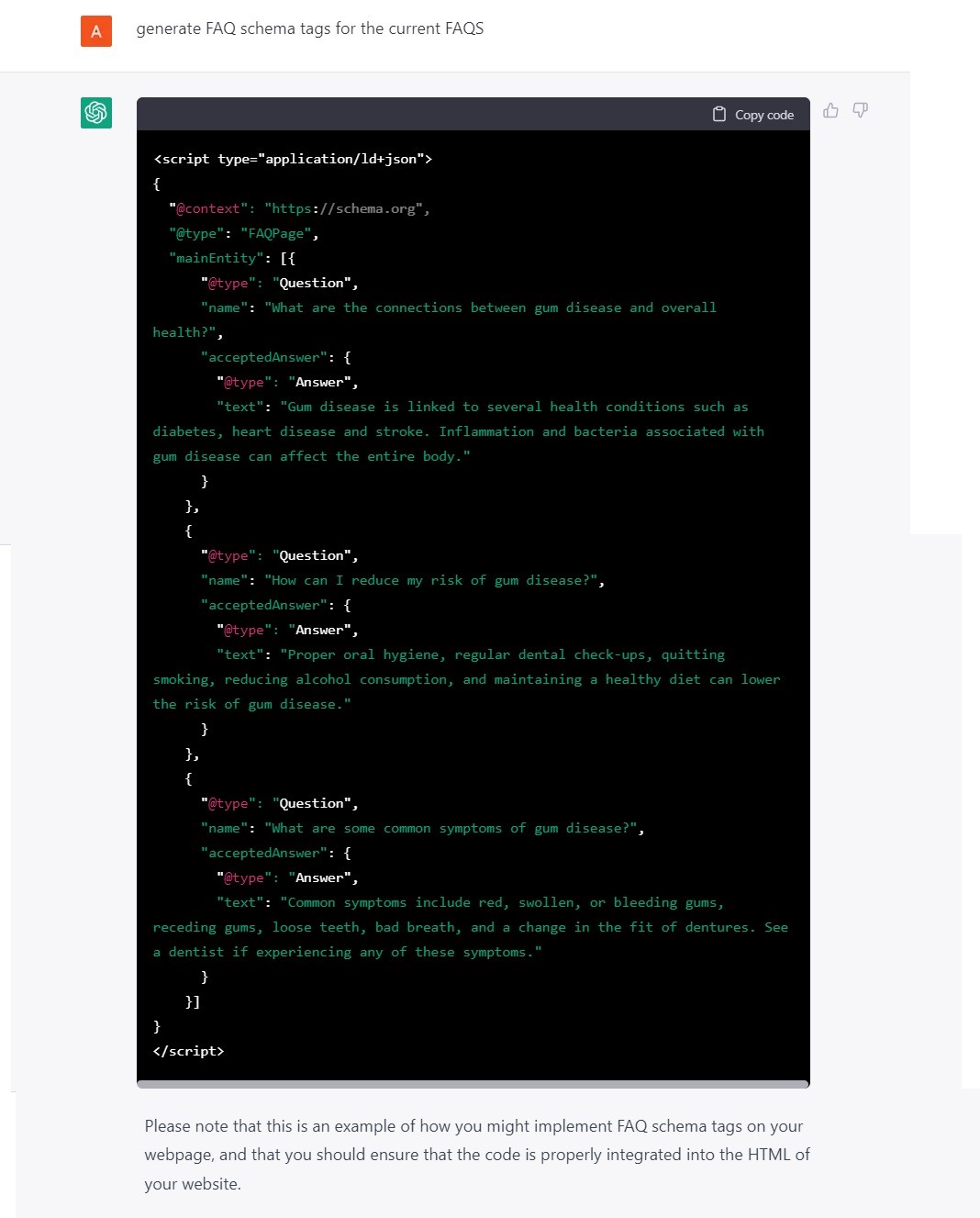
    Your Input: Generate FAQ schema tags for the current FAQs, (example below).

    Translation

    Your Input: Translate the schema tags in French.

    Outrank Article

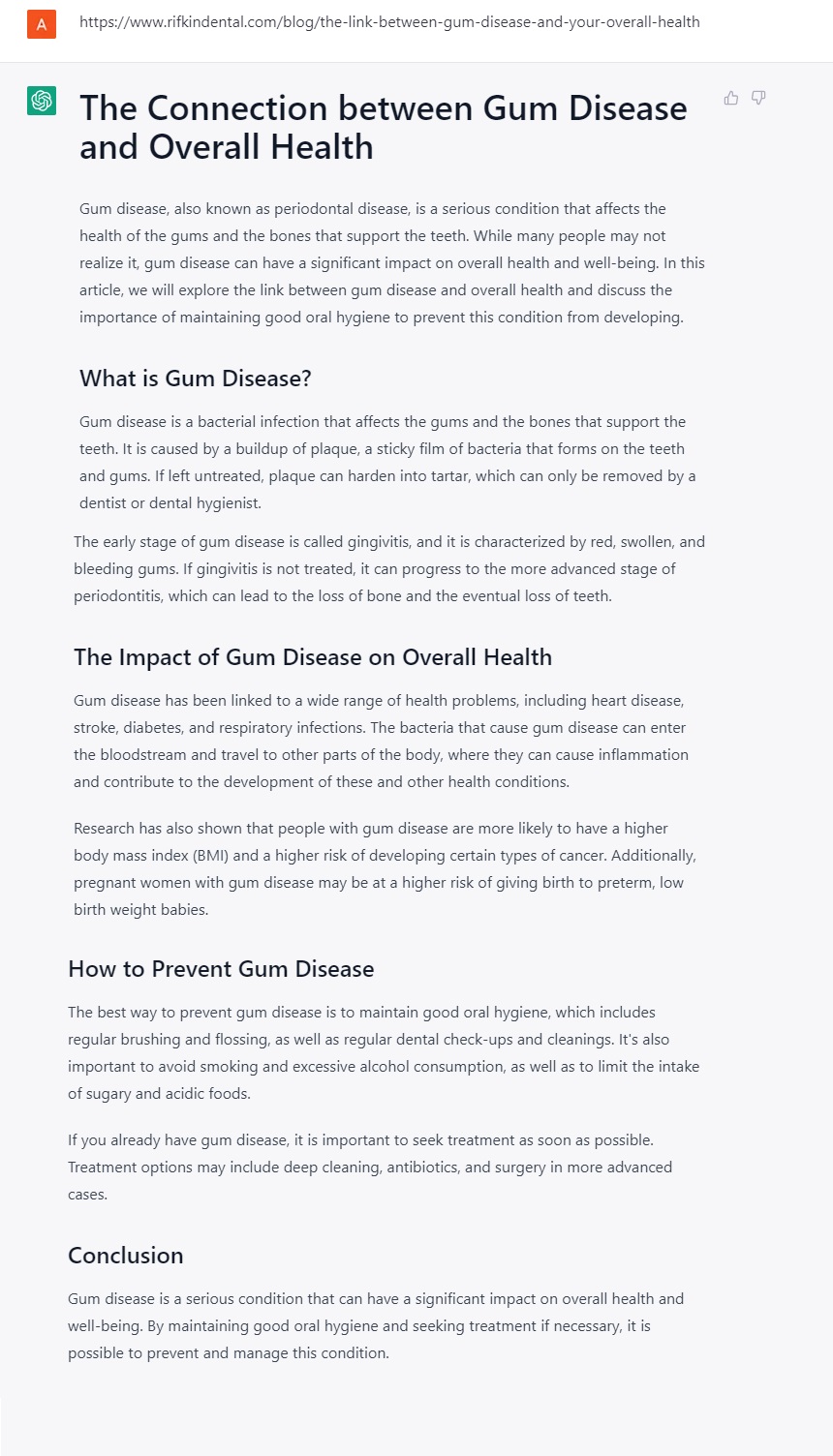
    Your Input: Type the competitor URL into the prompt. It’ll generate blog content similar to your competitor who may already rank at the top of the search engine return page (SERP), (see below).

    Note: This is a recommended practice for writing content. AI-generated answers may need to be corrected to meet search engine guidelines.

    The expectation for ‘own prompt’

    One of the coolest features under AIPRM is that you can create your own prompt based on your needs and requirements – like SILO structure, keyword strategy, translation by creating a tabular column for comparison, (see below).

    Pro Tip: You can also share the prompt template publicly with other users.

    WebChatGPT For SEO

    We all know that ChatGPT has a few limitations and limited knowledge of the world after 2021. The WebChatGPT chrome extension is open-source code – anyone can review and contribute to the project.

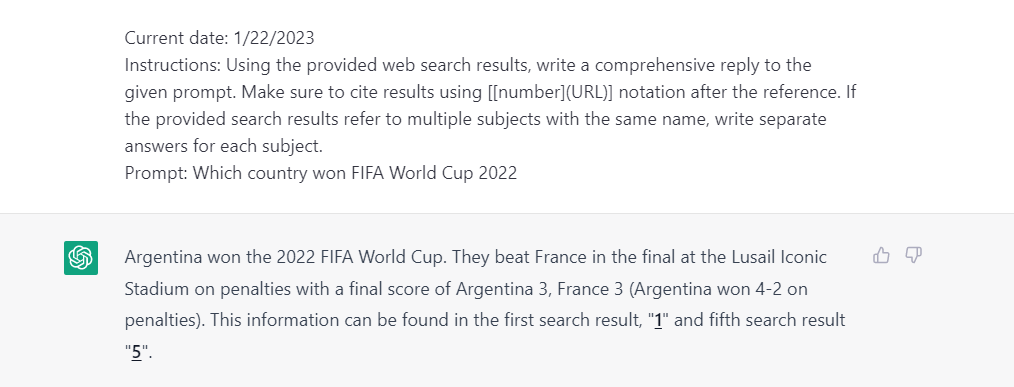
    With the help of WebChatGPT, you can overcome the downside of ChatGPT, in real time. You can get relevant returns with up-to-date information on recent content through your prompts.

    Real-time answer

    Your Input: Which country won FIFA World Cup 2022

    Top Useful SEO Prompts in 2023

    Stay up-to-date on the latest SEO strategies in 2023 with our comprehensive guide. Learn the best practices for optimizing your website and improving your search engine rankings, ensuring your website is ready to rank on the SERP in a constantly-evolving digital landscape.

    On-page SEO Prompts

    An AI chatbot designed for conversation – streamlines the process of On-page SEO by making it more efficient, quick, and precise.

    • Suggest keywords with high search volume and low competition
    • Write an SEO optimized title on the topic, under 60 characters
    • Write a meta description, not more than 160 characters
    • Cluster the keywords based on the category
    • Generate the best image alt text for your images
    • Create a no-follow link
    • Create a self canonical tag
    • Find opportunities for internal linking for existing article
    • Provide the best strategies for SEO to an international audience

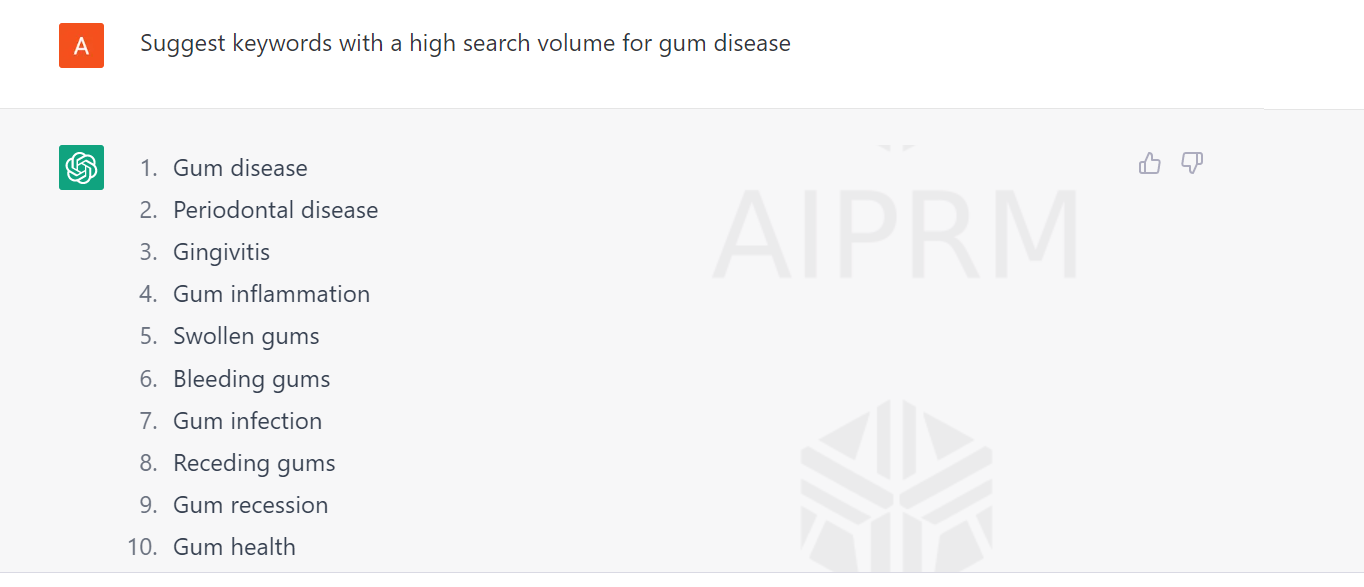
    Example for SEO keyword research

    Your Input: Suggest keywords with a high search volume for gum disease

    Off-page SEO Prompts

    ChatGPT can also assist with off-page SEO prompts by providing insights and strategies for improving your website’s off-page signals.

    • Generate a list of link-building opportunities
    • Create a list of potential affiliate marketing opportunities
    • Provide a list of 10 relevant websites (listing out their URLs) that talk about “off-page SEO”.
    • Create a list of guest blogging opportunities

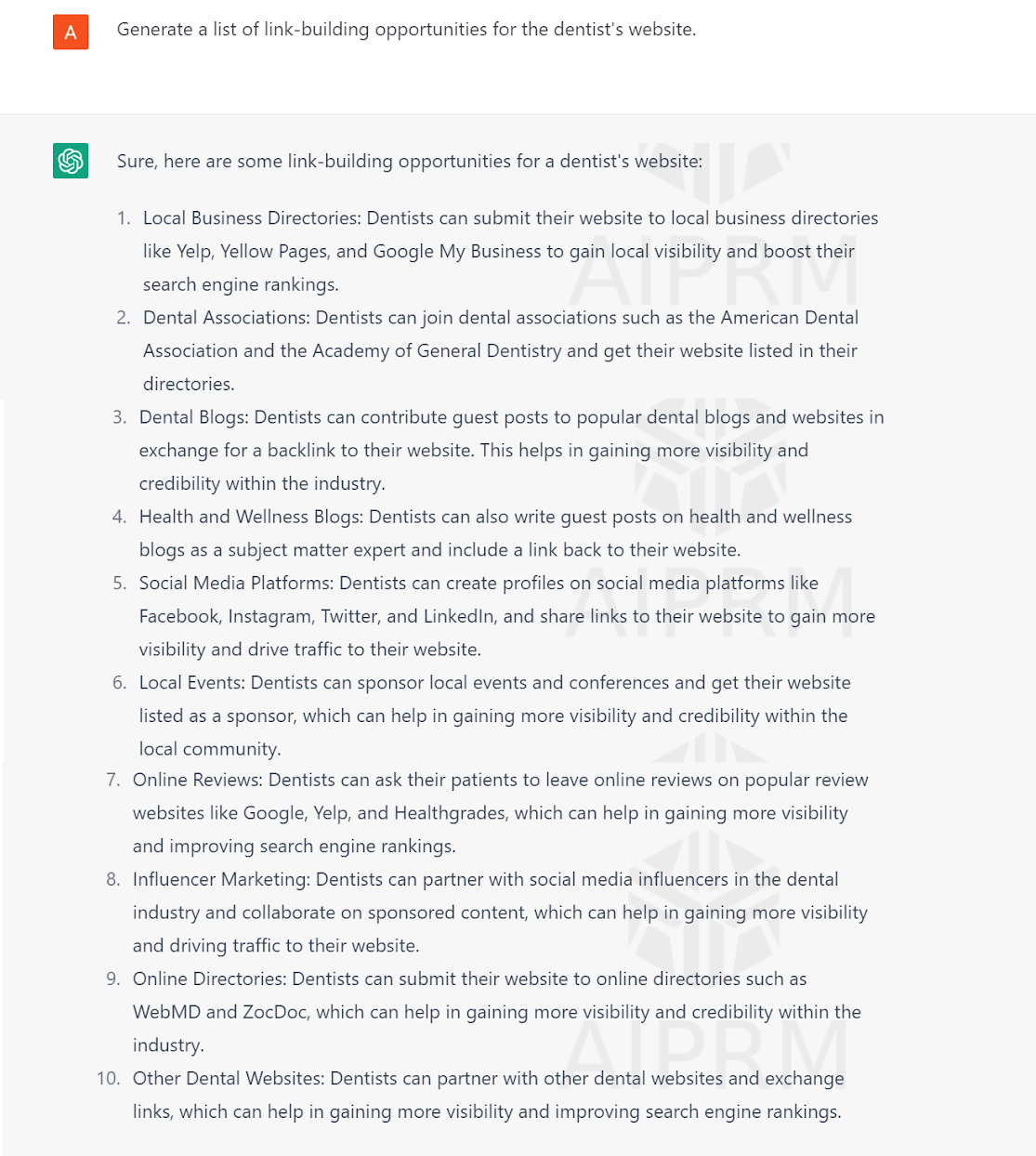
    Example for offpage (link building)

    Your Input: Generate a list of link-building opportunities for the dentist’s website.

    Content Creation Prompts

    Create engaging and informative content with SEO prompts to attract and retain audiences. Use data-driven strategies and high-quality writing to establish your brand as a subject matter expert in your industry.

    • List out the top 10 ranking blogs
    • Think like an SEO specialist and generate ideas for blog posts and article topics
    • Write an introduction with stats and facts for the blog post
    • As a Content Marketer, create a content calendar for a specific topic for next 30 days
    • Provide the target audience for a keyword
    • Proofread the page description
    • Generate the list of FAQs for the blog post
    • Suggest the SEO-friendly URL structure for a blog
    • Create a list of LSI keywords
    • Create a list of people who also ask about a topic

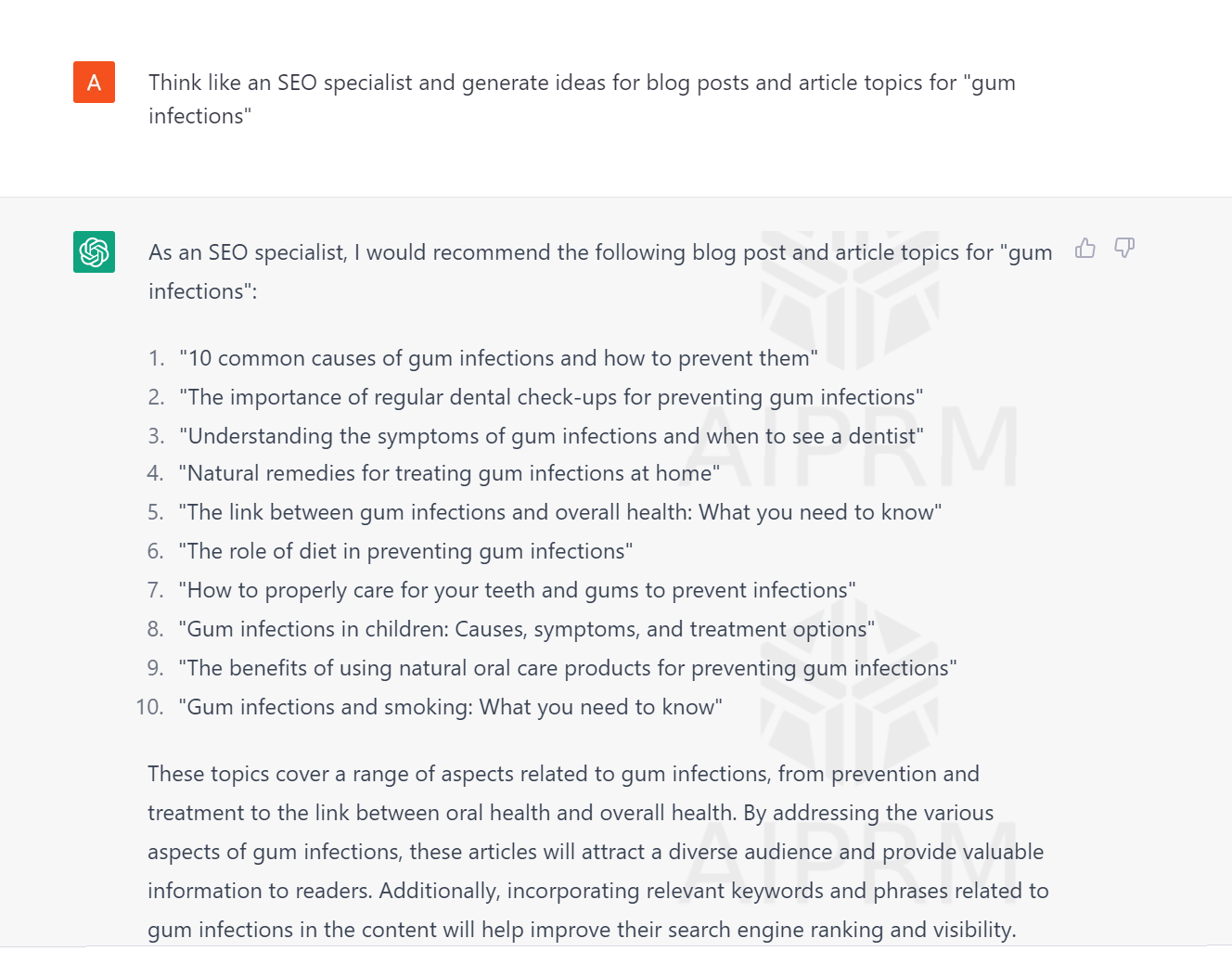
    Example for content creation

    Your Input: Think like an SEO specialist and generate ideas for blog posts and article topics for “gum infections”

    Interesting Facts About ChatGPT

    • According to the source, ChatGPT just crossed 1 million users; it’s been a few weeks since launch.
    • ChatGPT comes at no cost
    • One of the dominant viral AI chatbots
    • Microsoft has announced a significant investment, in billions of dollars in OpenAI, the organization behind the creation of the ChatGPT language model.
    • Reports have indicated that users of ChatGPT will have a monthly cost of $42 for “professional” access – no official announcement has been made.

    AI Statistics

    1. 35% of companies use AI in business, and 42% want to explore it. As AI adoption grows steadily, ticking up 4 points from 2021 – it’s a fast-growing trend for businesses.
    2. Slow AI adoption is driven by the lack of a cohesive strategy of applying the AI capabilities to business goals. Smaller companies lag behind larger ones in having a holistic AI strategy – 41% of those companies are developing one.
    3. 53% of IT professionals have quickened their AI rollout in the last 24 months, a higher rate than in 2021 when only 43% accelerated AI amid the COVID-19 response.
    4. The industry has advanced beyond chatbots, with 29% of companies using or considering natural language programming (NLP) solutions.
    5. 54% of organizations report cost savings & efficiencies with AI-automated IT/business/network processes. 53% see improved performance, and 48% report better customer experiences.

    Source: IMB

    FAQs on ChatGPT For SEO In Real Time

    When was ChatGPT launched?

    ChatGPT was launched on November 30, 2022. Samuel H. Altman, CEO of Open AI.

    What are the top ChatGPT chrome extensions for?

    Due to the popularity of ChatGPT, there are a number of chrome extensions released in the market. Fortunately, finding the right extension is easy, two of favorites are AIPRM for SEO & WebChatGPT.

    Is ChatGPT a competitor to Google?

    Absolutely not. Though ChatGPT and Google have some similarities in language models, ChatGPT is just a pre-trained language model.

    Do search engines, including Google, support AI-generated content?

    Search engines, including Google, support AI-generated content as long as it has been reviewed and enhances the user experience.

    Conclusion

    To summarize, ChatGPT is a viral AI-generated content tool for SEO that provides real-time, relevant, and high-quality content for user-relevant queries called AI for SEO success. ChatGPT for SEO with chrome extensions can improve website visibility and search rankings, leading to increased traffic and potential customers.

    Give it a try to ChatGPT today.